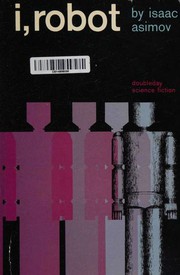
Start with I, Robot. It is nine short stories, each one a logic puzzle built on the Three Laws of Robotics, and it teaches you how Asimov thinks — problems solved by argument rather than action, ideas doing the work that character does elsewhere. If you bounce off it, you will bounce off all of him, and you will have lost two hundred pages instead of twenty books.
Then read Foundation. Not Prelude to Foundation, even though it comes first chronologically and even though a great many online reading orders will tell you to. Prelude was written thirty-six years later, assumes you already care about Hari Seldon, and spoils the central reveal of the original trilogy. Publication order is the right order here, and it is not especially close.
The robot books
I, Robot first, then The Rest of the Robots for more of the same short-story machinery. Then the robot detective novels in order: The Caves of Steel, The Naked Sun, The Robots of Dawn. These are murder mysteries with a human detective and a humanoid robot partner, and The Caves of Steel in particular holds up better than almost anything else Asimov wrote — a claustrophobic overpopulated Earth, a fair-play mystery, and an argument about prejudice underneath.
Robots and Empire is the hinge book: it is where Asimov begins welding the robot stories onto the Foundation universe. Read it after the three detective novels, and read it knowing it exists mostly to build a bridge.
The Foundation sequence
Foundation, Foundation and Empire, Second Foundation. That is the trilogy, written as magazine serials in the 1940s and still the reason anyone reads Asimov. The premise — a mathematician predicts the fall of a galactic empire and engineers a shortcut through the dark age that follows — is delivered as a series of political and intellectual crises resolved by people talking in rooms. The Mule sequence in Foundation and Empire is the high point of the whole enterprise.
The empire novels that sit between the robot books and the trilogy, including Pebble in the Sky and The Currents of Space, are not in this catalogue and are genuinely skippable.
Publication or chronological?
The chronological order runs Prelude to Foundation, Forward the Foundation, the robot novels, then the original trilogy, then the sequels. It is internally consistent and Asimov himself sketched it out in a late preface. It is still the wrong way to read these books, for one blunt reason: the original trilogy was written first and everything else was reverse-engineered to fit it, so chronological order front-loads the explanations and back-loads the discoveries. You spend four hundred pages with a character whose significance you have not yet been given a reason to care about.
Read publication order. Use the chronological order for a second pass, when the retrofitting becomes an interesting thing to watch rather than an obstacle.
Where to stop
After Second Foundation is a completely legitimate stopping point, and a lot of readers who love Asimov never go further. The trilogy ends on a real resolution.
If you continue, Foundation's Edge and Foundation and Earth are the late sequels, written in the 1980s at much greater length. They are talkier, more concerned with tying the two universes together, and they end on a philosophical turn that many long-time readers actively dislike. Read them for completeness, not because the story demands it.
The honest general warning about Asimov: the prose is functional, the characters are positions in an argument, and the women in the earlier books are written badly enough to be distracting. What you are here for is the ideas, delivered with unusual clarity. On that, he still delivers. More science-fiction paths are on Discover.
Follow the full ordered path here: Isaac Asimov Reading Order: Where to Start.