Emily Dickinson Reading Order: Where to Start
Reading Emily Dickinson starts with a decision most poets do not force on you: which edition to buy. She published almost nothing in her lifetime and left nearly 1,800 poems in hand-sewn packets, so every printed text is an editor's reconstruction, and the older editions regularised her dashes and capitals out of existence. Begin with a modern scholarly edition and a small selection to read from rather than through, then look at the manuscripts as objects, then read the letters, and only then the biographies — which are worth having, because the myth of the recluse in white is largely the invention of her first editors.
Start Here: Which Edition to Buy
IntermediateGet a text that reproduces Dickinson's punctuation and lineation, and learn to read a handful of poems slowly instead of the complete works quickly.
▸ Study plan for this stage
Pace: 6–8 weeks, and the number of pages is irrelevant. Read from Final Harvest, three to five poems a sitting, aloud, and reread each one before moving on — a Dickinson poem is eight to twenty lines and takes several minutes, not seconds. Keep a complete edition on the shelf for looking things up, not fo
- Dickinson published only a handful of poems in her lifetime and left nearly 1,800 in hand-sewn packets, so every printed text you can buy is an editor's reconstruction of an object she never prepared for print
- The first editions of the 1890s regularised her dashes, capitals and lineation out of existence, turning irregular manuscripts into conventional Victorian verse — and books with those texts are still in circulation, so check the copyright page before buying
- Thomas H. Johnson's 1955 edition restored the dashes after seventy years of tidying and introduced the numbering (the J numbers) that most criticism still cites; the complete Johnson volume in this stage is that text
- R. W. Franklin's later scholarly edition reorders the poems by his own reconstructed chronology and often chooses a different variant as final, which is why Franklin and Johnson numbers do not agree
- That disagreement is not pedantry: for many poems there is no single authorial final version, only variants she left standing side by side, and the editor picks one
- Final Harvest is Johnson's own selection of around 575 poems and is the practical book to read from — the standard way in for a first reader
- Read aloud, always. The metre is hymn metre — common measure, the shape of a Protestant hymnal — and the dashes are breath marks that only work in the ear
- Slant rhyme is the other constant: rhymes that almost land and refuse to close, which is the sound of an argument being left open
- Take one poem in two editions. What differs — punctuation, line breaks, word choice — and does the difference change the poem's meaning or only its manners?
- What does a dash do in a Dickinson line that a comma or a full stop would not?
- Sing one poem to a hymn tune. What does the metre reveal, and what does it make faintly blasphemous?
- Why is reading the complete poems in order a bad idea, and what does a selection like Final Harvest give up in exchange?
- Pick a poem with a variant word recorded. Which would you choose as final, and on what grounds?
- Before buying anything, check three editions in a shop or library for the same poem and choose your reading copy on the evidence of your own eyes.
- Copy out five poems by hand, dashes and capitals exactly as printed. The irregularity becomes physical when you write it.
- Read one poem aloud each morning for two weeks without looking up any commentary. Commentary comes later in this path for a reason.
- Keep a page recording which poems you keep returning to. That list, not a reading schedule, is how a Dickinson reader progresses.
Next up: Once you have felt an editor's hand on the page, the manuscripts show you exactly how much hand there was.

R. W. Franklin's edition, the current scholarly standard, printing his chosen version of all 1,789 poems in his reconstructed chronological order. This is the one to own; buy it first and read it in small doses.
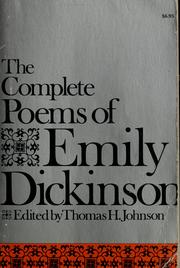
Thomas H. Johnson's 1955 edition, the text that restored her dashes after seventy years of tidying and the numbering scheme most criticism still cites. Worth knowing alongside Franklin, because the two disagree about order and about which draft is final.
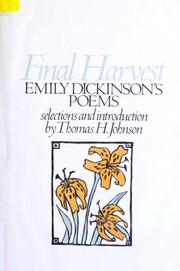
Johnson's own selection of around 575 poems. The practical starting book: a complete Dickinson is unreadable front to back, and this is the standard way in for a first reader.
The Manuscripts
IntermediateSee what the poems physically were before an editor turned them into pages, and understand why the editorial argument matters.
▸ Study plan for this stage
Pace: 2–3 weeks, treated as looking rather than reading. The Gorgeous Nothings is a large-format facsimile book of 255 pages — spend an hour with it at a time, at a table, comparing each facsimile with its transcription and then with the printed version in your reading edition. Envelope Poems is 95 pages
- These books reproduce what the poems physically were: pencil on torn envelope flaps, backs of recipes, scraps pinned together — objects with shapes, not lines on a uniform page
- The Gorgeous Nothings gives full-colour facsimiles with facing transcriptions, so you can see a poem and its printed self at once and measure the distance
- The shock is entirely in that distance, which is why this stage comes after you have read from a printed edition rather than before
- Line breaks in the manuscripts often follow the edge of the paper, which raises a real editorial question: is a break a formal choice or the end of an envelope flap?
- Words are frequently written above or beside others as unresolved alternatives — the manuscript keeps both, the printed book cannot, and every edition is silently choosing
- The arrangement on the paper is sometimes non-linear, with text running in several directions, which no typeset page can reproduce
- Envelope Poems is a smaller, cheaper selection from the same material and is the sensible option if the large facsimile volume is out of reach
- The practical lesson is durable: the poem you read is a performance of a document, and knowing that changes how much authority you grant any printed variant
- Pick one facsimile and its transcription. What decisions did the transcriber make that you would have made differently?
- Where a poem has alternative words written in, what does keeping both do that choosing one destroys?
- Do the paper's edges determine the line breaks in any poem you can find? What follows if they do?
- Does seeing the envelopes change how you read the poem, or only how you think about it?
- If you were editing a new complete Dickinson, what would you preserve from the manuscripts and what would you concede to print?
- Take three poems from The Gorgeous Nothings and find them in your reading edition. Write down every difference.
- Copy one envelope poem onto a scrap of paper of similar shape and write it in pencil. The physical constraint is instructive.
- Choose a poem with recorded variants and produce your own edited version, then justify each choice in a sentence.
- Note how long the facsimiles hold your attention compared with the printed poems. That difference is itself data about what the poems are.
Next up: Having seen the documents, the letters give you the voice that produced them — talking, joking, and much less remote than the poems allow.
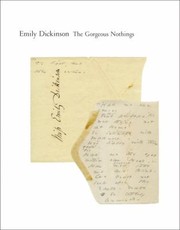
Full-colour facsimiles of the poems she wrote on envelope scraps, with transcriptions. Read after a printed edition, because the shock is entirely in the difference between the two.

A small, cheap selection from the same envelope material. Placed here as the affordable alternative if the large facsimile volume is out of reach.
The Letters
IntermediateRead the prose, which is where Dickinson is funniest, most flirtatious and least like the figure the biographies invented.
▸ Study plan for this stage
Pace: 4–5 weeks. Open Me Carefully is 323 pages and Johnson's Selected Poems and Letters 343 — this is prose and can be read at prose speed, a section an evening. Read Open Me Carefully first and slowly enough to notice where a poem is embedded in a letter, which happens constantly; Dickinson sent poems a
- The letters are where Dickinson is funniest, most flirtatious and least like the woman in white the biographies inherited
- Open Me Carefully gathers the letters and poems sent to Susan Dickinson, her sister-in-law and next-door neighbour, restored without the excisions and alterations her first editors made
- Susan was the most frequent recipient of her poems and the only regular editor she accepted — several poems were revised after Susan objected, which makes her a working collaborator
- The intensity of the Susan correspondence is the book's argument, and it changes how the love poems read; how far to press that reading is contested and the book presses fairly hard
- Johnson's Selected Poems and Letters gives the wider correspondence, including the letters to Thomas Wentworth Higginson that open with her asking whether her verse is alive
- The Higginson exchange is the closest thing to a poetics she wrote: she asks for judgement, receives conventional advice, ignores it entirely, and keeps writing to him for decades
- Reading letters and poems together reveals how much of her work was a private, addressed act — poems folded into notes to a neighbour with flowers
- Note whose books these are: everything in this stage and the two before it is Dickinson's own writing. The next stage is not
- What is the relationship between a poem sent in a letter and the same poem in a printed edition — is the recipient part of the poem?
- Where did Susan's response visibly change a poem, and do you think it improved it?
- What does Dickinson ask Higginson for, what does he give her, and why does she keep writing?
- How does the voice of the letters differ from the voice of the poems, and can you find a passage where the two meet?
- What did the first editors cut from the Susan letters, and what is the likely reason?
- Find three poems you already know from Final Harvest inside a letter here, and note what the surrounding prose does to them.
- Read the first Higginson letter aloud. It is a masterpiece of false modesty and hears completely differently spoken.
- Make a list of the recipients across both books and how the voice shifts for each. She writes very differently to different people.
- Write a paragraph on what you now think the poems were for, using only evidence from the letters.
Next up: You now have her own words in full, which is exactly the footing you need to judge the biographies, none of which she wrote.
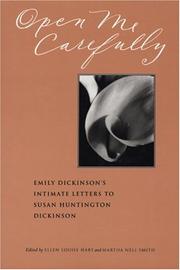
The letters and poems sent to her sister-in-law Susan Dickinson, restored without the excisions her first editors made. The single most revealing document about her, and it changes how the love poems read.

Johnson's selection from the full correspondence, including the letters to Higginson that begin Are you too deeply occupied to say if my Verse is alive? Read second for the broader picture of the life she actually led.
The Biographies
IntermediateRead the lives, and learn how much of the standard Dickinson story comes from a nineteenth-century family feud rather than from evidence.
▸ Study plan for this stage
Pace: 6–8 weeks, and the order matters more than the pace. My Wars Are Laid Away in Books is 764 pages and takes a month at 30 pages a day. Lives Like Loaded Guns is 472 and These Fevered Days 153 — the last is a weekend. Read the long documented life first, then the revisionist argument, then the short o
- Everything in this stage is written by someone else — Alfred Habegger, Lyndall Gordon and Martha Ackmann — about Dickinson. It is biography, not her work, and that distinction matters more here than for most poets
- The standard Dickinson story — the recluse in white who never left her room — is substantially a construction of her first editors and of a family feud, not a finding of research
- My Wars Are Laid Away in Books is the thorough modern life and is scrupulous about separating documented fact from inference, which is exactly what a reader needs first
- It also lays out the publication history: Lavinia finding the poems after her sister's death, and the rival camps around Susan Dickinson and Mabel Loomis Todd who edited and fought over them for decades
- Lives Like Loaded Guns is a revisionist account arguing that Dickinson had epilepsy and that the family scandal shaped how the work reached print. The epilepsy argument is inference from prescriptions and circumstance, is contested by other scholars, and should be read as a case rather than a findin
- Read after Habegger it is genuinely valuable, because you can see which parts of the argument rest on evidence and which on plausibility
- These Fevered Days tells the life through ten specific days, and its achievement is showing how much can be built from very little documented incident
- The general lesson: with a subject who left almost no external record, the biography you find most convincing usually reflects which silences you find most suggestive
- Which parts of the recluse-in-white image survive Habegger's account, and which turn out to be nineteenth-century marketing?
- What evidence does Gordon actually offer for the epilepsy claim, and what would it take to confirm or refute it?
- How did the Todd and Susan Dickinson factions shape which poems reached print first, and does that still affect which poems are anthologised?
- Ackmann builds a life from ten days. What does that method get right, and what must it leave out?
- After three biographies, what do you take as established fact about Dickinson's life — write the list, and note how short it is?
- Does knowing more about the life improve any specific poem for you? Name one either way.
- Keep a two-column list while reading Habegger: documented, and inferred. He signals the difference, and the exercise trains you for the next two books.
- Take Gordon's central claim and write the strongest one-page case against it using Habegger's evidence.
- Pick one of Ackmann's ten days and find every source she is drawing on. It is a good lesson in how thin the record is.
- Return to five poems from Final Harvest after the biographies and note whether biography helped, hurt, or did nothing. Be honest about the answer.
- Write a short paragraph distinguishing, for a friend, which books in this whole path are Dickinson's own and which are about her.
Next up: The path closes where it began, at the poems — but now with an edition you chose deliberately, the manuscripts in mind, and the life separated from the legend.
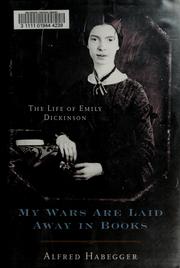
The most thorough modern biography, meticulous about what is documented and what is inference. Read first of the lives because it gives you the sourced version before anyone argues with it.

A revisionist account arguing that Dickinson had epilepsy and that the family scandal shaped how her work reached print. Contentious, and much more interesting once Habegger has given you the baseline.

The life told through ten specific days. The shortest and most readable of the three, and a good place to stop: it demonstrates how much can be built from very little documented incident.
Discussion
Keep reading
Paths that share books, cover the same subject, or open a related topic.