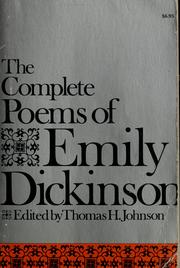
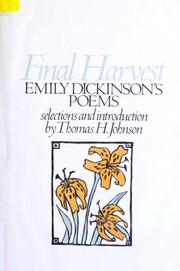
Start with Final harvest, Thomas H. Johnson's own selection of around 575 poems, and read three to five poems a sitting, aloud. Nobody reads 1,789 poems front to back; the ones who try stop somewhere around the fourth packet. A selection is the practical book to read from, and a complete edition is the book to look things up in.
Before that, though, comes the decision this poet forces and almost no other does. Dickinson published only a handful of poems in her lifetime and left nearly 1,800 in hand-sewn packets, so every printed text you can buy is an editor's reconstruction of an object she never prepared for print. The first editions of the 1890s, prepared by Mabel Loomis Todd and Thomas Wentworth Higginson, regularised her dashes, capitals and lineation out of existence and turned irregular manuscripts into conventional Victorian verse. Those texts are still in circulation, in cheap reprints and free ebooks.
How to check what you are buying
Look at the copyright page and the front matter before you spend anything. If it credits Johnson and dates the text to 1955, you have the edition that restored the dashes after seventy years of tidying, and the numbering that most criticism still cites. If it credits R. W. Franklin, you have the current scholarly standard, which reorders the poems by his reconstructed chronology and often chooses a different variant as final — which is why Franklin and Johnson numbers do not agree. If the front matter credits Todd or Higginson, or names no editor at all, put it down.
That disagreement is not pedantry. For many poems there is no single authorial final version, only variants she left standing side by side, and an editor picks one. Our catalogue holds The complete poems of Emily Dickinson, which is the Johnson text, and The Poems of Emily Dickinson Volume II, which is one volume of Franklin's multi-volume scholarly edition rather than the whole set — worth knowing before you order.
Read aloud, always. The metre is hymn metre, the shape of a Protestant hymnal, and the dashes are breath marks that only work in the ear. The slant rhymes, which almost land and refuse to close, are the sound of an argument being left open.
The manuscripts
The Gorgeous Nothings reproduces the poems she wrote on torn envelope flaps in full-colour facsimile with facing transcriptions, so you can see a poem and its printed self at once and measure the distance. Read it after a printed edition, because the shock is entirely in that difference. Line breaks in the manuscripts sometimes follow the edge of the paper; words are written above and beside others as unresolved alternatives that the manuscript keeps and no printed book can. Envelope poems is a small, cheap selection from the same material if the large facsimile volume is out of reach.
The letters
Open me carefully gathers the letters and poems sent to her sister-in-law and next-door neighbour Susan Dickinson, restored without the excisions her first editors made. Susan received more of her poems than anyone and was the only regular editor she accepted, which makes her a working collaborator. The book presses an intimate reading of that correspondence fairly hard, and how far to press it is genuinely contested. Selected poems and letters of Emily Dickinson gives the wider correspondence, including the letters to Higginson that open by asking whether her verse is alive. She asks for judgement, receives conventional advice, ignores it entirely, and keeps writing to him for decades.
Which books are actually hers
Everything above is Dickinson's own writing. The last stage is not, and the distinction matters more here than for most poets. My wars are laid away in books is Alfred Habegger's biography and the thorough modern life, scrupulous about separating documented fact from inference; read it first of the three. Lives Like Loaded Guns is Lyndall Gordon's revisionist account, arguing that Dickinson had epilepsy and that a family feud shaped how the work reached print — an inference from prescriptions and circumstance, contested by other scholars, and best read as a case rather than a finding. These Fevered Days is Martha Ackmann's short life told through ten specific days.
The reason to read any of them is that the standard story, the recluse in white who never left her room, is substantially a construction of her first editors and of that feud rather than a finding of research. The ordered list is in the Emily Dickinson reading path.