Best Books on Disability Rights and Living with Disability, in Reading Order
Disability is the one minority group anybody can join at any time, and the literature about it is unusually clear that the central problem is design and policy rather than bodies. This path opens with contemporary first-person writing that establishes the social model, moves to the history of how the American movement won its legal protections, then turns to the harder present-day arguments about design, care and interdependence, and closes with the academic field that supplies the theory. It is about a civil-rights movement and a way of living, not about any diagnosis or treatment.
Start Here
BeginnerLearn the vocabulary and the social model of disability, and hear from a range of disabled writers before encountering any framework about them.
▸ Study plan for this stage
Pace: 4-5 weeks for about 620 pages, all of it accessible. Demystifying Disability is 176 pages and can be read in a week — it is deliberately written as a primer, so read it straight through and then keep it as a reference. Sitting Pretty takes a week and a half of essay-length sittings. Disability Visib
- The medical model versus the social model — impairment as a fact about a body, disability as what happens when environments and policies are built for other bodies — which is the single distinction the whole path rests on
- Ladau's practical terminology guidance: identity-first versus person-first language, why disabled people disagree about it, and why asking beats guessing
- Ableism as a structural rather than an attitudinal category, showing up in stairs, forms, hiring practices and defaults, not only in rudeness
- Inspiration porn as Ladau and Taussig describe it: the use of disabled people as motivational objects for non-disabled audiences, and why it is a harm rather than a compliment
- Taussig's account of ordinary logistics — bathrooms, parking, being lifted, being photographed, being prayed over by strangers — as the actual daily content of disability
- The unasked-for help problem, and Taussig's careful writing about wanting connection while refusing to be a project
- Wong's editorial choice to include wildly different disabilities, races, class positions and access needs, and the fact that the anthology contradicts itself in places by design
- That there is no single disability community position on almost anything, and that a reader looking for one has already misunderstood the subject
- State the social model in one sentence, then name a concrete situation where it changes what you would do about a problem.
- Why do some disabled people prefer identity-first language and others person-first? Give the actual reasoning on both sides rather than picking one.
- Taussig describes being helped without being asked. What makes that experience different from ordinary courtesy, and what would a better version look like?
- Which two pieces in Disability Visibility most directly contradict each other, and what is the disagreement about?
- Ladau's book is aimed at non-disabled readers and Wong's is not aimed at anyone in particular. How does the intended audience change what each can say?
- Do an access audit of one building you use regularly — entrance, bathroom, signage, seating, door pressure, lighting, noise. Write a page. Ladau's chapters give you the checklist and Hendren in stage three will give you the theory.
- Write 200 words describing a barrier you have personally created or maintained without noticing. The exercise is uncomfortable and it is the point of the primer.
- Pick three essays from Disability Visibility with different disabilities at their centre and write one sentence each on what access means to that writer specifically. The answers will not resemble each other.
- Rewrite a news story about a disabled person in your own words, stripping out any inspiration framing. Note what is left.
- Keep a list of terms Ladau flags as contested and check it against how the later books on this path use them. Several authors will disagree with her.
Next up: You now have the vocabulary and a range of lived accounts; the next stage shows you that none of the access you have just been auditing existed by accident or by goodwill.

A short, direct primer on terminology, etiquette, the social versus medical model, and the most common mistakes non-disabled readers make. It exists precisely to be read first, and it makes everything after it more legible.

Essays on ordinary life as a wheelchair user — dating, work, being photographed, being helped without asking. Read second because Taussig turns Ladau's concepts into lived situations rather than definitions.
First-person pieces from many disabled writers across very different conditions, races and class positions. Placed third deliberately: it prevents the path from generalising a single experience, and it introduces most of the writers you will meet again later.
How the Rights Were Won
BeginnerUnderstand the American disability rights movement — Section 504, the 1977 sit-in, the ADA — as organised political action with named participants and specific tactics.
▸ Study plan for this stage
Pace: 8-9 weeks for about 840 pages. Being Heumann is 232 pages of memoir and reads in two weeks. No Pity is 379 pages of journalism and takes three. A Disability History of the United States is 228 pages but covers four centuries and is dense per page; three weeks. Read them in the given order — Heumann
- Section 504 of the Rehabilitation Act of 1973 and the four-year fight to get regulations signed, which is the hinge event of the American movement
- The 1977 occupation of the San Francisco federal building — 26 days, the longest sit-in of a federal building in American history — and the coalition that sustained it, including the Black Panther Party providing food
- The independent living movement out of Berkeley: the claim that disabled people should direct their own services, and the Centers for Independent Living model that followed
- Deinstitutionalisation as a campaign with a genuinely mixed record, which Shapiro reports honestly — institutions closed, community services often never funded
- The Capitol Crawl of March 1990 and the passage of the Americans with Disabilities Act, and what the ADA actually requires: reasonable accommodation, readily achievable barrier removal, and a complaint-driven enforcement model
- Why no pity was a political demand — the rejection of charity, telethons and medical paternalism in favour of a civil rights framing with legal remedies
- Nielsen's long history: colonial poor laws, the rise of the asylum, the ugly laws, immigration exclusion on grounds of defect, and the American eugenics movement including Buck v. Bell
- Nielsen's argument that disability has been used to justify the exclusion of other groups too, with disability claims deployed against women, immigrants and Black Americans seeking rights
- What did Section 504 require, and why did it take four years and an occupation to get regulations issued for a law already passed?
- The 504 sit-in succeeded partly through coalition. Who supported it, why, and what does that suggest about how small movements win?
- What does the ADA actually oblige an employer or a business to do? Be precise — most people who invoke it cannot state it.
- Deinstitutionalisation was a movement demand with bad outcomes for many people. How does Shapiro handle that, and what should the movement have asked for instead?
- Nielsen shows disability arguments being used to deny rights to other groups. What does that do to the idea that these are separate civil rights histories?
- Heumann writes from inside the movement and Shapiro from outside it as a reporter. Where do their accounts of the same events differ in emphasis?
- Build a timeline from 1973 to 1990 marking every statute, regulation, protest and court case the three books mention. This sheet is the backbone of the stage.
- Write 300 words on the 26 days of the 504 sit-in: who was inside, how they ate, how they communicated with the outside, and how it ended.
- Read Nielsen on Buck v. Bell and write half a page on the reasoning of the decision and on when, if ever, it was overturned.
- Take the access audit you did in stage one and identify which of the failures would actually violate the ADA and which are perfectly legal. The gap is instructive.
- Write a paragraph on one thing the movement demanded and did not get, and on why it did not.
- Find the Capitol Crawl in Shapiro's account and write down what the demonstrators were physically doing and what they were arguing.
Next up: Rights won by that movement are the floor rather than the ceiling, and the next stage contains the sharpest criticisms of what the rights framework left out.

A memoir by the organiser at the centre of the 504 sit-in and much of what followed. Start the stage here because the movement's history is far easier to hold once you have followed one person through it.
The standard journalistic history of the movement, written as the ADA passed. It widens Heumann's account into the full set of campaigns — independent living, deinstitutionalisation, access — and explains why 'no pity' was a political demand rather than a slogan.
Pushes the story back four centuries, through poor laws, institutions, immigration exclusion and eugenics. Read it third: the twentieth-century victories mean something different once you see the very long history they were reacting against.
Design, Care and Interdependence
IntermediateMove past access as compliance into the current arguments — how objects and environments are designed, what disability justice adds to disability rights, and how care actually gets organised.
▸ Study plan for this stage
Pace: 10-12 weeks for roughly 1,000 pages. What Can a Body Do? is 240 pages and takes two to three weeks, best read with objects in front of you. Care Work is 284 pages of essays and manifesto and needs three weeks — it is argumentative and rereading sections is normal. Golem Girl is 448 pages of memoir w
- Hendren's reframing of disability as a mismatch between a body and a built environment, which turns access from a moral obligation into a design problem with solvable instances
- Her insistence on specific objects — a modified lectern, a prosthetic arm made for one task, a cardboard chair — and the argument that the interesting adaptations are usually small, local and made by the people who need them
- Piepzna-Samarasinha's central charge that the mainstream disability rights movement centred white, physically disabled, professional-class people and left out disabled people of colour, queer and trans disabled people, and those with psychiatric and chronic-illness disabilities
- Disability justice as a named framework with its own principles — collective access, interdependence, leadership of the most impacted, anti-capitalist politics — offered as a successor to rather than a version of disability rights
- Care webs: the practical organisation of mutual aid among sick and disabled people outside of state and market provision, which Care Work documents as an existing practice rather than proposing as a theory
- Lehrer's account of surgery, institutionalisation as a child, and being a subject of medical looking, and her turn to portraiture as a way of controlling the terms of being seen
- Wong's pandemic writing on ventilator use, on triage protocols that ranked disabled lives, and on what it means to be told your survival is a resource allocation question
- Interdependence as the concept all four books converge on: independence was a useful political demand and is a poor description of how any human life works
- Hendren says the problem is misfit rather than deficit. What does that change in practice, and where does the reframing stop being useful?
- What does disability justice add that disability rights did not have? Name the additions specifically rather than as a general call for inclusion.
- Piepzna-Samarasinha is criticising the movement described in the previous stage. Which of those criticisms do Heumann and Shapiro's accounts support, and which would they contest?
- What is a care web, and what does it depend on that a state service does not? What does it lack that a state service has?
- Lehrer paints portraits of disabled people. How does that answer the history of freak shows and medical photography she describes?
- Independence was the demand of the 1970s and interdependence is the frame of this stage. Is that a correction, a generational shift, or a retreat?
- Take one everyday object and redesign it for a specific body and a specific task, sketching it. Hendren's method is particular rather than universal, and doing it once teaches more than reading three chapters.
- Write out the principles of disability justice as Piepzna-Samarasinha states them, then test your stage-one access audit against them. Note which failures the rights framework catches and which only this one does.
- Map an actual care web — your own, or one you can observe — showing who provides what to whom and what happens when one node is unavailable.
- Look at Lehrer's paintings alongside her text and write half a page on what the portrait is doing that the prose cannot.
- Write 250 words on crip time using examples from at least two of the books in this stage.
- Draft a short access statement for an event you might run, specifying what you would provide by default rather than on request. Then cost it.
Next up: The first-person and activist literature has now given you both the arguments and the evidence; the last stage supplies the theoretical apparatus that the field built on top of them.
A design researcher reframes disability as a mismatch between bodies and built environments, using specific objects and adaptations. It is the clearest statement of why the social model has practical consequences rather than only rhetorical ones.

The central text of disability justice, which argues that the rights framework centred white and physically disabled people and left care work invisible. Read it as a direct critique of the previous stage, not as a continuation of it.

An artist born with spina bifida writes about surgery, institutions, portraiture and being looked at. It brings the theoretical argument about representation back to a single life, and it prepares the ground for the academic work on staring in the final stage.

Wong's own memoir-in-fragments, covering the pandemic years, ventilator use, and the practical politics of staying alive inside American healthcare. It closes the stage with the most contemporary account in the path.
The Academic Field
BeginnerEngage disability studies as a scholarly discipline: how disability is represented, and what a theory built from disabled bodies rather than about them looks like.
▸ Study plan for this stage
Pace: 7-8 weeks for 455 dense pages. Extraordinary Bodies is 224 pages of literary and cultural criticism; three to four weeks, and read the freak show chapters and the sentimental fiction chapters carefully. Disability Theory is 231 pages and is the hardest reading on the path; four weeks, and expect to
- Garland-Thomson's normate: the unmarked position from which the disabled body is seen as deviation, and the observation that the normal body is a cultural product requiring constant maintenance
- The staring relation as an analytic object — who may look, at whom, for how long — which she develops from the nineteenth-century freak show through to modern photography
- The freak show as a commercial institution with a script, in which difference was staged and narrated rather than simply displayed, and the disabled performers who had agency within it
- Siebers's central claim that disability is a form of knowledge and a standpoint, not merely an object of study or an identity to be represented
- His complex embodiment theory, which insists on the reality of pain and impairment against a strong social constructionism that risks defining the body out of existence
- His defence of identity politics against the anti-identitarian turn in theory, arguing that disability identity produces insight that cannot be had otherwise
- The disagreement between the two books, which is the reason to read them together: Garland-Thomson analyses how disability is represented, Siebers argues that treating disability primarily as representation is itself the error
- The relationship of both to the first-person writing in earlier stages: theory that cannot account for Taussig, Lehrer or Wong is not adequate theory, and reading in this order lets you apply that test
- Define the normate and explain what work the concept does that ableism does not.
- Garland-Thomson analyses the stare. What are the terms of a staring relation, and how does she think it can be redirected rather than merely avoided?
- Siebers argues against a purely social-constructionist account of the body. What is his argument, and what does the social model lose if he is right?
- Siebers defends identity politics at a moment when theory had turned against it. State his case, then state the best objection to it.
- Where do Garland-Thomson and Siebers actually disagree, and where are they doing different jobs that only look like disagreement?
- Test both theorists against the first-person writing you read in stage one. Which lived accounts does each framework handle well, and which does it struggle to accommodate?
- Take one film, novel or advertisement featuring a disabled character and analyse it using Garland-Thomson's apparatus — normate, staring, narrative function. Two pages.
- Write 300 words explaining complex embodiment in plain language, without using the words construction or discourse.
- Set a paragraph of Siebers beside a passage from Taussig or Lehrer describing the same phenomenon and write half a page on what each register achieves.
- Identify one claim in Garland-Thomson that Siebers rejects, quote both, and write a paragraph on what is at stake in the disagreement.
- Finish the path with a two-page essay on what changed in your understanding, citing at least one book from each of the four stages and being specific about which authors you now think are wrong.
- Redo your original access audit from stage one. Write half a page on what you now see that you did not see the first time.
Next up: You end with the theory, the history, the lived accounts and the current arguments held together — which is the only position from which any of them makes proper sense.
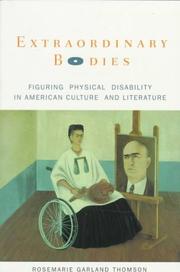
The founding work of literary and cultural disability studies, on freak shows, sentimental fiction and the cultural work that 'the normal body' does. Read it first in this stage — it supplies the analytic vocabulary the next book argues with.
Siebers argues that disability is a form of knowledge, not only a subject of study, and takes on identity politics and social constructionism directly. It is the hardest book in the path and the right last one, because it presumes the whole history and the whole first-person literature above it.
Discussion
Keep reading
Paths that share books, cover the same subject, or open a related topic.