Best Books on Construction Management, in Reading Order
Construction management is a working discipline with a real textbook canon, and this path follows the order the job itself imposes: understand what is being built, then how projects are structured and contracted, then how cost and schedule are actually controlled. Only after that does it become worth reading the research on why large projects overrun so reliably, because that literature is only useful once you know what an estimate and a critical path are. A final stage covers lean practice and the long life of a building after handover.
Orientation
BeginnerLearn the vocabulary of the industry — delivery methods, project phases, the roles of owner, designer and contractor — and enough building anatomy to follow a set of drawings
▸ Study plan for this stage
Pace: 3-4 weeks. Read Jackson's Construction Management JumpStart straight through in the first two weeks at about 40 pages a sitting — it is written as an introductory survey and does not reward slow reading. Ching's Building Construction Illustrated is not a book you read straight through at all; it is
- The three-party structure of a job — owner, designer, contractor — and the fact that the contract between them is what defines everyone's actual authority, not the org chart
- Project delivery methods as the first real decision: design-bid-build, design-build, construction manager at risk, and what each one does to the owner's risk and the contractor's incentives
- The phases as Jackson lays them out — pre-design, design, procurement, construction, closeout — and which decisions are cheap in each and expensive in the next
- Building anatomy well enough to read a wall section: what carries load, what keeps water out, what keeps heat in, and the order these get installed in
- The distinction between hard cost and soft cost, and why owners routinely underestimate the second
- That drawings and specifications are a legal instrument, not just instructions — Ching shows you what is being described, Jackson tells you who is bound by the description
- Under design-bid-build, who bears the risk of a design error, and how does that change under design-build?
- What does a construction manager at risk actually put at risk, and at what point in the project does that risk attach?
- Walk the assembly of an exterior wall from the outside in, naming each layer and what it is there to do. Ching's wall-section drawings are the answer key.
- Why does a change requested during the design phase cost so much less than the same change requested during construction?
- What is in a set of construction documents besides the drawings, and which of those documents governs when the drawings and the specifications disagree?
- Take Ching's chapter on foundations and sketch, from memory afterwards, a section through a slab-on-grade and a section through a basement wall. Check yourself against the book. If you cannot draw it you cannot schedule it.
- Pick a real building near you that is currently under construction and write half a page identifying, from what you can see, which delivery method is probably in use and what evidence points that way.
- Write a one-page comparison of design-bid-build and design-build using only Jackson's chapters, framed as advice to an owner who has never built anything before.
- Make a single-page glossary of the forty terms in JumpStart you did not know before you started — RFI, submittal, retainage, punch list, bonding capacity, and so on. You will use it constantly in the next stage.
Next up: You now have the vocabulary and enough building anatomy to read the textbook layer, where these same phases and roles are treated as a system to be managed rather than a landscape to be described.

The standard first book: project delivery methods, the players, the phases, and how a job goes from concept to closeout, written for people entering the field. Read it before anything else — everything after assumes this map.

Ching's drawings of how buildings are actually assembled, from foundations to finishes. A manager who cannot picture the work cannot schedule or price it, and this is the fastest way to acquire that picture.
The core discipline
IntermediateUnderstand project organization, means and methods, equipment, and the contracts and legal relationships that govern who bears which risk
▸ Study plan for this stage
Pace: 8-10 weeks, and this is the heaviest stage on the path — roughly 1,600 pages across three books. Read Gould and Joyce's Construction Project Management first and alone, about a chapter a sitting over three weeks. Then run Nunnally's Construction Methods and Management and Clough's Construction Contr
- The project as an organisation that is assembled, run and then deliberately dissolved — Gould and Joyce's central framing, and the reason construction management differs from managing a factory
- Means and methods as the contractor's exclusive domain: Nunnally's earthwork, concrete and equipment chapters are the physical reality that any schedule is a claim about
- Equipment productivity as a calculation rather than a guess — cycle times, bucket capacity, efficiency factors — which is where an estimate stops being a wish
- Risk allocation as the actual content of a contract: Clough's treatment of who bears differing site conditions, weather, escalation and design error is the heart of the stage
- Bonds and insurance as the mechanism by which an owner buys certainty, and bonding capacity as the real ceiling on how large a job a contractor can take
- The subcontract chain, and the fact that the general contractor's management problem is mostly a coordination problem between firms it does not employ
- Safety as a management system with a cost structure, not as an exhortation — Nunnally treats it this way and the framing matters
- Claims as the predictable output of ambiguous contract language, which is why Clough spends so long on documentation
- In Clough's terms, which party should bear the risk of differing site conditions, and what is the argument for putting it there rather than on the other party?
- What is the difference between a performance bond and a payment bond, and who is protected by each?
- Using Nunnally's method, how would you calculate the hourly production of an excavator moving a given quantity of soil, and which of the inputs is the one most likely to be wrong?
- Gould and Joyce describe the project team assembling and dissolving. What does that temporary structure do to knowledge retention between jobs, and how do firms try to compensate?
- Why does a lump-sum contract push the contractor toward aggressive change-order management, and what does a cost-plus contract do instead?
- What documentation would you need to have created during the work, before any dispute arose, to defend a claim later?
- Work the equipment-productivity problems in Nunnally's earthmoving chapters with a calculator and actually finish them. These are the only quantitative problem sets on the path and they are the difference between reading about estimating and being able to do it.
- Take one standard contract clause type Clough discusses — no-damage-for-delay, or differing site conditions — and write two paragraphs arguing it from the owner's side, then two from the contractor's. Do not conclude.
- Build a one-page risk matrix for a hypothetical mid-size project: rows for the risks Clough enumerates, columns for owner, general contractor, subcontractor, insurer, and mark where each one lands under a lump-sum contract.
- Summarise Gould and Joyce's account of the procurement phase in 300 words, without using the word 'process'. The constraint forces you to name who actually does what.
- Read Nunnally's safety chapter and write down the three most common serious-injury mechanisms on a site. Compare against the OSHA focus-four if you know it.
Next up: With means, methods and contract risk in hand, you can finally read cost and schedule as what they are — quantified predictions about physical work under a specific allocation of risk — rather than as spreadsheet exercises.
The standard university text tying together design, procurement, field operations and controls in one coherent framework. This is the textbook layer, and it is where the JumpStart vocabulary becomes a working method.
The field-operations counterpart: earthwork, concrete, equipment productivity, safety and site planning. Read it alongside Gould so the management framework has physical operations underneath it.

The long-standing reference on how contractors actually operate as businesses — bidding, bonds, insurance, subcontracts, claims. Contracts allocate risk, and risk allocation is most of what a construction manager manages.
Cost and schedule
IntermediateBe able to build and defend an estimate, construct and update a CPM schedule, and understand how change orders and delay claims are analysed
▸ Study plan for this stage
Pace: 7-9 weeks. Peurifoy and Oberlender's Estimating Construction Costs first, three weeks, working the takeoff examples rather than reading past them. Then O'Brien and Plotnick's CPM in Construction Management over three to four weeks — it is a reference book of over 500 pages and you should read the co
- Quantity takeoff as the foundation of everything: an estimate is a set of quantities multiplied by unit costs, and every argument about price is really an argument about one of those two
- Labour and equipment productivity rates, where they come from, and Peurifoy and Oberlender's insistence that historical company data beats published tables
- The structure of a bid: direct cost, indirect cost, general conditions, overhead, contingency, and profit — and the fact that only the last two are genuinely a choice
- Critical path as a computed property of the logic network, not a line someone draws — O'Brien's treatment of forward pass, backward pass, total float and free float is the technical core
- Float ownership: whose float is it when the schedule has slack, and why that question decides delay claims
- Time impact analysis and windows analysis as the accepted methods for proving what a delay actually caused, and why a schedule maintained honestly during the job is worth more than any expert retained after it
- Concurrent delay, and why it is the argument that resolves fewest claims and generates most fees
- The submittal-RFI-change order-payment application cycle in Levy as the paperwork through which cost and schedule actually get controlled day to day
- Given a takeoff and a set of productivity rates, how do you convert to a bid price, and at which step does contingency enter?
- What is the difference between total float and free float, and why does that distinction matter when two subcontractors both claim they were delayed?
- O'Brien and Plotnick treat the schedule as potential evidence. What does that imply about how a superintendent should update it during the job, including on the weeks when the news is bad?
- Explain concurrent delay in plain language and say why the owner and the contractor will always characterise the same facts differently.
- In Levy's account, what does a change order actually consist of, and what makes one enforceable rather than merely agreed to on site?
- Why can a project be ahead on cost and behind on schedule at the same time, and what would earned-value analysis say about that state?
- Do a full quantity takeoff for a single element — a concrete footing and stem wall, or the framing of one room — from any drawing you can find, following the Peurifoy and Oberlender method, and price it. Then find someone in the trade to tell you how wrong you are.
- Hand-draw a twelve-activity network for a small project, then do the forward and backward pass with a pencil and find the critical path. Do this before touching scheduling software, exactly once, so you know what the software is doing.
- Take your network and insert a two-week delay on a non-critical activity, then on a critical one. Write a paragraph on what changed and who would be arguing about it.
- Using Levy's chapters, draft the paperwork trail you would need for a single change order: the RFI that surfaced the issue, the proposed change, the pricing basis, and the schedule impact statement.
- Reconstruct from O'Brien the sequence of steps in a time impact analysis, and write it as a checklist you could hand to a project engineer.
Next up: Now that you know what an estimate and a critical path actually are, the research literature on why projects overrun stops being anecdote and becomes a set of claims you can test against your own numbers.

The classic estimating text: quantity takeoff, labour and equipment productivity, overhead and markup. Take estimating before scheduling — a schedule with no cost basis is a wish.

The definitive treatment of critical path scheduling, including how schedules are used in delay and disruption claims. Dense and reference-like, and the book practitioners actually cite when a schedule becomes evidence.
A practitioner's handbook covering the day-to-day mechanics — submittals, RFIs, change orders, payment applications, closeout. Read it last in this stage as the operational glue between the estimate and the schedule.
Why big projects overrun
IntermediateUnderstand the evidence on cost and schedule overrun in major projects, and the behavioural and political mechanisms behind it, well enough to apply the countermeasures
▸ Study plan for this stage
Pace: 4-5 weeks. Flyvbjerg, Bruzelius and Rothengatter's Megaprojects and Risk is short — 218 pages — but it is an academic policy book with tables, and reading it properly means reading the tables. Give it two to three weeks. How Big Things Get Done is 360 pages of trade non-fiction and reads in a week o
- The empirical finding that the whole literature rests on: cost overrun in major transport projects is not random error but a distribution skewed heavily in one direction, across decades and countries
- Optimism bias versus strategic misrepresentation — the honest and the dishonest explanations for the same data — and Flyvbjerg's argument that both operate but that the second explains more than professionals like to admit
- The survival-of-the-unfittest mechanism: the project whose forecast was most wrong is the project most likely to get funded, so the selection process rewards bad forecasting
- Reference class forecasting, borrowed from Kahneman and Tversky's outside view, as the countermeasure — forecast from the distribution of comparable completed projects, not from the bottom-up plan
- Modularity as the structural fix in How Big Things Get Done: things built from many repeated small units learn and converge, one-off megastructures do not
- Think slow, act fast — the argument that planning is cheap and reversible while building is expensive and irreversible, which inverts the usual instinct to get shovels in the ground
- The fat tail: the real problem is not the average overrun but the small proportion of projects that overrun catastrophically, which is a different statistical object requiring different management
- What is the actual evidence base in Megaprojects and Risk — how many projects, over what period, in which sectors — and what are the acknowledged limits of that dataset?
- Distinguish optimism bias from strategic misrepresentation using a concrete example. Which one would a better forecasting method fix, and which one would it not?
- How does reference class forecasting differ from adding a contingency percentage, and why does Flyvbjerg insist they are not the same thing?
- How Big Things Get Done argues modularity is the strongest predictor of delivery success. Which of the project types you know are modular in this sense, and which are irreducibly one-off?
- If strategic misrepresentation is real, the institutional fix is about accountability rather than technique. What would that look like, and who would resist it?
- Do the countermeasures in the popular book follow from the evidence in the academic one, or does the second book claim more than the first supports?
- Pick a public infrastructure project in your own country with a documented original budget and a documented final cost. Compute the overrun and place it in Flyvbjerg's distribution.
- Build a reference class for a project type you know: find ten or more completed comparable projects, record forecast and actual cost and duration for each, and compute the distribution. This is the single most useful exercise on the whole path and it takes an afternoon.
- Re-price one of your own estimates from the previous stage using the reference class you just built, and write a paragraph on the size of the gap between the bottom-up number and the outside-view number.
- Write 200 words summarising the strategic-misrepresentation argument as its critics would state it, then 200 words on why Flyvbjerg thinks the critics are wrong.
- List which of the case studies in How Big Things Get Done are genuinely evidence for the modularity thesis and which are illustrations chosen after the thesis was formed.
Next up: Having seen why projects fail at the portfolio and forecasting level, the last stage drops back down to the site, where lean practice offers the only fixes a superintendent can apply on a Tuesday morning.

The research that established how systematic overruns are, and argued the cause is a mix of optimism bias and strategic misrepresentation rather than bad luck. Read the academic version first; it is the evidence base for the popular book that follows.
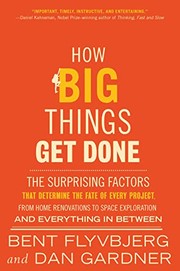
Flyvbjerg's accessible restatement plus the prescription — reference class forecasting, modularity, think slow and act fast. It is the most practically usable book on the path and lands far harder once you know the underlying dataset.
Better ways to build
IntermediateLearn the lean construction approach to flow and waste, and think about buildings as things that keep changing long after the project closes out
▸ Study plan for this stage
Pace: 3-4 weeks. The Lean Builder is 252 pages written as a site narrative and reads quickly — a week, and it is the more actionable of the two. How Buildings Learn is 243 pages, heavily illustrated with before-and-after photographs, and rewards a slower two to three weeks because the argument lives in th
- Flow versus resource utilisation: the lean claim that keeping every crew busy actively damages the schedule, which is counterintuitive to anyone trained on equipment cost
- The Last Planner System and pull planning, where the people who will do the work set the near-term sequence rather than receiving it from a master schedule
- Percent Plan Complete and the discipline of tracking commitments made and kept, which is the measurement that makes the rest of it work
- The eight wastes as they show up on a construction site specifically — waiting, transport, over-processing, defects, and above all rework
- Donarumo and Zandy's choice to teach this as a story about a superintendent rather than as theory, and what that choice says about who lean adoption actually depends on
- Brand's shearing layers — site, structure, skin, services, space plan, stuff — each changing on a different timescale, which is the framework the whole book turns on
- The claim that a building's adaptability over decades matters more than its original design, and that most of the money is spent after handover
- Low Road versus High Road buildings: cheap adaptable space that gets used hard and improved, versus prestigious designed space that resists change
- Why does the Last Planner System put the near-term schedule in the hands of foremen, and what does the master schedule become once it does?
- Explain, using an example from The Lean Builder, why a crew standing idle can be the correct outcome rather than a failure.
- What does Percent Plan Complete measure that a percent-complete schedule update does not?
- Brand's shearing layers imply that a design decision which welds a fast layer to a slow one is a mistake. Give an example from a building you know.
- Brand argues architects systematically build High Road buildings when clients would be better served by Low Road ones. Is that a fair charge, and what would the architect's answer be?
- Flyvbjerg's fix operates on the portfolio and the forecast; lean operates on the week's work. Where do the two accounts of failure actually disagree about the cause?
- Run a pull-planning session on something you control, even a non-construction project: work backwards from a milestone with the people doing each piece, and record the handoffs. The mechanics transfer exactly.
- Track Percent Plan Complete on your own weekly commitments for four weeks. The number will be lower than you expect, which is the point Donarumo and Zandy are making.
- Photograph one building near you from the same position and write Brand's six shearing layers onto the image, noting the age of each layer. Then find an older photograph of the same building if one exists.
- Pick a building you have used for years and write half a page on what it was originally for, what it is used for now, and what physical changes made that possible.
- Write a 300-word memo to an owner arguing for lean delivery on their next project, citing only the mechanisms in The Lean Builder and only claims you could defend from the book.
Next up: You end with the site-level practice that fixes the week and the long view that reframes what the project was for, which together are the working construction manager's actual mental model.

Lean construction taught as a site-level narrative — pull planning, last planner, daily huddles — rather than as theory. The most direct answer to the overrun problem at the level a superintendent can act on.

Argues that buildings are shaped far more by decades of adaptation than by the original design, and that most of a building's cost happens after the ribbon-cutting. A deliberately different frame to close on: it changes what you think a project is for.
Discussion
Keep reading
Paths that share books, cover the same subject, or open a related topic.