How to learn Mathematics
This curriculum takes a complete beginner from intuitive number sense all the way to rigorous, proof-based university mathematics. Each stage builds the conceptual vocabulary and problem-solving habits needed for the next, so that by the end the reader can engage confidently with advanced mathematical literature and think like a mathematician.
Awakening Mathematical Intuition
BeginnerDevelop a love for mathematical thinking, overcome math anxiety, and build intuition for numbers, patterns, and logical reasoning without formal notation.
▸ Study plan for this stage
Pace: 6–8 weeks total: Weeks 1–4 for "The Joy of X" (~20–25 pages/day, reading leisurely and reflectively); Weeks 5–8 for "How to Solve It" (~15–20 pages/day, pausing frequently to apply Pólya's heuristics to small problems before moving on)
- Mathematics as a living, exploratory language — Strogatz's tour from arithmetic through calculus reframes math as storytelling and pattern-finding rather than rote procedure
- The power of abstraction: how moving from concrete numbers to variables and functions reveals hidden structure across wildly different situations
- Numbers have personalities and relationships — primes, infinity, imaginary numbers — and intuition grows by playing with these relationships rather than memorizing rules
- Pattern recognition as the heartbeat of mathematics: spotting regularities in sequences, shapes, and change is the first step in every mathematical insight
- Pólya's four-phase problem-solving framework: Understand the Problem → Devise a Plan → Carry Out the Plan → Look Back
- Heuristics as mental tools: working backwards, drawing a diagram, solving a simpler analogous problem, looking for symmetry, and checking extreme cases
- The 'Look Back' habit: revisiting a solved problem to generalize, find alternate solutions, and extract reusable insight — the engine of mathematical growth
- Productive struggle and intellectual courage: both books model that confusion is normal, temporary, and the very soil in which intuition takes root
- After reading Strogatz, can you explain in plain language — without formulas — why negative times negative equals positive, and give a real-world analogy that makes it feel obvious?
- Strogatz uses the metaphor of a 'rock-paper-scissors' style cycle to discuss certain mathematical relationships. What does this reveal about the limits of transitivity, and where else might that idea appear?
- What does Pólya mean by 'auxiliary problem,' and how does deliberately solving a simpler or analogous problem help you unlock a harder one? Give a concrete example.
- Walk through Pólya's four phases using a puzzle you actually solved during your exercises. Where did you get stuck, and which heuristic unstuck you?
- Both books argue that looking back after solving a problem is not optional busywork. Why do both authors treat it as the most intellectually generative phase?
- How has your relationship with 'not knowing the answer' changed after working through these two books? What specific idea or moment shifted your feeling about mathematical confusion?
- **Joy of X reflection journal**: After each chapter of Strogatz, write 3–5 sentences in plain English summarizing the core idea, then invent one real-life situation where that idea shows up. No formulas required — pure narrative.
- **Number play sessions**: Spend 15 minutes, three times a week, exploring a single number or sequence (e.g., powers of 2, triangular numbers, the number 0). Ask: What patterns do I see? What happens at the edges (very large, very small, negative)? Sketch your observations.
- **Pólya problem log**: For every problem you attempt while reading 'How to Solve It,' keep a written log with four labeled sections — Understand / Plan / Execute / Look Back — and fill in each section honestly, including dead ends and restarts.
- **Heuristic flashcards**: Create one index card per heuristic Pólya introduces (draw a diagram, work backwards, find a pattern, introduce auxiliary elements, etc.). On the back, write a problem you personally solved using that heuristic. Review the deck weekly.
- **Teach-it-back challenge**: Choose one concept from Strogatz (e.g., the idea behind calculus, or why √2 is irrational) and explain it out loud — to a friend, a pet, or a voice recording — as if your listener has never taken a math class. Identify exactly where your explanation breaks down; that gap is your next study target.
- **Cross-book synthesis**: After finishing both books, pick any one puzzle from 'How to Solve It' and write a short essay (one page) connecting it to a theme from 'The Joy of X.' How does Strogatz's intuitive framing illuminate the problem, and how does Pólya's framework structure the solution?
Next up: By the end of this stage the reader has replaced math anxiety with curiosity and owns a flexible problem-solving framework, creating the perfect foundation for a more structured encounter with formal mathematical reasoning, proof, and notation in the next stage.

A warm, witty tour through the big ideas of mathematics — from arithmetic to calculus — that builds genuine curiosity and shows why math matters before any formal study begins.

Teaches the universal problem-solving mindset (understand, plan, execute, reflect) that underpins all mathematical work; reading this early instills habits that pay dividends at every later stage.
Core Pre-University Mathematics
BeginnerGain solid fluency in algebra, geometry, trigonometry, and pre-calculus — the essential toolkit for all higher mathematics.
▸ Study plan for this stage
Pace: 10–14 weeks total. Weeks 1–9: Lang's "Basic Mathematics" (~25–35 pages/day, 4–5 days/week) — work through it methodically, never skipping proofs. Weeks 10–14: Simmons' "Precalculus Mathematics in a Nutshell" (~15–20 pages/day, 4–5 days/week) — it is short but dense; re-read each section at least twi
- Arithmetic foundations and the number line: integers, rationals, reals, and their algebraic properties (Lang, Ch. 1–2)
- Algebraic manipulation: solving linear and quadratic equations, inequalities, and working with polynomials and rational expressions (Lang, Ch. 3–6)
- Coordinate geometry: the Cartesian plane, distance and midpoint formulas, equations of lines and circles (Lang, Ch. 7–9 + Simmons, Geometry section)
- Functions and their graphs: definition of a function, domain/range, composition, inverses, and graphical transformations (Lang, Ch. 10–11)
- Exponentials and logarithms: laws of exponents, logarithm rules, solving exponential and logarithmic equations (Lang, Ch. 12–13)
- Trigonometry: unit circle definitions of sin/cos/tan, key identities (Pythagorean, angle-sum, double-angle), graphs of trig functions, and solving trig equations (Lang, Ch. 14–15 + Simmons, Trigonometry section)
- Geometric reasoning: area, perimeter, similarity, congruence, the Pythagorean theorem, and properties of common figures (Lang geometry chapters + Simmons, Geometry section)
- Pre-calculus bridge concepts: behavior of polynomial and rational functions, introduction to limits intuitively, and the concept of a rate of change (Simmons, Algebra + Trigonometry sections)
- Can you state and apply the distributive, associative, and commutative laws to simplify algebraic expressions, as Lang develops them from first principles?
- Given a quadratic equation, can you solve it by factoring, completing the square, and the quadratic formula — and explain why all three methods are equivalent?
- Can you derive the equation of a line through two points and the equation of a circle from its center and radius using the distance formula?
- Can you define sin θ and cos θ using the unit circle, reproduce the values at the standard angles (0°, 30°, 45°, 60°, 90°), and prove the Pythagorean identity sin²θ + cos²θ = 1?
- Can you sketch the graphs of the core function families (linear, quadratic, exponential, logarithmic, sine, cosine) and describe how transformations (shifts, reflections, stretches) alter each graph?
- After working through Simmons, can you explain in your own words why algebra, geometry, and trigonometry are not isolated topics but a unified language — and give one concrete example of each subject informing the others?
- Daily drill sets: For every chapter in Lang, write out and solve at least 10 problems by hand without a calculator — focus especially on algebraic manipulation and equation-solving. Check every answer and diagnose each error.
- Proof reconstruction: After reading any theorem in Lang (e.g., the quadratic formula derivation, the distance formula), close the book and re-derive it from scratch on paper. This is Lang's own intended method.
- Graphing portfolio: Maintain a dedicated notebook page for each function family. Each time a new function appears (in either book), hand-draw its graph, label key points, and note its domain, range, and any asymptotes.
- Trigonometry unit-circle flashcards: Make a set of cards for all standard angles in both degrees and radians. Drill sin, cos, and tan values daily during Weeks 10–14 until recall is instant.
- Simmons end-of-section problems: 'Precalculus in a Nutshell' is built around its exercises — complete every single problem in all three sections (Geometry, Algebra, Trigonometry). For any problem you cannot solve in 15 minutes, write out the exact step where you got stuck and revisit the relevant passage.
- Synthesis problems: At the end of the stage, write and solve 5 original problems that each require combining at least two of the three domains (e.g., a geometry problem solved with trigonometry, or a logarithmic equation whose solution is interpreted on a graph). This mirrors the unified perspective Simmons emphasizes.
Next up: Mastering the algebraic fluency, function behavior, and trigonometric identities built in this stage provides the indispensable symbolic and geometric vocabulary that single-variable calculus — limits, derivatives, and integrals — demands from its very first definitions.
A rigorous yet accessible treatment of arithmetic through pre-calculus by a master expositor; it fills gaps left by school education and prepares the reader for university-level work.

A concise, beautifully written review of geometry, algebra, and trigonometry that consolidates pre-calculus knowledge and bridges directly into calculus.
The Calculus and Linear Algebra Core
IntermediateMaster single- and multi-variable calculus and the fundamentals of linear algebra — the two pillars of virtually all applied and pure mathematics.
▸ Study plan for this stage
Pace: 20–24 weeks total. Spivak's "Calculus" (~500 pages): 12–14 weeks at ~35–40 pages/week — slow down for proof-heavy chapters (epsilon-delta, integration theory). Axler's "Linear Algebra Done Right" (~340 pages): 8–10 weeks at ~35 pages/week — pause at each chapter to reconstruct proofs from memory bef
- Epsilon-delta definitions of limits and continuity (Spivak Ch. 5–6): understanding the formal machinery behind intuitive calculus
- The least-upper-bound property and completeness of the reals as the foundation for all limit arguments (Spivak Ch. 7–8)
- Rigorous differentiation: the derivative as a limit, the Mean Value Theorem and its consequences, Taylor's theorem with remainder (Spivak Ch. 9–12)
- The Riemann integral: upper/lower sums, integrability criteria, and the Fundamental Theorem of Calculus in its precise form (Spivak Ch. 13–15)
- Infinite sequences and series: convergence tests, power series, and uniform convergence (Spivak Ch. 22–24)
- Vector spaces, subspaces, span, linear independence, and bases — defined abstractly without coordinates (Axler Ch. 1–2)
- Linear maps, null spaces, ranges, and the Fundamental Theorem of Linear Maps (rank-nullity) (Axler Ch. 3)
- Eigenvalues, eigenvectors, invariant subspaces, and the road to diagonalization and the spectral theorem (Axler Ch. 5–7)
- Given an ε > 0, can you construct a valid δ for a non-trivial limit (e.g., a quadratic function) directly from Spivak's definition, and explain why each step is logically necessary?
- State and prove the Fundamental Theorem of Calculus (both parts) in the style Spivak uses — what continuity and integrability hypotheses are actually required?
- Why does Axler deliberately avoid determinants until the final chapter, and how does his approach to eigenvalues via invariant subspaces differ from the characteristic-polynomial route taught in most courses?
- What is the rank-nullity theorem, and how does its proof in Axler reveal something about the structure of linear maps that a matrix-computation proof obscures?
- How does uniform convergence of a sequence of functions (Spivak Ch. 24) differ from pointwise convergence, and why does it matter for swapping limits with integrals or derivatives?
- Given a finite-dimensional inner product space, outline the argument Axler uses to guarantee the existence of an orthonormal basis and state the spectral theorem for self-adjoint operators.
- Spivak proof drills: For every major theorem (IVT, MVT, FTC), close the book and reconstruct the full proof on paper. Check each logical step against Spivak's version and annotate every gap you missed.
- Epsilon-delta workshop: Write out ε-δ proofs for at least 10 limits of increasing complexity (constant, linear, quadratic, rational, then a piecewise function). Time yourself — fluency matters as much as correctness.
- Spivak problem sets: Attempt every starred (★) problem in Chapters 5, 9, 13, and 22. These are deliberately hard; spending 30–60 minutes stuck before seeking hints is part of the process.
- Axler proof reconstruction: After each chapter of 'Linear Algebra Done Right', write a one-page 'proof sketch' of the chapter's main theorem (e.g., rank-nullity, existence of eigenvalues over ℂ, spectral theorem) using only your notes — no peeking.
- Concept-connection essay: Write a 1–2 page explanation of how the completeness of ℝ (from Spivak) is silently used in Axler's finite-dimensional theory (e.g., why eigenvalues of operators on ℂⁿ always exist). This forces cross-book synthesis.
- Worked example portfolio: For Axler, choose 3 concrete vector spaces (polynomials of degree ≤ n, continuous functions on [0,1], 2×2 matrices) and manually verify every abstract definition in the first three chapters — basis, linear map, null space, range — for each space.
Next up: Mastering Spivak's rigorous single-variable analysis and Axler's coordinate-free linear algebra equips the reader with both the proof discipline and the structural vocabulary needed to tackle multivariable analysis, differential geometry, or abstract algebra — fields where calculus and linear algebra fuse into a single, more powerful language.

The gold-standard introduction to calculus that treats the subject with full rigor; it simultaneously teaches proof-writing and deep analytic thinking, making it the ideal bridge to advanced math.
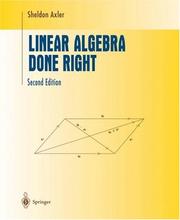
Approaches linear algebra through vector spaces and linear maps rather than matrices, building the abstract structural thinking that is essential for all further pure mathematics.
Learning to Prove and Abstract
IntermediateTransition fully into rigorous proof-based mathematics by mastering logic, set theory, and the foundational structures of algebra and real analysis.
▸ Study plan for this stage
Pace: 6–9 months total, divided across three books: (1) "How to Prove It" — 4–5 weeks, ~15–20 pages/day, working every exercise; (2) "Principles of Mathematical Analysis" (Rudin) — 3–4 months, ~8–12 pages/day, never skipping proofs; (3) "Abstract Algebra" (Dummit) — 2–3 months, ~10–15 pages/day, focusing
- Formal logic and proof techniques (direct, contrapositive, contradiction, induction) as developed in Velleman — the grammar of all subsequent work
- Naive and axiomatic set theory: sets, functions, relations, equivalence classes, and cardinality (Velleman Chapters 1–7)
- The real number system: completeness axiom, supremum/infimum, Archimedean property, and the construction of ℝ (Rudin Chapter 1)
- Sequences and series: convergence, Cauchy criterion, absolute vs. conditional convergence, power series (Rudin Chapters 2–3)
- Continuity, differentiation, and the Riemann–Stieltjes integral: epsilon-delta definitions, uniform continuity, the fundamental theorem (Rudin Chapters 4–6)
- Metric space topology: open/closed sets, compactness, connectedness, completeness — the geometric backbone of analysis (Rudin Chapter 2)
- Group theory: subgroups, cosets, Lagrange's theorem, normal subgroups, quotient groups, homomorphisms, and the isomorphism theorems (Dummit Part I)
- Ring and field theory: ideals, quotient rings, polynomial rings, UFDs, PIDs, and field extensions as an introduction to Galois theory (Dummit Parts II–III)
- Given a proposition, can you identify its logical structure, write its negation, and choose the most efficient proof strategy — as Velleman's framework demands?
- What does it mean for a set to be compact in a metric space, and why does compactness guarantee that a continuous function attains its maximum (Rudin Theorem 4.16)?
- How does the least-upper-bound property of ℝ distinguish it from ℚ, and why is this property essential for proving the Bolzano–Weierstrass theorem (Rudin Chapter 2–3)?
- State and prove the first isomorphism theorem for groups (Dummit Section 3.3) — what does it tell you about the relationship between a homomorphism and a quotient group?
- What is the difference between a PID and a UFD, and why does every PID imply UFD but not conversely (Dummit Chapter 8–9)?
- How do the epsilon-delta definition of continuity and the open-set definition (Rudin Theorem 4.8) capture the same idea, and what does this equivalence reveal about the role of topology?
- Velleman drills: Complete every exercise in Chapters 3–6 of 'How to Prove It' in writing. For each proof, explicitly label the strategy used (direct, contrapositive, etc.) and have a peer or mentor check the logical structure before moving on.
- Rudin Chapter 2 topology map: Draw a concept map linking the definitions of open set, closed set, compact set, and connected set. For each node, write the definition, one example, and one non-example directly from Rudin's text and exercises.
- Epsilon-delta workshop: Prove from scratch — without consulting notes — that f(x) = x² is uniformly continuous on [0, 1] and not uniformly continuous on ℝ, using only Rudin's definitions. Then do the same for f(x) = sin(1/x) on (0,1].
- Rudin problem sets: Solve all end-of-chapter problems for Chapters 1, 2, 3, and 4. Keep a dedicated 'mistake journal' recording every error, the misconception behind it, and the corrected reasoning.
- Group theory proof portfolio (Dummit Part I): Write self-contained proofs of: (a) Lagrange's theorem, (b) every subgroup of a cyclic group is cyclic, (c) the first isomorphism theorem. Then construct the full subgroup lattice of S₄ by hand.
- Ring theory construction exercise (Dummit Part II): Explicitly construct ℤ[x]/(x²+1) and show it is isomorphic to ℂ. Then prove that ℤ[x] is a UFD but not a PID by finding an ideal that is not principal.
Next up: By internalizing rigorous proof-writing, the topology and analysis of ℝⁿ, and the core algebraic structures, the reader has built the dual fluency — analytic and algebraic — needed to tackle advanced topics such as real and complex analysis, topology, and Galois theory at the graduate level.
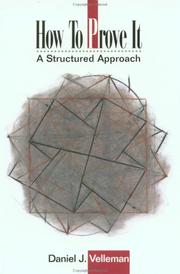
The clearest available guide to constructing formal proofs; it should be read before diving into analysis or abstract algebra to ensure the reader is fluent in the language of mathematics.
Known as 'Baby Rudin,' this is the canonical introduction to real analysis; its concise, demanding style forges the analytical precision required for advanced study.
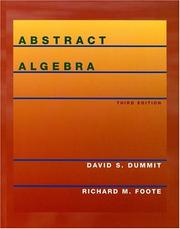
The definitive undergraduate–graduate text on groups, rings, and fields; placed here after analysis so the reader has the proof maturity to appreciate the deep structural results.
Advanced Horizons
ExpertEngage with graduate-level mathematics across topology and complex analysis, and gain a panoramic view of the entire mathematical landscape.
▸ Study plan for this stage
Pace: 20–24 weeks total: ~7–8 weeks for Munkres' "Topology" (~25–30 pages/day, focusing on Part I: General Topology and Part II: Algebraic Topology); ~6–7 weeks for Ahlfors' "Complex Analysis" (~15–20 pages/day, given its density and proof-heavy style); ~5–6 weeks for Aleksandrov's "Mathematics: Its Conte
- Topological spaces, open/closed sets, bases, and the foundational axioms of point-set topology as developed in Munkres Part I — including compactness, connectedness, and the separation axioms (T1, Hausdorff, normal)
- Continuity, homeomorphisms, and quotient spaces in Munkres — understanding topology as the study of properties invariant under continuous deformation
- Metric topology and its relationship to general topology in Munkres — when metric intuitions generalize and when they fail
- Fundamental groups and an introduction to algebraic topology in Munkres Part II — the homotopy relation, π₁, and covering spaces as a bridge between topology and algebra
- The geometry of the complex plane in Ahlfors — Möbius transformations, the Riemann sphere, and conformal mappings as analytic functions that preserve angles
- Core theorems of complex analysis in Ahlfors — Cauchy's integral theorem and formula, Taylor and Laurent series, the residue theorem, and their far-reaching computational and theoretical consequences
- Analytic continuation, Riemann surfaces, and the global behavior of complex functions in Ahlfors — moving beyond local power series to a unified geometric picture
- The panoramic synthesis in Aleksandrov — how algebra, analysis, geometry, topology, probability, and mathematical logic interconnect, and what it means to 'do mathematics' at a mature level
- Given a topological space defined by a specific collection of open sets (from Munkres), can you verify the topology axioms, determine whether the space is Hausdorff or compact, and construct or refute a homeomorphism to a known space?
- How does Munkres use the fundamental group π₁ to distinguish topological spaces — for example, why is the circle S¹ topologically distinct from the disk D², and what role do covering spaces play in computing π₁?
- From Ahlfors, can you state and prove Cauchy's integral formula, and explain how it implies that every holomorphic function is infinitely differentiable — a fact with no analogue in real analysis?
- How does Ahlfors develop the residue theorem, and how would you apply it to evaluate a definite real integral that resists elementary techniques?
- What does Ahlfors mean by analytic continuation, and why does it force a function like the complex logarithm to be defined on a Riemann surface rather than the punctured plane?
- After reading Aleksandrov, how would you explain to a fellow advanced student the unity underlying seemingly disparate fields — for instance, how does the concept of a 'group' appear in both the topology of Munkres and the transformations of Ahlfors, and what does Aleksandrov say about the role of abstraction in modern mathematics?
- Munkres problem sets (topology): Work every exercise in Chapters 2–4 (topological spaces, continuity, connectedness, compactness) and at least half of the exercises in Chapters 9–11 (fundamental group, covering spaces). Do not skip the counterexample-construction problems — they are the most instructive.
- Topology construction lab: For at least five different sets (e.g., ℝ, S¹, the torus, the Möbius band, ℝⁿ), explicitly write out the topology, verify separation axioms, compute or look up π₁, and draw the covering space. Build a personal 'zoo' of topological spaces for reference.
- Ahlfors proof reconstruction: After reading each major theorem in Ahlfors (Cauchy's theorem, the residue theorem, the open mapping theorem, the Riemann mapping theorem), close the book and reconstruct the proof from memory in your own notation. Compare with the text and note every gap.
- Residue calculus drill: Use the residue theorem (Ahlfors) to evaluate at least 10 definite integrals of the form ∫₋∞^∞ R(x)dx and ∫₀^{2π} f(cos θ, sin θ)dθ. Then verify each answer numerically with a calculator or computer algebra system (e.g., WolframAlpha or Python/SciPy).
- Conformal mapping sketchbook: Using Ahlfors' treatment of Möbius transformations and conformal maps, hand-sketch the image of standard grids and circles under at least five maps (e.g., z², 1/z, eᶻ, the Joukowski map). Annotate which angle-preserving properties hold and where conformality breaks down (critical points).
- Aleksandrov synthesis essay: After completing all three books, write a 2–3 page personal essay (no audience required) answering: 'What is mathematics?' Draw explicitly on Munkres' structural approach to topology, Ahlfors' analytic-geometric fusion in complex analysis, and Aleksandrov's panoramic philosophical perspective. Identify two open questions or areas you wish to explore next.
Next up: By mastering the rigorous structural language of topology (Munkres), the deep analytic machinery of complex functions (Ahlfors), and the bird's-eye philosophical coherence of the mathematical enterprise (Aleksandrov), the reader has the graduate-level fluency and panoramic awareness needed to pursue specialized research-track study — whether in differential geometry, algebraic topology, analytic n
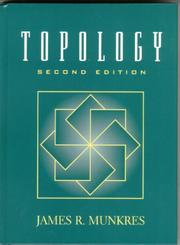
The standard graduate introduction to point-set and algebraic topology; it generalizes and unifies ideas from analysis and algebra into a powerful abstract framework.
A masterpiece of mathematical writing that reveals the stunning elegance of complex analysis; it rewards the reader who has completed real analysis with a richer, more beautiful theory.
A sweeping survey of the entire field written by leading Soviet mathematicians; read last, it connects every topic studied so far into a unified vision of what mathematics is and where it goes.
Discussion
Keep reading
Paths that share books, cover the same subject, or open a related topic.