Badminton for beginners: top books to master strokes and strategy
This curriculum takes a beginner from zero badminton knowledge to tactical match-play competence across four progressive stages. Each stage builds on the last — first establishing correct technique and vocabulary, then refining strokes, then developing physical and mental athleticism, and finally applying everything through advanced tactics and strategic thinking.
Foundations: Rules, Grips & Core Strokes
BeginnerUnderstand the rules of the game, learn correct grip styles, and develop the fundamental strokes — clears, drops, and basic serves — so every subsequent technique is built on a sound base.
▸ Study plan for this stage
Pace: 4–5 weeks, ~25–30 pages/day, with 2–3 practice sessions per week on court
- Court dimensions, net height, and basic scoring rules (singles vs. doubles) from Grice's foundational overview
- Grip fundamentals: forehand, backhand, and neutral grips as detailed in both Grice and Wadood, and how grip affects stroke execution
- The clear stroke: technique, footwork, and when to deploy it as a primary attacking/defensive shot
- The drop shot: controlled technique and strategic placement to shorten rallies
- Basic serve mechanics: high serve, low serve, and flick serve fundamentals for initiating play
- Footwork and court positioning principles that underpin all strokes
- Common beginner mistakes and how to correct them through deliberate practice
- What are the dimensions of a badminton court and how do they differ between singles and doubles play?
- Describe the three main grip styles and explain when each is most appropriate during a rally
- How does the clear stroke differ from the drop shot in terms of technique, trajectory, and tactical purpose?
- What are the key differences between a high serve and a low serve, and when should each be used?
- Explain the footwork pattern required to execute a proper clear from the baseline
- What are three common beginner errors in grip or stroke technique, and how would you correct them?
- Grip drill: Spend 10 minutes daily switching between forehand, backhand, and neutral grips without a racket, focusing on muscle memory and comfort
- Wall practice: Hit 50 clears and 50 drops against a wall daily, focusing on consistent contact point and follow-through
- Serve practice: Execute 20 high serves and 20 low serves in succession, aiming for consistency and accuracy to different court zones
- Footwork ladder drills: Use a ladder or tape on the court to practice split-step, lunge, and recovery patterns for 15 minutes, 3 times per week
- Court positioning game: Play points focusing only on footwork and positioning (not winning), with a partner or coach providing feedback
- Video analysis: Record your own clears, drops, and serves; compare them to technique descriptions in Grice and Wadood, identifying one correction per session
Next up: This stage establishes the mechanical and rule-based foundation that allows you to progress to intermediate strokes (smashes, net shots, drives) and tactical play, where you'll apply these fundamentals under game pressure.
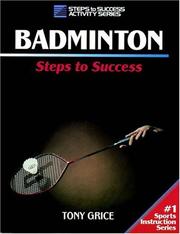
The single best beginner entry point: it uses a structured, drill-based 'steps' format to introduce grips, footwork patterns, clears, smashes, and net play in a logical sequence. Read this first to build vocabulary and correct muscle-memory habits before anything else.
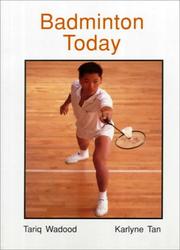
A clear, well-illustrated instructional text that reinforces the fundamentals with biomechanical explanations and common-error corrections. Reading it directly after Grice solidifies why the techniques work, not just how to perform them.
Stroke Refinement: Smashes, Drives & Net Play
BeginnerDeepen stroke quality across all areas of the court — overhead smashes, flat drives, net kills, and deceptive drops — moving from mechanical correctness to fluid, purposeful shot-making.
▸ Study plan for this stage
Pace: 4–5 weeks, ~20–25 pages/day, with 2–3 dedicated practice days per week on court
- Overhead smash mechanics: grip, footwork, racket acceleration, and timing for maximum power and control
- Flat drive technique: compact swing, wrist snap, and court positioning for aggressive baseline and mid-court shots
- Net play fundamentals: soft touch, racket angle control, and positioning for kills and interceptions
- Deceptive drops and slices: disguising intent through similar preparation and subtle racket manipulation
- Shot selection and court awareness: reading opponent position and choosing the right stroke for each situation
- Transition from mechanical form to fluid, purposeful execution under match conditions
- Recovery and positioning after each stroke to maintain court control
- What are the key grip and footwork adjustments needed to execute a powerful overhead smash, and how do they differ from a clear?
- How does the flat drive differ mechanically from a clear, and when should you choose a drive over other offensive shots?
- What soft-touch techniques and racket angles are essential for effective net play, and how do you avoid lifting the shuttle?
- How can you disguise a drop shot to look like a drive or smash, and why is this deception strategically valuable?
- How should your court positioning and recovery change after executing smashes, drives, and net shots?
- What decision-making framework helps you select the appropriate stroke based on shuttle height, opponent position, and court situation?
- Smash drill: Practice 50 overhead smashes from the service box, focusing on consistent grip, footwork, and follow-through; progress to smashing from mid-court and baseline positions
- Drive repetition: Hit 40 flat drives from the baseline against a wall or partner, emphasizing compact swing and wrist snap; vary angles and depths
- Net play touch work: Execute 30 soft net shots (kills, blocks, and gentle returns) at the net, concentrating on racket angle and touch control without lifting
- Drop-shot disguise: Practice 25 drop shots with identical preparation to drives and smashes; have a partner watch and call out when they detect the deception
- Transition drill: Alternate between smashes, drives, and net shots in a sequence (smash → recover → drive → recover → net kill), building fluid movement and positioning
- Match-play simulation: Play 3–4 practice games focusing on stroke selection—use smashes when shuttle is high, drives for mid-court aggression, and net play for finishing; review decision-making afterward
Next up: Mastering these refined strokes and shot selection builds the foundation for advanced tactical play, where you'll learn to combine these techniques into aggressive patterns, exploit opponent weaknesses, and execute winning strategies under competitive pressure.
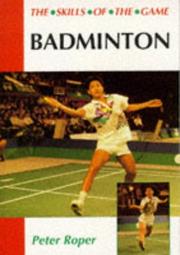
Roper's book focuses specifically on stroke production and shot selection for each court zone, making it the ideal bridge from foundational mechanics to more varied, match-realistic shot-making. Its court-zone framework gives learners a spatial vocabulary they will use for the rest of the curriculum.
Footwork & Athletic Movement
IntermediateMaster the six-corner footwork system, split-step timing, and court recovery so the learner can reach every shuttle efficiently and return to base position ready for the next shot.
Downey's classic coaching manual devotes extensive attention to movement patterns and positional play in singles, explaining how footwork and stroke choice are inseparable. It introduces the tactical reasoning behind court positioning that the next stage will deepen.
Grice's follow-up work moves beyond static drills into dynamic, game-speed movement sequences and combination play. Reading it here reinforces footwork in the context of real rally patterns rather than isolated exercises.
Tactics & Match Strategy
ExpertDevelop a complete match-play mind-set: reading opponents, constructing rally patterns, exploiting weaknesses, managing pressure points, and adapting tactics between singles and doubles to win more matches.
▸ Study plan for this stage
Pace: 4–5 weeks, ~25–30 pages/day, with 2–3 days per week dedicated to on-court practice and match analysis
- Self 1 vs. Self 2: Quieting the critical inner voice to enable intuitive, flow-based play
- The role of concentration and trust in executing tactics under pressure
- How to observe and read opponent patterns without overthinking during rallies
- Adapting your mental approach to different match situations and opponent styles
- Using visualization and imagery to rehearse tactical scenarios mentally before matches
- The connection between emotional control and tactical decision-making in high-pressure moments
- Building confidence through process-focused thinking rather than outcome obsession
- What is the difference between Self 1 and Self 2 thinking, and how does this distinction apply to executing badminton tactics under match pressure?
- How can you use the concept of 'letting it happen' rather than 'making it happen' to improve your ability to read and react to opponent patterns in real time?
- What role does visualization play in preparing for match situations, and how would you use it to rehearse tactical responses to specific opponent weaknesses?
- How does managing your inner dialogue and reducing self-judgment improve your tactical adaptability between singles and doubles formats?
- What does Gallwey mean by 'concentration without tension,' and how would you apply this to constructing rally patterns while maintaining pressure on your opponent?
- How can you use the principles in this book to manage pressure points in critical moments (e.g., match point, deciding set) and maintain tactical clarity?
- Read one chapter per session and journal: identify one Self 1 thought that typically disrupts your tactical execution, then write a Self 2 response (trust-based, non-judgmental) to use in your next match
- Practice 'quiet mind' rallies: during practice, play 3–4 games where you consciously suppress internal commentary and focus only on observing your opponent's patterns; note what you notice without judgment
- Visualization drill: spend 10 minutes before each practice session mentally rehearsing 3 specific tactical scenarios (e.g., exploiting opponent's weak backhand, adapting to aggressive net play) in vivid detail
- Match analysis with mental lens: watch a recorded match of yourself or a professional player, and identify moments where Self 1 thinking (doubt, over-analysis) vs. Self 2 thinking (trust, flow) affected tactical execution
- Pressure-point simulation: play practice matches with artificial pressure (e.g., 'must win this rally' or 'opponent is match point up') and deliberately apply Gallwey's concentration techniques to maintain tactical composure
- Opponent-reading exercise: in casual play, spend entire games focused solely on identifying 2–3 patterns in your opponent's shot selection, positioning, or movement without trying to win; then play a second game adapting your tactics based on those observations
Next up: This stage establishes the mental and psychological foundation for tactical mastery—learning to trust intuition and manage pressure—which will be built upon in the next stage with sport-specific tactical frameworks, shot selection systems, and detailed match-play scenarios tailored to badminton's unique demands.

Though written for tennis, this landmark sports-psychology text is universally applied by elite racket-sport coaches. It teaches the learner to quiet self-interference, trust trained technique under pressure, and compete with a calm, focused mind — the final layer needed to turn good strokes into consistent match wins.
Discussion
Keep reading
Paths that share books, cover the same subject, or open a related topic.