Anne Carson Reading Order: Where to Start
Anne Carson is a classicist who writes poetry, essays, translations and books that refuse to be any of those things, so the usual advice to "start with the early work" fails badly here — Eros the Bittersweet is an academic monograph and Nox is a facsimile of a handmade scrapbook in a box. The reliable way in is Autobiography of Red, the one book that behaves enough like a novel to carry a reader who has never met her before. From there the path splits into the classicist, the elegist and the formal experimenter, which is the order in which her books get harder rather than the order she wrote them.
Start Here: The Novel in Verse
BeginnerMeet Carson through the one book that gives you a plot, a protagonist and an emotional arc, and learn to read her line breaks as narrative rather than decoration.
▸ Study plan for this stage
Pace: 3 weeks. Autobiography of Red is 155 pages and Short Talks is 57, so this looks like a week of reading and is not. Give Autobiography of Red two weeks at roughly 15 pages a day, and read Short Talks across the third week in sittings of five or six talks. These are short books that take a long time,
- Autobiography of Red does not begin where you expect: the novel proper is preceded by an essay on the Greek poet Stesichoros, the surviving fragments of his lost Geryon poem, and mock appendices on his blinding by Helen. Readers who treat that apparatus as a preface to skim lose the terms the novel
- Geryon is a red winged monster out of a lost Greek poem and an ordinary boy with a camera at the same time, and Carson never resolves that into metaphor. Nothing is standing in for anything.
- The line breaks are narrative, not decoration — a break lands where the attention breaks, so the pacing of a page is the pacing of a mind.
- The plot stays legible even where the syntax does not. When a sentence resists you, the story usually does not, and learning to keep going on the story while a sentence stays closed is the skill this stage exists to teach.
- Short Talks is the smallest possible dose of her method: forty-odd prose miniatures, each under a page, each announcing a subject and then swerving off it. The swerve is the form, not a failure to stay on topic.
- Full comprehension on a first pass is not the goal with either book, and it is not the goal with several books later on this path. You are learning what kind of attention each one wants.
- The final section of Autobiography of Red is a sequence of captioned photographs that were never taken, which is Carson stating her whole relation to evidence in about twenty pages.
- The front matter claims something specific about what adjectives do. What is the claim, and how does it describe the novel that follows?
- Where do Geryon's wings actually appear in the text, and what is happening to him each time?
- In the myth Herakles kills Geryon. What does Carson do with that ending instead, and does the volcano section resolve anything?
- Pick three Short Talks and say what each is actually about. It is never the announced title.
- Which passages did you not understand on a first pass, and did the story carry you anyway? That answer is your calibration for the rest of the path.
- Read the Stesichoros front matter properly rather than skipping to page one of the novel, then reread it after finishing. The fragments have already told you the ending.
- Mark every appearance of the colour red for the first fifty pages, then stop marking. By then you will have found the system.
- Copy out one Short Talk by hand and mark where it turns. Most turn once, in the last sentence.
- Read the closing Photographs section aloud. The line breaks are audible in a way they are not on the page.
Next up: You have read Carson as a storyteller; the next stage shows you the classical scholarship the story was built out of.

The consensus entry point, and rightly so: a red winged monster from a lost Greek poem is rewritten as a gay teenager with a camera, and the story is legible even if you know nothing about Stesichoros. Everything Carson does elsewhere — the classical source, the fragment, the erotic wound — is here in a form you can simply read.
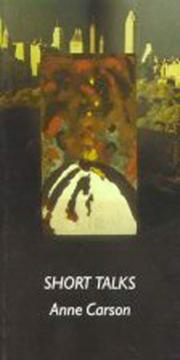
Read second because it is the smallest possible dose of her method: forty-odd prose miniatures, each a page or less, each swerving from its announced subject. It teaches the reflex you need for the harder books — trust the swerve, do not look for the argument.
The Classicist Underneath
IntermediateUnderstand the Greek scholarship that every later book is built on, and see what Carson thinks translation actually is.
▸ Study plan for this stage
Pace: 5–6 weeks. Eros the Bittersweet is 189 pages of academic prose and reads like the monograph it is — about 15 pages a day for two weeks. If Not, Winter counts 409 pages but prints the Greek facing the English, so the English is roughly half of that and much of it is single words; two or three long si
- Eros the Bittersweet is her doctoral work and the master key to everything else: it argues that desire needs three points, not two — lover, beloved, and the gap between them. Once you have the triangle, the shape of Autobiography of Red explains itself.
- Sappho's word is sweetbitter in that order, and Carson's refusal to flip it into the familiar English compound is the entire argument in miniature.
- In If Not, Winter the brackets mark where the papyrus is physically missing. They are content, not damage, and not a defect of your edition — the hole in the text is part of the text.
- A facing-page translation is an argument about how much English can carry. You do not need the Greek, but noticing where a bracket falls against the Greek line is the reason the layout exists.
- Many fragments here are two or three words long. They are not offcuts to skip on the way to the famous ones; the one-word fragments are the experience the edition was built to give.
- An Oresteia is a trilogy no Greek would recognise: Aischylos' Agamemnon, Sophokles' Elektra and Euripides' Orestes lined up so the same house degrades across three authors and three generations of dramatic taste.
- Her transliterations — Aischylos, Sophokles, Stesichoros — are a small consistent refusal to receive Greek through Latin, and they signal that translation here is an argument rather than a service.
- State the erotic triangle in your own words, then apply it to Geryon and Herakles. Does it fit, and where does it strain?
- What does Eros the Bittersweet claim the alphabet did to the Greek sense of a bounded self?
- Open If Not, Winter at fragment 31 and then at a fragment reduced to two words. What can each do that the other cannot?
- Read the three plays of An Oresteia in order and describe how each playwright treats the house of Atreus differently. Which one does Carson seem to be arguing for?
- Where does Carson's Sappho sound most like Carson? Set a passage beside one from Autobiography of Red and say what they share.
- Before you start, check what your copy of If Not, Winter actually contains — the facing Greek, the brackets, the notes at the back. Readers who assume the brackets are printing errors misread the book for a hundred pages.
- Read ten consecutive fragments without skipping the one-word ones, at the pace the white space asks for rather than the pace the page count suggests.
- Keep the house of Atreus straight on one sheet while reading An Oresteia. Carson supplies no chart and the three plays assume different amounts of prior knowledge.
- Reread the opening chapter of Eros the Bittersweet immediately after finishing it. The argument closes a circle and the first pages read differently from the far end.
Next up: The scholarship gives you her materials; the next stage is where she turns them on her own losses.
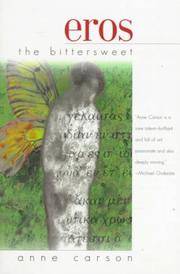
Her doctoral work, and the master key to the rest: an argument that desire is structurally a lack, triangulated between lover, beloved and the gap between them. Read it after Autobiography of Red and that novel's whole shape suddenly explains itself.

Her Sappho, printed with brackets marking every place the papyrus is torn. It is the clearest statement of her aesthetic — the hole in the text is part of the text — and it is genuinely usable as a reading edition of Sappho.
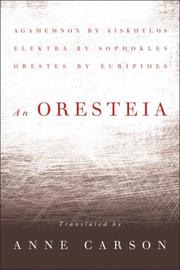
Three tragedies by three different playwrights assembled into one arc, which no Greek would recognise as a trilogy. Take it as the transition into her later work: this is Carson treating the canon as raw material rather than inheritance.
The Books About Loss
BeginnerFollow Carson into elegy, where the formal experiments stop being playful and start doing the emotional work directly.
▸ Study plan for this stage
Pace: 4–5 weeks. The Beauty of the Husband is 154 pages in twenty-nine numbered tangos — two or three tangos a sitting over about ten days, rather than a push. Nox is listed at 192 pages, but it is not a book you page through: it is a single accordion-folded strip reproduced in a box, and unfolding a sect
- The Beauty of the Husband calls itself a fictional essay in twenty-nine tangos, and all three of those words are load-bearing: it argues, it invents, and it moves in figures that keep returning to where they started.
- Each tango is headed by a fragment of Keats, and the epigraph is usually doing more work than the first page under it.
- This is the book that proves the difficulty elsewhere is never evasion. It is her most emotionally direct work and also one of her strictest forms, at the same time.
- Nox is a facsimile of an object — a handmade scrapbook of clippings, photographs, letters, paint and tape assembled after her brother's death, reproduced page for page including the tape. You are reading a photograph of a thing, not a designed book.
- The left-hand pages of Nox give a dictionary entry for each successive Latin word of the Catullus elegy, in order, so the poem is translated word by word down the length of the whole book while the elegy for her brother runs on the right.
- Those lexicon entries are contaminated: night, ash and the brother keep surfacing inside definitions of ordinary words. That is the grief mechanism of the book, and skimming the left-hand pages loses it entirely.
- Men in the Off Hours ends with a short prose piece on her mother's death, and it is where the essay-poem-epitaph mixture she is now known for settles into a single register.
- Who is speaking in The Beauty of the Husband, and how much of the husband do you ever get directly?
- The wife keeps taking him back. Does the book explain why, or show you that explanation is the wrong request?
- Read ten of Nox's lexicon entries closely. What has been smuggled into the Latin definitions, and at which entry did you first notice?
- What does the Catullus original have that Carson's translation of it in Nox does not, and what does hers have instead?
- In the last piece of Men in the Off Hours, what does she borrow from Virginia Woolf, and what is the borrowing for?
- Read the Keats epigraphs of The Beauty of the Husband straight through on their own first. It takes ten minutes and works as a table of contents for the argument.
- Unfold more of Nox than fits on your lap. It was made as one continuous strip and the continuity is the point of the object.
- Track one recurring Latin word through Nox's left-hand pages and mark where its definition stops being neutral.
- After Nox, read the Catullus elegy in any other translation and set it beside hers. The gap between them is what the whole box is about.
- Note which of these three books you could describe to someone else afterwards. Being unable to is not a failure of reading here.
Next up: Grief is what made the formal experiments necessary; the last stage is where they run without a story underneath to justify them.
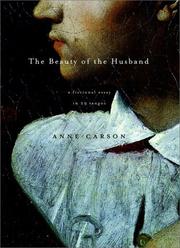
Subtitled a fictional essay in twenty-nine tangos, it is the dissolution of a marriage told in numbered movements. It is the most emotionally direct thing she has written and the best proof that the difficulty in her work is never evasion.
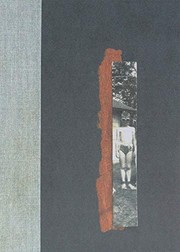
An elegy for her estranged brother, built around a word-by-word gloss of a Catullus poem, published as an accordion facsimile in a box. Read it after The Beauty of the Husband so that the object-ness of it reads as grief rather than as a stunt.
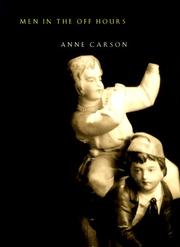
The collection that ends with a short essay on her mother's death, and the book where the essay-poem-epitaph mixture she is now known for settles into place. A good bridge from the elegies back into the collections.
The Deeper Cuts
BeginnerRead the genuinely difficult Carson — the sequel, the essays, the mixed collections — with enough context that the difficulty is legible as design.
▸ Study plan for this stage
Pace: 6 weeks, and the slowest stage on the path. Red Doc> is 167 pages set in a fixed narrow justified column that resists ordinary reading speed — allow a week and a half in short sittings. Plainwater has no page count recorded here and changes genre roughly every seventy pages; give it two weeks and tr
- Red Doc> is deliberately harder than Autobiography of Red. Same character decades later, but the long narrative lines are gone, replaced by a fixed narrow justified column that forces odd stresses and mid-word breaks.
- That column came out of a jammed word processor and she kept it, which is characteristic: an accident is accepted as a constraint and then obeyed for a whole book.
- Red Doc> withholds nearly everything the first book gave. Geryon is now G, Herakles is a damaged veteran, and the emotional payoff of the earlier novel is treated as already spent. Reading it first would be a mistake.
- Plainwater is four unrelated projects in one binding — translations of Mimnermos with invented interviews, the Short Talks, a verse novella, and a pilgrimage journal across Spain — with nothing joining them but her.
- The Glass Essay is the most conventionally powerful poem she has written: a woman at her mother's house on a northern moor, reading Emily Brontë, working through a break-up. It is the piece to give a sceptic.
- The Gender of Sound, in the same volume, is a straight critical essay. Reading it after the poem shows the same mind operating with the poetry switched off.
- Decreation holds an opera libretto, a screenplay, poems and an essay on Sappho, Marguerite Porete and Simone Weil — three women who each tried to write themselves out of the way. The scattering is the subject, not a failure to organise.
- By this point the difficulty should read as design rather than obscurity, which is the only reason these four are placed last instead of first.
- What has the narrow column of Red Doc> done to your reading pace, and what does the book get in exchange for that cost?
- Who is G, and what specifically would you have lost by reading Red Doc> before Autobiography of Red?
- Which section of Plainwater felt like the real book to you, and what does that answer say about which Carson you came for?
- In The Glass Essay, what are the Nudes, and how do they answer the Brontë material running alongside them?
- What do Sappho, Marguerite Porete and Simone Weil have in common in Decreation's central essay, and does the opera earn the same claim?
- Read twenty pages of Red Doc> aloud. The column is a scoring device and it becomes obvious the moment you hear it.
- Set the last page of Autobiography of Red beside the first page of Red Doc> and write down what has been taken away.
- Read The Glass Essay in one sitting with the phone in another room. It does not survive interruption.
- Check the contents page of Decreation before you start and count how many distinct forms it holds. Knowing the shape in advance is what stops the book feeling like a mess.
- Choose the Carson you would hand to someone who says they do not read poetry, and write two sentences on why. Most people land on Autobiography of Red or The Glass Essay, and which one you picked tells you what you now think she is.
Next up: You have read her across every form she works in, so any Carson you have missed can be opened cold — within ten pages you will know what kind of reading it is asking for.

The sequel to Autobiography of Red, set decades later and typeset in a narrow justified column produced by a jammed word processor. Save it for here: it assumes you already care about Geryon and it withholds almost everything the first book offered.
Essays, fake interviews, a translation of Mimnermos and a pilgrimage journal across Spain, bound together with no unifying apparatus. The best single demonstration of her range once you can tolerate a book that changes genre mid-stride.
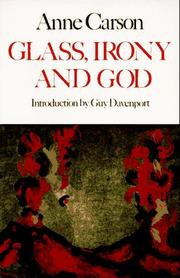
Contains The Glass Essay, the long Brontë-haunted poem many readers consider her finest single piece, plus the essay The Gender of Sound. Read the poem first and the essays after.
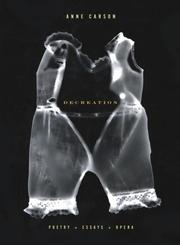
Opera libretto, screenplay, essay on Simone Weil and Marguerite Porete, poems — the most formally scattered book she has published and the natural end of this path. If you can read Decreation with pleasure, nothing else in her catalogue will be closed to you.
Discussion
Keep reading
Paths that share books, cover the same subject, or open a related topic.