Start with Autobiography of Red. It is the only book of hers with a story running the whole way through, and reading her as a storyteller first is what makes the rest legible. Geryon is a red winged monster out of a lost Greek poem and an ordinary boy with a camera at the same time, and Carson never resolves that into metaphor. Nothing is standing in for anything.
The obvious alternatives are the two books she is most famous for outside poetry — Nox, the elegy for her brother, and her Sappho — and both are worse entry points. Neither has a narrative to carry you when a sentence closes against you, which is precisely the skill this first book teaches. It is 155 pages and it will take a fortnight at about fifteen pages a day. Short books that take a long time is the ratio for everything here.
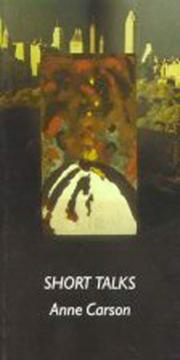
One warning: do not skip the front matter. Autobiography of Red opens with an essay on the Greek poet Stesichoros, the surviving fragments of his lost Geryon poem, and mock appendices on his blinding by Helen. Readers who treat that apparatus as a preface to skim lose the terms the novel then uses — and the fragments have already told you the ending. Read Short Talks alongside it, forty-odd prose miniatures each under a page, each announcing a subject and then swerving off it. The swerve is the form.
The classicist underneath
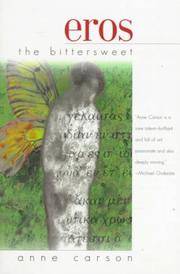
Eros the bittersweet is her doctoral work and the master key to everything else. It argues that desire needs three points rather than two — lover, beloved, and the gap between them — and once you have that triangle the shape of Autobiography of Red explains itself. It reads like the monograph it is, so plan about fifteen pages a day.
If Not, Winter is her Sappho, filed in our catalogue under Sappho's name rather than hers. Check what your copy contains before you start: the Greek faces the English, and the brackets mark where the papyrus is physically missing. They are content, not damage, and not a defect of your edition. Many fragments run to two or three words; those are not offcuts to skip on the way to the famous ones, they are the experience the edition was built to give.
An Oresteia is a trilogy no Greek would recognise — Aischylos, Sophokles and Euripides lined up so the same house degrades across three authors and three generations of dramatic taste. Keep the house of Atreus straight on one sheet; Carson supplies no chart.
The books about loss
The Beauty of the Husband calls itself a fictional essay in twenty-nine tangos, and all three words are load-bearing. Each tango is headed by a fragment of Keats, usually doing more work than the first page under it. This is the book that proves the difficulty elsewhere is never evasion: it is her most emotionally direct work and one of her strictest forms at once.
Nox needs a buying warning. It is not a book you page through — it is a facsimile of a handmade scrapbook, a single accordion-folded strip reproduced in a box, including the tape. The left-hand pages give a dictionary entry for each successive Latin word of a Catullus elegy while the elegy for her brother runs on the right, and those definitions are contaminated: night, ash and the brother keep surfacing inside ordinary words. Skimming the left-hand pages loses the whole mechanism. Men in the off hours closes with a short prose piece on her mother's death and is where the essay-poem-epitaph mixture settles into one register.
Leave these until last
Red Doc> is deliberately harder than Autobiography of Red — same character decades later, but set in a fixed narrow justified column that forces odd stresses and mid-word breaks, and it treats the earlier novel's emotional payoff as already spent. Reading it first would be a mistake.
Plainwater is four unrelated projects in one binding. Glass, irony, and God contains The Glass Essay, the most conventionally powerful poem she has written and the piece to give a sceptic; read it in one sitting with the phone in another room. Decreation holds an opera libretto, a screenplay, poems and an essay on three women who each tried to write themselves out of the way — check the contents page first, because knowing the shape is what stops it feeling like a mess.
Where to stop
Autobiography of Red plus Glass, irony, and God is enough for most readers. Go further only if the difficulty started reading as design rather than obscurity. More poetry reading paths are on Discover.
Follow the full ordered path here: Anne Carson Reading Order: Where to Start.