How animals think: the science of animal minds
This curriculum takes you from the first intuitive question — "do animals really think and feel?" — through the science of animal cognition, emotion, and communication, and finally into the frontier debates about consciousness and moral status. Each stage builds the conceptual vocabulary and scientific grounding needed to engage meaningfully with the next, moving from accessible narrative science to rigorous, field-defining works.
Foundations: Opening the Door
BeginnerDevelop an intuitive sense that animal minds are rich and varied, and gain the basic vocabulary (cognition, sentience, theory of mind) needed for deeper reading.
▸ Study plan for this stage
Pace: 6–8 weeks total: Weeks 1–4 for "Are We Smart Enough to Know How Smart Animals Are?" (~25–30 pages/day, 5 days/week), then Weeks 5–8 for "The Soul of an Octopus" (~20–25 pages/day, 5 days/week). Allow one buffer day per week for reflection and note-taking.
- Umwelt: every species perceives and experiences a unique sensory world tailored to its ecological niche (central to de Waal's argument that we must evaluate animals on their own terms)
- Cognition vs. instinct: the distinction between flexible, experience-based problem-solving and hardwired behavior, and why the line is blurrier than traditionally assumed
- Sentience: the capacity to have subjective experiences — pleasure, pain, curiosity — and why behavioral and neurological evidence supports it across many species
- Theory of mind: the ability to attribute mental states (beliefs, intentions, desires) to others, and the ongoing scientific debate about which animals possess it
- Anthropocentrism vs. anthropomorphism: de Waal's critique of both extremes — dismissing animal minds entirely vs. projecting human experience uncritically — and how to find a rigorous middle ground
- Convergent cognitive evolution: the idea (from de Waal) that similar cognitive abilities can evolve independently in distantly related lineages (e.g., corvids and great apes)
- Individual personality in animals: Montgomery's sustained portrait of four named octopuses (Athena, Octavia, Kali, Karma) as evidence that individuals within a species differ in temperament, curiosity, and social style
- Embodied and distributed cognition: the octopus as a case study in intelligence that is radically non-centralized — two-thirds of its neurons live in its arms — challenging human-centric models of mind
- According to de Waal, what is wrong with testing a chimpanzee's cognition using a task designed around human or rat behavior, and what does the concept of Umwelt tell us about how to design better experiments?
- How does de Waal distinguish between 'being anthropocentric' and 'being anthropomorphic,' and why does he argue that avoiding one extreme does not require falling into the other?
- What specific behaviors do Athena, Octavia, Kali, and Karma display in 'The Soul of an Octopus' that Montgomery uses as evidence for individual personality, and what alternative (non-mentalistic) explanations might a skeptic offer?
- How does the octopus nervous system — with its distributed, arm-based neurons — challenge the assumption that a centralized brain is necessary for complex cognition?
- What is 'theory of mind,' which animals does de Waal argue show evidence of it, and what methodological challenges make it difficult to test conclusively in non-human species?
- After reading both books, how would you define 'animal cognition' in your own words, and what is one thing each book changed or complicated about your prior intuitions?
- Umwelt mapping: Pick any animal you encounter or can observe (a pet, a bird outside, an animal at a zoo). Write a one-page 'sensory profile' imagining its Umwelt — what stimuli it prioritizes, what it likely ignores — drawing on de Waal's framework to guide your thinking.
- Vocabulary flashcards: Create a two-sided card for each of the following terms introduced across both books — cognition, sentience, theory of mind, Umwelt, anthropomorphism, anthropocentrism, convergent evolution, distributed cognition. On the back, write the definition AND a concrete example from one of the two books.
- Skeptic vs. advocate debate (solo or with a partner): Choose one behavior described by Montgomery (e.g., Athena squirting water at a staff member). Write two short paragraphs — one arguing it demonstrates genuine cognition/personality, one arguing it can be explained without invoking mental states. Then write a third paragraph adjudicating between them using de Waal's methodological criteria.
- Reading journal — 'My prior assumptions': Before starting de Waal, write a half-page on what you currently believe about animal intelligence. After finishing each book, revisit and annotate that entry: what was confirmed, what was challenged, and what new questions emerged.
- Comparative cognition chart: Draw a simple table with rows for 5–6 species discussed prominently across both books (e.g., chimpanzees, crows, elephants, octopuses, dolphins, dogs) and columns for: evidence of tool use, evidence of social cognition, evidence of individual personality, and nervous system notes. Fill it in using only evidence from the two books.
- Find one peer-reviewed paper (via Google Scholar) cited or alluded to in de Waal's endnotes on a topic that surprised you most. Read the abstract and first paragraph, then write three sentences connecting it back to a specific passage in the book — this previews the more source-heavy reading ahead.
Next up: These two books establish the intuition and vocabulary — that animal minds are real, varied, and worth taking seriously — which equips the reader to engage more critically and scientifically with the mechanisms, evolutionary origins, and ethical implications of animal cognition explored in more advanced texts.
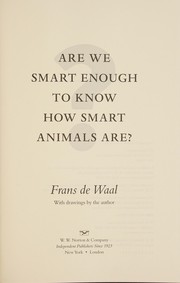
A perfect entry point: de Waal dismantles human-centric thinking and introduces core concepts like cognition, tool use, and social intelligence through vivid, accessible stories. Reading this first sets the intellectual frame for everything that follows.
A beautifully written narrative that makes the strangeness of invertebrate minds concrete and emotionally compelling. It pairs perfectly with de Waal by showing that intelligence can evolve along radically different paths.
Emotions & Inner Lives
BeginnerUnderstand the scientific evidence for animal emotions — joy, grief, empathy, and play — and learn how researchers study subjective states without projecting human feelings.
▸ Study plan for this stage
Pace: 8–10 weeks total. Weeks 1–5: "Mama's Last Hug" (~25–30 pages/day, 5 days/week). Weeks 6–10: "The Emotional Lives of Animals" (~20–25 pages/day, 5 days/week). Reserve one day per week for reflection, journaling, and exercises.
- Homology vs. analogy in emotion: de Waal's argument that animal emotions are evolutionarily homologous to human emotions, not merely superficially similar behaviors
- The problem of anthropomorphism vs. anthropodenial: de Waal's case that denying inner lives to animals is as unscientific as over-projecting human feelings onto them
- Behavioral and physiological markers of emotion: how researchers use facial expressions, body language, hormone levels (cortisol, oxytocin), and brain imaging as proxies for subjective states
- Core emotion categories in animals — joy, grief, fear, empathy, and play — and the specific species evidence de Waal and Bekoff marshal for each
- Bekoff's concept of 'minding animals': the ethical and scientific obligation to take animal subjectivity seriously as a research stance
- The PLAYS framework and play signals: Bekoff's detailed work on how animals signal 'this is play' (e.g., the play bow in dogs) and what this reveals about intentionality and social cognition
- Anecdote vs. evidence: how both authors navigate the tension between compelling individual stories and the need for replicable, controlled scientific data
- Observer bias and methodological humility: strategies researchers use (blind coding, ethograms, cross-species comparison) to study emotions rigorously without projecting
- According to de Waal, what is 'anthropodenial,' and why does he consider it just as problematic as naive anthropomorphism? Use at least one example from 'Mama's Last Hug' to support your answer.
- How does de Waal use the story of Mama the chimpanzee to argue for the evolutionary continuity of emotions between humans and other primates?
- What specific behavioral and physiological evidence does Bekoff present to support the claim that animals experience emotions such as grief or joy — and what are the limitations he acknowledges in that evidence?
- Describe Bekoff's concept of play signals (e.g., the play bow). What does the existence of these signals suggest about animal intentionality and self-awareness?
- Both de Waal and Bekoff grapple with the challenge of studying subjective inner states scientifically. What methodological tools or principles do they each propose to do this responsibly?
- After reading both books, how would you define 'emotion' in a way that applies across species? What criteria would you use, and which book shaped your thinking more?
- Emotion field journal: Over 2 weeks, observe a pet, backyard animal, or animals at a zoo/sanctuary. Log specific behaviors daily using an ethogram-style table (behavior, duration, context, possible emotional state). At the end, review your notes for anthropomorphic assumptions and revise them using the vocabulary from Bekoff and de Waal.
- Concept map: After finishing 'Mama's Last Hug,' draw a concept map linking de Waal's key terms — homology, anthropodenial, mirror neurons, emotional contagion, empathy — with arrows showing how each concept supports his central argument.
- Anecdote audit: Choose three animal stories from either book that moved you emotionally. For each, write a short paragraph distinguishing (a) what was directly observed, (b) what was inferred, and (c) what additional evidence would be needed to make the inference scientifically robust.
- Comparative reading response: Write a 1–2 page reflection comparing how de Waal and Bekoff each handle the 'hard problem' of animal consciousness. Where do they agree? Where do their approaches or emphases differ? Which do you find more persuasive and why?
- Play behavior analysis: Find a freely available video of animal play (e.g., dogs, ravens, or dolphins — many are on YouTube or scientific archive sites). Watch it twice: once freely, once using Bekoff's play-signal criteria. Write up what you noticed differently on the second viewing.
- Vocabulary self-quiz: Build a personal glossary of 15–20 terms from both books (e.g., anthropomorphism, anthropodenial, homology, ethogram, play bow, emotional contagion, empathy, sentience). For each term, write the definition in your own words and a one-sentence example from the books.
Next up: Mastering the evidence for animal emotions and the methodological tools for studying inner lives equips the reader to tackle more cognitively complex questions — such as animal self-awareness, theory of mind, and problem-solving — that build directly on the emotional and social foundations established by de Waal and Bekoff.
Focuses specifically on animal emotions and facial expressions, building directly on the cognitive framework from Stage 1. De Waal carefully distinguishes evidence from anthropomorphism, teaching the reader how to think rigorously about feelings.
Broadens the emotional lens beyond primates to wolves, elephants, and birds, introducing the concept of 'deep ethology.' Bekoff's accessible style and wealth of field examples consolidate the beginner's understanding before the curriculum gets more technical.
Specialists: Birds, Dogs & Primates
IntermediateGo deep into the cognition of specific, well-studied animal groups — understanding the experimental methods scientists use and the surprising complexity they have uncovered.
▸ Study plan for this stage
Pace: 8–10 weeks total: ~2.5–3 weeks per book at a relaxed but consistent pace of 20–25 pages/day. Suggested breakdown — Weeks 1–3: "The Genius of Birds"; Weeks 4–6: "Inside of a Dog"; Weeks 7–10: "Chimpanzee Politics" (slower pace to absorb the dense social dynamics and political case studies).
- Avian intelligence and neuroanatomy: how birds like crows, parrots, and Clark's nutcrackers achieve complex cognition despite lacking a neocortex (Ackerman)
- Episodic-like memory and caching behavior: evidence from scrub-jays and nutcrackers for 'what-where-when' memory as a window into animal minds (Ackerman)
- Umwelt — the species-specific sensory world each animal inhabits, and why dogs experience reality through smell rather than vision (Horowitz)
- Olfactory cognition in dogs: how the dog's nose constructs a rich, time-stamped model of the social and physical environment (Horowitz)
- Experimental design in animal cognition research: the importance of controlling for the 'Clever Hans effect,' double-blind protocols, and ruling out simpler explanations (Horowitz & Ackerman)
- Machiavellian intelligence hypothesis: the idea that social complexity — not tool use — was the primary driver of primate cognitive evolution (de Waal)
- Coalition formation, reciprocity, and power negotiation among chimpanzees: how de Waal's Arnhem colony revealed strategic alliance-building rivaling human politics (de Waal)
- The distinction between proximate mechanisms (how a behavior works) and ultimate functions (why it evolved) as a framework for interpreting all three books
- After reading Ackerman, can you explain why the size of the hippocampus in food-caching birds is considered strong evidence for spatial memory, and what experimental controls make this claim credible?
- Horowitz argues that humans systematically misread dogs by projecting human sensory priorities onto them — what specific examples does she give, and how does the concept of Umwelt reframe dog training and companionship?
- What methodological safeguards does Horowitz describe to ensure that dog cognition experiments measure genuine understanding rather than subtle human cueing?
- In 'Chimpanzee Politics,' how does de Waal use the careers of Yeroen, Luit, and Nikkie to illustrate that chimpanzee power is maintained through social intelligence rather than brute force alone?
- Across all three books, what recurring experimental challenges arise when scientists try to attribute 'higher' cognitive abilities (planning, theory of mind, deception) to non-human animals, and how do the authors address skeptics?
- How do the three animal groups — birds, dogs, and chimpanzees — each represent a different evolutionary pathway to complex cognition, and what does this diversity suggest about the nature of intelligence itself?
- Crow/Scrub-jay observation journal (Ackerman): Spend 20–30 minutes on three separate days watching corvids or any local birds. Log behaviors and hypothesize what cognitive demands each behavior might require — then check your hypotheses against Ackerman's descriptions of field and lab experiments.
- Smell-walk exercise (Horowitz): Take a 15-minute walk deliberately trying to notice the world through scent rather than sight — identify at least 5 distinct odors and what information they carry. Reflect in writing on how this reframes Chapter 2–4 of 'Inside of a Dog' and the concept of Umwelt.
- Experiment critique worksheet: Choose one study described in any of the three books, write a one-page critique identifying (a) the hypothesis, (b) the controls used, (c) one alternative explanation the authors ruled out, and (d) one you think they did not fully address.
- Power-mapping exercise (de Waal): After finishing 'Chimpanzee Politics,' draw a relationship map of the Arnhem colony's key individuals — Yeroen, Luit, Nikkie, and the females — showing alliances, rivalries, and how the balance of power shifted across the three main political phases de Waal describes.
- Comparative cognition essay (all three books): Write a 500-word essay answering: 'What is the single most surprising finding from each book, and together, what do they imply about the relationship between brain structure and intelligence?' Use specific experimental evidence from each author.
- Concept connection chart: Create a three-column table (Birds / Dogs / Primates). For each of the key concepts listed in this plan, fill in the relevant example or evidence from the corresponding book — leave cells blank where a concept doesn't apply, and reflect on the pattern of blanks.
Next up: By mastering the experimental methods and species-specific findings in birds, dogs, and primates, the reader is now equipped to step back and engage with broader, more philosophical questions — such as consciousness, emotion, and moral status — that the next stage of the curriculum addresses across the animal kingdom as a whole.
Corvids and parrots repeatedly appear in cognition research; this book explains the neuroscience and behavioral experiments behind their remarkable abilities. It introduces lab methodology in a readable way, preparing the reader for more technical texts.
A cognitive scientist's rigorous yet warm examination of how dogs perceive and think about their world. Horowitz models excellent scientific skepticism and introduces concepts like umwelt (an animal's subjective sensory world) that are essential for advanced reading.

A landmark, field-defining study of primate social intelligence, power, and alliance. Now that the reader has broad emotional and cognitive grounding, this book shows how complex social cognition plays out in real communities over time.
Communication & Language
IntermediateExamine the frontier of animal communication — from whale song and prairie dog calls to great-ape language experiments — and understand what separates animal communication from human language.
▸ Study plan for this stage
Pace: 3–4 weeks, ~25–30 pages/day (the book is ~350 pages); read one species section per sitting to allow focused reflection before moving on
- Animal culture as a vehicle for communication: how sperm whales, chimpanzees, and scarlet macaws transmit learned behaviors and vocal repertoires across generations
- Vocal learning and dialects: how sperm whale clans develop distinct click codas (coda repertoires) that function as identity markers and social glue
- Social transmission vs. genetic inheritance: distinguishing what animals learn from conspecifics versus what is hard-wired, and why this distinction matters for defining 'language'
- The concept of 'who-ness': Safina's argument that individual identity, personality, and self-awareness underpin meaningful communication in highly social species
- Referential vs. expressive signaling: whether animal calls point to specific objects/events in the world or merely express internal emotional states
- Cultural conformity and norm enforcement: how animal groups reinforce communicative conventions (e.g., clan codas) and what this implies about proto-linguistic rules
- The gap between animal communication systems and human language: productivity, displacement, and recursion as criteria — and where the species in the book fall short of or approach those criteria
- Embodied and multimodal communication: the role of posture, touch, and movement alongside vocalizations in conveying meaning among the book's featured species
- How do sperm whale coda dialects illustrate the difference between genetically inherited calls and culturally learned communication, and what does this tell us about the prerequisites for language?
- Safina argues that 'culture' is inseparable from communication in the species he profiles — what specific evidence from the book supports or challenges this claim?
- Using examples from at least two of the three species (sperm whales, chimpanzees, scarlet macaws), explain what referential communication looks like in non-human animals and where its limits appear to lie.
- What does Safina mean by 'who-ness,' and how does individual identity shape the communicative interactions he describes? Does a sense of self seem necessary for complex communication?
- By the end of the book, where would you place sperm whale, chimpanzee, and scarlet macaw communication on a spectrum between simple signal systems and human language — and what single feature most clearly marks the boundary?
- How does the transmission of communicative conventions across generations in the book's animal communities compare to how human children acquire language?
- Coda mapping exercise: After reading the sperm whale section, draw a diagram showing how coda types spread within and between clans. Label which codas are shared across clans and which are clan-exclusive, then write a one-paragraph hypothesis about what social function the exclusive codas serve.
- Criteria checklist: Create a table with the classic Hockett design features of human language (arbitrariness, displacement, productivity, cultural transmission, etc.) as rows and the three species (sperm whales, chimpanzees, macaws) as columns. Fill in each cell with evidence from the book — present, absent, or partial — and write a short conclusion.
- Field listening journal: Find freely available recordings of sperm whale codas or chimpanzee vocalizations online (e.g., from research lab archives or documentaries). Listen for 15 minutes and write down what you notice about repetition, variation, and context — then compare your observations to Safina's descriptions.
- Comparative essay (500 words): Choose one communicative behavior Safina describes and argue whether it qualifies as 'language' by a definition of your choosing. Defend your definition, apply it rigorously, and acknowledge the strongest counterargument.
- Concept debate: Write two short position statements (150 words each) — one arguing that the animals in the book possess proto-language, one arguing they do not — drawing only on evidence from *Becoming Wild*. Then write a one-sentence verdict explaining which argument you find more convincing and why.
- Reading-response log: At the end of each of the book's three main species sections, write a 200-word entry answering: What new communicative behavior surprised me most, and does it change how I define 'language'? Review all three entries together when you finish the book and note how your thinking evolved.
Next up: Safina's portrait of culturally transmitted, identity-laden animal communication sets up the deeper question of animal minds — cognition, theory of mind, and self-awareness — that the next stage will explore through more experimentally rigorous lenses.

Safina embeds the reader in the cultures of sperm whales, scarlet macaws, and chimpanzees, showing how social learning and communication transmit knowledge across generations — a concept called animal culture that bridges cognition and language.
Advanced: Consciousness, Ethics & the Frontier
ExpertEngage with the hard philosophical and scientific questions: What is consciousness? Which animals have it? What do our answers mean for how we treat other species?
▸ Study plan for this stage
Pace: 10–13 weeks total: ~3 weeks on "Other Minds" (~25 pages/day), ~4 weeks on "Beyond Words" (~20 pages/day, allowing time for reflection on the rich case studies), ~3 weeks on "The Question of Animal Culture" (~15 pages/day, denser academic text). Reserve 1–2 weeks for cross-book synthesis, essay writi
- The 'hard problem' of consciousness and why it resists scientific resolution — introduced through Godfrey-Smith's cephalopod case studies in 'Other Minds'
- Convergent evolution of nervous systems: how octopus and vertebrate minds evolved independently, challenging assumptions that complex cognition requires a vertebrate brain ('Other Minds')
- Subjective experience (qualia) and the question of what it is 'like' to be another animal — and whether that question is even answerable ('Other Minds')
- Emotional and social complexity as evidence of inner life: Safina's longitudinal portraits of elephants, wolves, and orcas in 'Beyond Words' as empirical grounding for philosophical claims
- Anthropomorphism vs. anthropodenial: Safina's argument that refusing to attribute feelings to animals is itself a bias, not a neutral scientific stance ('Beyond Words')
- Defining animal culture: the criteria of social learning, transmission across generations, and behavioral variation between groups — and why meeting these criteria is contested ('The Question of Animal Culture')
- Mechanisms of social learning (imitation, emulation, stimulus enhancement) and why the mechanism matters for deciding whether something counts as 'true' culture ('The Question of Animal Culture')
- Ethical implications of cognition and consciousness: how answers to 'which animals are conscious?' directly shape obligations around welfare, captivity, and conservation
- After reading 'Other Minds,' can you explain why the octopus is philosophically significant — what does its independently evolved nervous system reveal about the relationship between brain structure and consciousness?
- Godfrey-Smith uses the concept of 'grade' of experience — what does he mean, and how does it help navigate the all-or-nothing trap of asking 'is this animal conscious?'
- Safina documents specific named individuals (e.g., elephant matriarchs, orca family units) in 'Beyond Words' — what is his methodological argument for why individual-level observation is scientifically valid rather than merely anecdotal?
- How does Laland's framework in 'The Question of Animal Culture' distinguish between 'social learning' and 'culture,' and why does that distinction matter scientifically and ethically?
- Taken together, what do all three books suggest about the relationship between social complexity, learning, and the likelihood of conscious experience?
- If an animal demonstrably has culture (in Laland's sense), does that obligate us to treat it differently? Construct an argument drawing on evidence from all three books.
- Consciousness audit: After finishing 'Other Minds,' draw a diagram mapping the nervous-system architectures Godfrey-Smith describes (centralized vertebrate brain vs. distributed octopus system). Annotate each with what forms of experience Godfrey-Smith thinks are plausible, and write a one-page reflection on what this implies about how we detect consciousness.
- Empathy vs. evidence journal: While reading 'Beyond Words,' keep a two-column log — left column records Safina's observational evidence (behavior, physiology, social context), right column records your emotional/intuitive response. After finishing, analyze: where did evidence and intuition align or conflict? What does this reveal about the anthropomorphism debate?
- Culture checklist: Using Laland's criteria from 'The Question of Animal Culture,' apply his framework to one species Safina discusses in 'Beyond Words' (e.g., orcas or elephants). Does that species meet Laland's bar for 'culture'? Write a 500-word assessment citing both books.
- Philosophical position paper: Write a 700–1,000 word essay answering: 'Is consciousness a binary property or a continuum?' Use Godfrey-Smith's grade concept, Safina's case studies, and Laland's cultural evidence as your three pillars of argument.
- Ethics debate prep: Formulate two opposing positions on a real-world policy question (e.g., 'Should orcas be held in captivity?' or 'Should elephants have legal personhood?'). For each position, marshal the strongest evidence from all three books, then write a personal verdict explaining which evidence you find most compelling and why.
- Cross-book synthesis map: Create a concept map (on paper or digitally) linking the three books' central claims. Identify at least two points of genuine tension between the authors (e.g., Safina's embrace of emotional language vs. Laland's mechanistic caution) and two points of convergence. Present the map to a friend or study partner and explain it aloud.
Next up: By wrestling with consciousness, culture, and ethics across these three books, the reader has built the philosophical vocabulary and critical skepticism needed to engage with cutting-edge primary research — making them ready for a frontier stage focused on peer-reviewed literature, emerging neuroscience, and active scientific debates in animal cognition.
A philosopher and diver explores cephalopod cognition and the deep evolutionary origins of mind. This is the most philosophically rigorous book in the curriculum and rewards the full conceptual vocabulary built in earlier stages.
Synthesizes decades of field research on elephants, wolves, and orcas into a sustained argument about animal consciousness and personhood. It integrates emotion, cognition, and communication — tying together every thread of the curriculum.

A technical but accessible collection that pushes into the cutting edge of how culture, learning, and tradition shape animal minds — the ideal capstone for a reader ready to engage with primary scientific debates.
Discussion
Keep reading
Paths that share books, cover the same subject, or open a related topic.