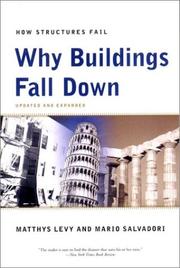
Why buildings fall down
Matthys Levy, Mario George Salvadori · 1992 · 340 pages
As an Amazon Associate we earn from qualifying purchases. Some book links are affiliate links; you pay the same price and we may earn a small commission.
About this book
Once upon a time, seven wonders of the world stood tall and brilliant and, it must have seemed, would stand forever, impervious to time and gravity. Now only one remains—the pyramid at Khufu, in the Egyptian desert near Cairo. All of the others have fallen down. Modern technologies, computerized designs, and new materials have minimized structural failures nearly to the vanishing point. Even so, we can learn from ancient as well as recent history. *Why Buildings Fall Down* chronicles the how and why of the most interesting structural failures in history and especially in the twentieth century. Not even all of the pyramids are still with us. The Pyramid of Meidum has shed 2,500,000 tons of limestone and continues to disintegrate. Beginning there our authors, both world-renowned structural engineers, take us on a guided tour of enlightening structural failures—buildings of all kinds, from ancient domes like Istanbul's Hagia Sophia to the state of the art Hartford Civic Arena, from the man-caused destruction of the Parthenon to the earthquake damage of 1989 in Armenia and San Francisco, the Connecticut Thruway bridge collapse at Mianus, and one of the most fatal structural disasters in American history: the fall of the Hyatt Regency ballroom walkways in Kansas City. Buildings have fallen throughout history whether made of wood, steel, reinforced concrete, or stone. But these failures do respect the laws of physics. All are the result of static load or dynamic forces, earthquakes
Appears in these reading paths


Best Books to Learn Earthquake Engineering and Seismic Design
Best Books on Structural Engineering, in Reading Order
Related reading guides
Reader reviews
Ratings and notes from readers — tagged with how deep into the subject they were.
Loading reviews…