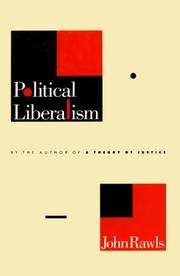
Political liberalism
John Rawls · 1993 · 457 pages
As an Amazon Associate we earn from qualifying purchases. Some book links are affiliate links; you pay the same price and we may earn a small commission.
About this book
In Political Liberalism John Rawls continues and revises the idea of justice as fairness he presented in A Theory of Justice, but changes its philosophical interpretation in a fundamental way. His earlier work assumed what Rawls calls a "well-ordered society," one that is stable, relatively homogenous in its basic moral beliefs, and in which there is broad agreement about what constitutes the good life. Yet in modern democratic society a plurality of incompatible and irreconcilable doctrines - religious, philosophical, and moral - coexist within the framework of democratic institutions. Indeed, free institutions themselves encourage this plurality of doctrines as the normal outgrowth of freedom over time. Recognizing this as a permanent condition of democracy, Rawls therefore asks, how can a stable and just society of free and equal citizens live in concord when deeply divided by these reasonable, but incompatible, doctrines? His answer is based on a redefinition of a "well-ordered society." It is no longer a society united in its basic moral beliefs but in its political conception of justice, and this justice is the focus of an overlapping consensus of reasonable comprehensive doctrines. Justice as fairness is now presented as an example of such a political conception; that it can be the focus of an overlapping consensus means that it can be endorsed by the main religious, philosophical, and moral doctrines that endure over time in a well-ordered society. Such a consensus, R
Appears in these reading paths

The Best Books on Liberalism
The Best Books to Understand John Rawls
Related reading guides
Reader reviews
Ratings and notes from readers — tagged with how deep into the subject they were.
Loading reviews…