Start with Their Eyes Were Watching God. The obvious alternatives both have real advocates: read chronologically and open with Jonah's gourd vine, her 1934 first novel, or open with the folklore in Mules and Men, on the grounds that the ethnography is the foundation everything else is built on. Neither is right for a first-time reader.
Their Eyes Were Watching God is the reason Hurston is read at all today, and it is the book where the two halves of her — the trained anthropologist and the novelist with an ear for spoken language — fuse completely. Janie's voice, the frame of a woman telling her own story to a friend on a porch, the hurricane: it works on first contact in a way the earlier novel does not, and it takes an evening. It also happens to be the shortest route to understanding why the folklore matters, because you meet the material as living speech before you meet it as collected data.
The folklore, second
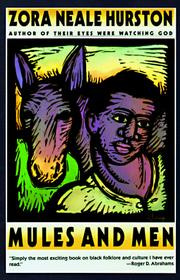
Mules and Men is the book to read next. Hurston went back to Eatonville and to Louisiana with a Barnard anthropology training and collected folktales, work songs and hoodoo practice, then presented them inside a narrative of her own fieldwork rather than as a catalogue. It is the first significant collection of African American folklore assembled by a Black scholar, and it is enormously entertaining.
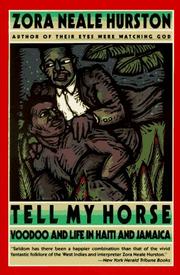
Tell my horse is the companion, from her Caribbean fieldwork in Jamaica and Haiti, and it is stranger — vodou ceremony, political commentary, and the famous photograph of a woman she presented as a zombie. Scholars have long debated how much Hurston shaped her material for narrative effect in both books, and how her position as an outsider funded by a white patron affected what she recorded. That debate is genuine and unresolved; it does not disqualify the books, and it is better read with than without.
The other novels
Jonah's gourd vine comes next, now that you can hear the language. It is a preacher's rise and fall, drawn from her parents' marriage, and its sermon set-piece is extraordinary even where the plot is loose.
Moses, man of the mountain retells Exodus with Moses as a Black conjure man and the Israelites speaking in African American vernacular. It is her most formally daring book and her most uneven, and readers tend to feel strongly in both directions.
Seraph on the Suwanee, a novel is the last one published in her lifetime and the hardest to place: a novel about poor white Floridians, written partly to prove she was not confined to Black subjects. It is generally considered her weakest, and it is where most readers stop. Read it only if you want the full arc.
The memoir, and the late discovery
Dust tracks on a road is her autobiography and comes with a warning. It is charming, funny and evasive — she rearranges dates, skips a decade, and says almost nothing about the two marriages. The wartime publisher also cut passages critical of American foreign policy, restored only in later editions. Get a restored edition and read it as performance rather than record.
Barracoon is the late arrival and belongs at the end. It is her 1931 account of interviews with Cudjo Lewis, believed to be among the last survivors of the final slave ship to reach the United States, and it went unpublished for nearly ninety years because Hurston refused to rewrite his speech into standard English. Publishers wanted it smoothed; she would not. It appeared in 2018 exactly as she wrote it, and knowing that history is part of reading it.
On the disputes
Hurston's reputation has been contested from the start and still is. Richard Wright reviewed Their Eyes Were Watching God harshly in 1937, accusing it of playing to a white audience; Hurston's political conservatism, including her published opposition to the reasoning in Brown v. Board of Education, has troubled admirers ever since; and she died in obscurity before Alice Walker's 1975 essay set the revival in motion. Those arguments are live and this guide does not settle them.
Valerie Boyd's Wrapped in Rainbows is the standard biography. Browse more literary reading paths on Discover.
Follow the full reading path →