Wire wrapping is unusual among crafts in how cheap it is to start and how quickly the results diverge. Two people follow the same project photo and one produces a clean, tight, symmetrical piece while the other produces something that looks like it was made with pliers in a hurry. Almost always the difference is material knowledge rather than dexterity: wrong gauge, wrong temper, marred wire from the wrong jaws, or work-hardened wire that was bent one time too many and snapped.
So the reading order that helps is fundamentals first. A project book will tell you to use twenty-gauge half-hard wire without telling you what half-hard means, why it matters that copper work-hardens as you bend it, or that nylon-jaw pliers exist precisely to stop you scarring the surface. Learn the material and the tools, and the projects stop being copying exercises.
Get the fundamentals down
Denise Peck's Wire style is a good opening because it pairs a clear fundamentals section — wire types, gauges, tempers, the small tool kit, and the core moves like loops, jump rings, spirals and coils — with a set of projects that use them immediately. The technique-then-apply structure is what you want at the start: each project is really a drill for a specific skill.
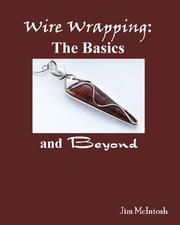
Jim McIntosh's Wire Wrapping focuses squarely on the wrapping technique itself, including the traditional approach of binding stones without solder or glue. Setting a cabochon or an irregular tumbled stone securely in wire alone is the skill that defines the craft, and it is the one that most rewards a book with careful step-by-step instruction rather than a video you have to keep scrubbing back through.
Build volume and speed
Heidi Boyd's Wired beautiful is the book for making a lot of things reasonably quickly — approachable projects, mixed materials, beads and wire together. That matters more than it sounds. Wire technique improves through repetition, and the fastest way to develop clean, consistent wraps is to make thirty of them rather than agonise over one. Use this stage to build muscle memory and to find out which forms you actually enjoy making.
Move toward sculpture
Sharilyn Miller's Wire art jewelry workshop is where the craft turns from assembly into design. Miller works in a bolder, more sculptural idiom — hammered and textured wire, larger forms, hand-forged components — and the book covers the finishing techniques that separate handmade from homemade: hammering to work-harden and flatten, using a mandrel for consistent curves, filing ends, and oxidising and polishing to give the metal depth. This is the point at which you stop following patterns and start designing pieces.
A few things worth knowing before you buy anything. Practise in copper, which is cheap and forgiving, before spending on sterling or gold-filled. Buy three pliers — round-nose, chain-nose and flat-nose — plus flush cutters, and get flush cutters that actually cut flush, because a burr on every wire end is what makes work look amateurish. Understand that dead-soft wire bends easily but holds shape poorly, half-hard holds structure, and every bend hardens the wire further until it eventually breaks. And file or tuck every cut end; a wrapped pendant that scratches the wearer is a failed pendant.
If you like building objects from raw material, the neighbouring jewelry making reading covers soldering and metalwork, which is the natural next expansion. Follow the full path to learn the wire before the patterns.
Follow the full ordered path here: Wire Wrapping Jewelry: The Best Books to Start With.
Ready to learn something deeply?
Build a reading path — free