People come to wildlife biology because they like animals and discover that the job is mostly study design, statistics and paperwork with intense field seasons attached. The animals are real, but so is the fact that a wildlife biologist spends more hours estimating detection probability than watching anything through binoculars.
Be clear about what books can and cannot do here. This career is gated by credentials and experience: a relevant degree, usually a master's for research or agency positions, plus seasonal field technician work that is competitive, poorly paid and how nearly everyone gets in. No reading list substitutes for that, and nobody should promise you a post at the end of it. What these books do is make you competent faster — they are the actual texts assigned in the graduate programmes and used by working biologists, so reading them early tells you honestly whether the quantitative core suits you.
Know your organisms
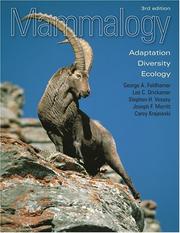
George Feldhamer's Mammalogy is the standard survey — evolution, systematics, physiology, behaviour and the ecology of mammals as a group. It is a large textbook and worth working through rather than reading, because the taxonomic and physiological grounding underpins everything else. If your interest is birds, fish or herpetofauna, substitute the equivalent standard text for that group; the structural role in the path is the same.
Learn to count things properly
This is the part that surprises newcomers, and it is where the field actually lives. Introduction to distance sampling by S. T. Buckland covers the theory and practice of line-transect and point-transect surveys, and above all the central problem: you never detect every animal, and estimating abundance means modelling what you missed. Get this and a lot of published wildlife research becomes legible.
The Wildlife Techniques Manual edited by Nova Silvy is the field's reference work, and the research volume covers study design, capture and marking, radio telemetry, sampling methods and analysis. It is the book to own rather than read cover-to-cover — you go to the relevant chapter when you need to design a specific piece of fieldwork.
The models underneath
Larry Rockwood's Introduction to Population Ecology gives you the theory: growth models, density dependence, life tables, metapopulations, predator-prey and competition dynamics. It is the framework that makes survey data mean something rather than being a list of counts.
Then Occupancy estimation and modeling by Darryl MacKenzie, which is one of the genuinely important methodological books in modern wildlife science. It formalises the fact that not detecting a species is not the same as its absence, and gives you the models that separate occupancy from detectability. Anyone doing camera-trap, acoustic or presence-absence work needs this. It assumes comfort with likelihood-based statistics, so pair it with a solid stats course rather than reading it cold — and learn R alongside, because that is where this work is done.
Conservation and the money
Reed Noss's Saving nature's legacy covers regional conservation planning: reserve design, connectivity, ecosystem-level thinking and the argument for protecting processes rather than individual species. It moves you from measuring populations to deciding what to do about them.
Story Clark's A Field Guide to Conservation Finance is the unglamorous and unusually practical closer — land trusts, easements, funding structures, deal-making. Conservation outcomes are frequently decided by whether someone could assemble the financing, and very few biologists are taught this.
A realistic route: take the statistics seriously, learn R, apply for every seasonal technician job you can, and read Buckland and MacKenzie before your first study design. Follow the full path to build from organism to model to policy.
Follow the full ordered path here: Books to Read on the Way to a Wildlife Biology Career.