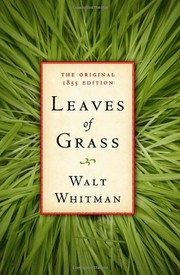
Start with Leaves of Grass, and start specifically with the 1855 first edition. That second half of the sentence is the whole recommendation, because Whitman essentially wrote one book and then rewrote, reordered and expanded it for thirty-seven years across six substantially different editions. Which one you buy determines which poet you meet, and most shops sell the last one by default.
The difference is not cosmetic. The 1855 edition is twelve untitled poems and a preface, about ninety pages, with no author name on the title page — lean, strange and electric, the book that made Emerson write to a stranger to say he had been greeting him at the beginning of a great career. The 1891 to 1892 "deathbed" edition runs to nearly four hundred poems, heavily revised, sorted into thematic clusters, with the early work smoothed, retitled and in places defused. Both are worth reading. Starting with the first one means meeting the poems before the poet had begun managing his own reputation, and it makes the later edition far more interesting when you get there, because the differences are the story.
The practical advice: check the copyright page or the editor's note before you buy. A book called simply Leaves of Grass could be either, and the covers rarely say.
How to read him
Whitman wrote long unmetered lines built on breath and repetition, and they only work aloud. Read every poem out loud, even under your breath, and take three or four at a sitting rather than trying to cover ground. Ten pages an evening is plenty; six to eight weeks for the first book is the right allowance. Readers who try to read Whitman silently and fast almost always report that he is repetitive, and they are not wrong about the words on the page — the repetition is a musical device that does nothing until it is voiced.
Song of Myself is the centre of the 1855 book and the poem everything else radiates from. It is worth reading twice: once straight through without stopping to understand it, and once slowly.
The war poems
Drum-taps and Memoranda during the war, at 84 and 128 pages, read slowly. Whitman spent the Civil War visiting wounded soldiers in Washington hospitals, and this is the work that came out of it — the cosmic expansiveness of 1855 pulled down into individual dying men. Five or six poems at a sitting, aloud, is the right pace even though the book could be finished in an evening.
One practical note: Drum-taps was published separately in 1865 and only later absorbed into Leaves of Grass, so a standalone edition is worth seeking out. The poems in their original sequence read quite differently from the same poems scattered through the later collection. Read Memoranda during the war directly afterwards — it is the prose record of the same hospitals and it makes the poems land harder.
The prose
Specimen days is fragmentary autobiography and reads best a few entries at a time over a month. Democratic vistas is short but densely argued, a genuinely uncomfortable essay in which the great optimist of American democracy looks at the country after the war and is not sure it is working; read it slowly, in two or three sittings.
Franklin Evans, or The Inebriate is the temperance novel Whitman wrote in 1842 and later disowned. It is genuinely quick and genuinely not good. Treat it as an afternoon's curiosity rather than a reading commitment — its only real interest is how completely unlike the poems it is.
Where to stop
Most readers should stop after the war poems. The 1855 Leaves of Grass, Song of Myself read twice, and Drum-taps is the essential Whitman, and it is roughly three hundred pages. Everything after that is for readers who want the man as well as the work.
More poet and author reading orders are on Discover.
Follow the full ordered path here: Walt Whitman Reading Order: Where to Start.
Ready to learn something deeply?
Build a reading path — free