Walt Whitman Reading Order: Where to Start
A Whitman reading order is short and honest about it: he essentially wrote one book, Leaves of Grass, and then rewrote and expanded it for thirty-seven years across six substantially different editions. So the real question is not which title but which edition, and this path answers it — start with the 1855 first edition, then read the poems he added during and after the Civil War, then the prose that explains what he thought the poems were for. There is no long back catalogue here, and padding one out would misrepresent him.
The One Book, and Which Edition
IntermediateRead Whitman at his most concentrated and understand why the edition you choose changes the poet you meet.
▸ Study plan for this stage
Pace: 6–8 weeks, and the pacing instruction matters more than the page count. Whitman wrote long unmetered lines built on breath and repetition, and they only work aloud — read every poem out loud, even if only under your breath, and take three or four at a sitting rather than trying to cover ground. Ten
- Whitman produced six substantially different editions of Leaves of Grass between 1855 and 1892, so the title names a project rather than a fixed text
- The 1855 edition contains twelve untitled poems and a prose preface, and the poem later called 'Song of Myself' takes up roughly a third of it
- The 1855 preface is a manifesto for an American poetry that does not yet exist, and much of it was later cannibalised into poems
- Whitman's line is long, unmetered and organised by breath, parallelism and cataloguing — it is designed for the voice and is nearly inert read silently at speed
- The catalogue — the long accumulating list of trades, bodies, places and people — is his central device, and it is an argument about democracy rather than a stylistic tic
- The 'I' of these poems is deliberately unstable: it absorbs other people, claims to be them, and refuses to stay a single biographical person
- The frank treatment of the body and of male intimacy was scandalous in 1855 and was progressively softened, regrouped and partly hidden across later editions
- What does the 1855 preface claim the American poet should be, and how much of that programme does the poetry actually carry out?
- How does 'Song of Myself' move between the intimate and the panoramic, and what triggers each shift?
- What is a Whitman catalogue doing politically — what does the list form assert about the people in it?
- Who is the 'I' of these poems, and where does the poem tell you it is not simply Walt Whitman of Brooklyn?
- Why does the 1855 edition print no author's name on its title page, and what does the frontispiece portrait do instead?
- Having read it aloud, what does hearing the line give you that reading it silently does not?
- Check the edition before you buy. Look for '1855' or 'first edition' on the cover or copyright page, or an editor's note stating which text is reprinted. This is the single most consequential decision in the path.
- Read the entire 1855 preface first, aloud, in one sitting. It is short, it is a manifesto, and everything after it makes more sense with it in place.
- Read 'Song of Myself' over two weeks, ten or fifteen sections at a time, aloud. Reading it in one go is possible and almost always produces a blur.
- Pick one catalogue passage and read it standing up at full voice. It sounds absurd and it is the fastest way to understand why Whitman wrote in this line.
- Once you have finished, find any later text of 'Song of Myself' — the 1881 or 1891 version — and compare the opening fifty lines with the 1855 original. The revisions are the clearest evidence of what Whitman spent forty years doing.
- Keep a note of the sections you want to return to. With this poem more than any other, the list changes on every reading.
Next up: With the confident, expansive 1855 voice fixed in your ear, the war poems land as what they are — the same poet after three years in military hospitals, writing in a register that expansiveness cannot reach.
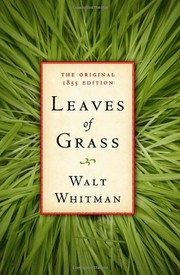
The whole career in one title. Start with the 1855 first edition — twelve untitled poems, no author name on the title page, and the famous preface: it is the leanest, strangest and most electric Whitman. The 1891 deathbed edition is the other common choice, four hundred poems and heavily revised, and worth reading later precisely because the differences are the story.

Available separately, and worth owning on its own because it is a third of the 1855 edition and the poem the rest of American poetry argues with. Read it slowly and aloud after a first pass through Leaves of Grass, not before.
The War Poems
IntermediateRead the work that broke the early confidence, and see what Whitman's hospital years did to his voice.
▸ Study plan for this stage
Pace: 3–4 weeks for 84 and 128 pages, read slowly. Drum-Taps is short enough to finish in an evening and should not be — five or six poems at a sitting, aloud, is the right pace. Read Memoranda During the War directly afterwards. One practical note: Drum-Taps was published separately in 1865 and only late
- Drum-Taps was written across the war and published separately in 1865; its sequence moves from recruiting-day excitement to hospital exhaustion, and the arc is destroyed when the poems are redistributed into thematic clusters
- The Lincoln elegies, including 'When Lilacs Last in the Dooryard Bloom'd', came in the Sequel printed with Drum-Taps and are included in most modern standalone editions
- Whitman spent roughly three years as a volunteer visitor and nurse in Washington hospitals, and the poems come directly out of that work
- The war poems are quieter, shorter-lined and far less certain than the 1855 poems — the confidence that carried the catalogues cannot carry this material and Whitman does not pretend otherwise
- 'The Wound-Dresser' and 'A Sight in Camp in the Daybreak Gray and Dim' are the clearest instances of the change: observation replaces absorption, and the poet stops claiming to be the people he describes
- Memoranda During the War collects his prose notes from the hospitals and is the least mythologising thing he ever wrote
- Reading the prose immediately after the poems shows you the raw material and exactly what the poems added and removed
- How does the sequence of Drum-Taps move, from first poem to last, and what does that arc argue?
- What happens to the Whitman 'I' in the war poems — does it still absorb other people, and if not, what replaces that gesture?
- How does 'When Lilacs Last in the Dooryard Bloom'd' handle Lincoln's death without naming him, and why might Whitman have chosen that?
- What does 'The Wound-Dresser' show the reader that Memoranda During the War tells them, and which is more affecting?
- Where in the Memoranda does Whitman record something the poems could not use?
- Is the postwar Whitman a better poet than the 1855 one? Argue it rather than assuming.
- Read Drum-Taps in its published sequence, in order, without skipping to the famous poems. The sequence is the work, and the standalone edition exists precisely to preserve it.
- Read 'When Lilacs Last in the Dooryard Bloom'd' aloud in full, in one sitting. It is long, formally intricate, and the finest thing he wrote after 1855.
- Pair each of three war poems with a passage from Memoranda During the War covering similar ground. The comparison is the most instructive exercise in this whole path.
- Note every physical detail in the Memoranda — wounds, amputations, letters written for dying men. Whitman's prose is unliterary here on purpose and the plainness is the point.
- Read 'Song of Myself' section 33 or another catalogue passage immediately after finishing Drum-Taps. The distance the poet travelled in ten years is audible in a single reading.
Next up: The Memoranda have already shown you Whitman writing plain prose about what he saw; the last stage turns to the prose in which he argues about what America was becoming, and closes with the one book that sits entirely outside the project.
Published separately in 1865 and only later absorbed into Leaves of Grass, which is why the standalone edition is worth seeking out. The war poems in their original sequence are quieter and more devastated than the same poems scattered through the later Leaves.
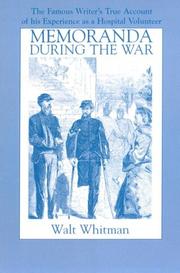
His prose notes from three years as a volunteer nurse in Washington hospitals. Read it directly after Drum-Taps: it is the raw material the poems are made from, and it is the least mythologising thing he ever wrote.
The Prose
IntermediateRead Whitman's arguments about America and about himself, and finish with the one work outside the main project.
▸ Study plan for this stage
Pace: 5–7 weeks for 372, 108 and 147 pages. Specimen Days is fragmentary and reads best a few entries at a time over a month. Democratic Vistas is short but densely argued and should be read slowly, in two or three sittings. Franklin Evans is genuinely quick and genuinely not good; treat it as an afternoo
- Specimen Days is an autobiography made of fragments — Long Island childhood, the war years, then long stretches of convalescent nature notes from the 1870s — and is the best prose Whitman wrote
- The fragmentary form is deliberate: Whitman explicitly refuses a shaped life story, which is consistent with the unstable 'I' of the poems
- The nature notebooks in the second half are the least performed writing he produced and give the most direct access to the man rather than the persona
- Democratic Vistas, from 1871, turns on the postwar republic Whitman had spent twenty years celebrating, calling American society hollow, corrupt and materialist
- It is essential for anyone who assumes Whitman was simply a patriotic celebrant — the essay is the intellectual counterweight to the confidence of 1855
- Democratic Vistas also argues that democracy requires a literature adequate to it and that America does not yet have one, which retroactively frames Leaves of Grass as an attempt to supply the lack
- Franklin Evans is the 1842 temperance novel Whitman later dismissed as hackwork written for money; it is included only as the completist's tail and its interest is entirely in the distance between it and the 1855 preface
- What does Specimen Days refuse to do that an autobiography normally does, and why is that refusal consistent with the poems?
- How do the war entries in Specimen Days differ from those in Memoranda During the War?
- What exactly is Whitman's charge against postwar America in Democratic Vistas, and how far does it retract the 1855 position?
- What does Democratic Vistas think literature is for in a democracy, and does Leaves of Grass meet the standard it sets?
- Reading Franklin Evans, what does it show about Whitman in 1842 that makes the 1855 preface surprising?
- Having read the poems and the prose, what did Whitman actually believe about America — and did he hold one position or several over time?
- Read Specimen Days a handful of entries at a time over several weeks. It is a notebook and it collapses if read like a memoir.
- Read Democratic Vistas immediately after rereading the 1855 preface. Sixteen years apart, the two documents are the same writer arguing with himself, and the pairing is the sharpest thing in this stage.
- Mark the passages in Specimen Days where Whitman writes about trees, weather and convalescence rather than about America. That is where the prose is best and it is easy to skim past.
- Give Franklin Evans two hours and no more. It exists in the path for completeness, and treating it as an obligation is a good way to end the path badly.
- Write a paragraph on which Whitman you would give to someone else — 1855, Drum-Taps, or Democratic Vistas — and why. The choice is a real one and there is no consensus answer.
Next up: This is the end of the path: one book read in the edition that matters, the war poems that broke its confidence, and the prose that argued with everything preceding it — so the natural next move is the 1891 deathbed Leaves of Grass, read as a rival version of a life's work rather than as a definitive text.
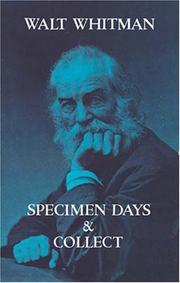
His autobiography by way of fragments — childhood on Long Island, the war, and then years of convalescent nature notes. The best prose he wrote, and the most direct access to the man rather than the persona.
The 1871 essay in which he turns on the postwar republic he had spent twenty years celebrating, calling it hollow and materialist. Essential for anyone who thinks Whitman was simply a patriot, and the intellectual counterweight to Song of Myself.

The 1842 temperance novel he later dismissed as hackwork written for money. Genuinely not good, and included only as the completist's tail: it shows how far the 1855 preface was from anything he had done before.
Discussion
Keep reading
Paths that share books, cover the same subject, or open a related topic.