Sikhism is often flattened in outside accounts into either turbans and swords or vague talk of tolerance, missing both its precise theology and its remarkable history. To understand it you need the teachings of the Gurus, the scripture at the community's heart, and the historical and modern contexts that made Sikhs who they are.
The order here begins with a concise introduction, moves through the founding and history, then to the sacred texts and the questions modern scholarship raises.
Get oriented
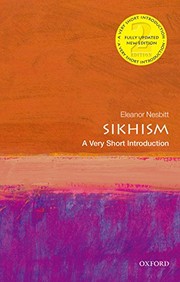
Start with Sikhism: A Very Short Introduction, Eleanor Nesbitt's compact and reliable overview, which lays out beliefs, practice, and identity without assuming prior knowledge. Then The Sikhs, Patwant Singh's sweeping popular history, gives the dramatic narrative sweep of the community from its founding to the present.
The founder and the history
Go next to origins. Gurū Nānak and the Sikh religion, W. H. McLeod's foundational scholarly study of the first Guru, is the classic academic account of how the faith began. For the fuller chronicle, A History of the Sikhs, Vol. 1 and A History of the Sikhs, Vol. 2, Khushwant Singh's standard two-volume history, together trace the community from Guru Nanak through the Sikh empire and into the modern era.
Scripture and modern study
At the heart of Sikhism is its scripture, treated as the living Guru. Bhagat bani in Sri Guru Granth Sahib, a scholarly examination of the non-Sikh saints whose verses the scripture includes, shows its remarkable inclusiveness. The Name of My Beloved: Verses of the Sikh Gurus, Nikky-Guninder Kaur Singh's translation, offers a beautiful and accessible way into the sacred poetry, and The feminine principle in the Sikh vision of the transcendent, her scholarly study, opens the tradition's theology of the divine feminine. For contemporary questions, The Construction of religious boundaries, Harjot Oberoi's influential and debated history, examines how Sikh identity was defined, Sikhism, Gurinder Singh Mann's concise study, gives a current scholarly overview, and The Sikh Diaspora: Tradition and Change in an Immigrant Community, Verne Dusenbery's work, follows Sikhs into the global present.
Read in this order, Sikhism emerges as a coherent faith with a rich scripture and a turbulent, living history. Follow the full path from introduction to modern scholarship.
Follow the full reading path →
Ready to learn something deeply?
Build a reading path — free