The Ming is one of the best-served subjects in Chinese history in English, which creates its own problem: several of the outstanding books cover overlapping ground from different angles, and readers who pick at random end up reading three accounts of the late sixteenth century without ever meeting the early dynasty.
The order below fixes that by going roughly chronologically through the dynasty rather than through the publishing history, and by flagging the two pairs of books that overlap enough that you should probably pick one.
Start with a survey
Ming China, 1368-1644 by John W. Dardess is the compact institutional and political survey — brief, dense and reliable, and the fastest way to acquire the emperors, the bureaucracy and the sequence of crises.
The troubled empire by Timothy Brook is the volume covering the Yuan and Ming in the History of Imperial China series, and it is far more than a textbook chapter. Brook organises it around climate, ecology and the pressures they placed on a large agrarian state, which turns out to be an unusually productive way in.
The commercial and material world
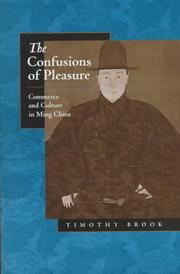
The Confusions of Pleasure is Brook's other Ming book, on commerce, consumption and the anxieties they produced in a society whose official ideology ranked merchants near the bottom. It overlaps with The troubled empire — same historian, same dynasty — but the questions are different enough that reading both is worthwhile if you like his work. If you only want one, take The troubled empire for the whole dynasty and The Confusions of Pleasure for the late Ming specifically.
Superfluous things by Craig Clunas is the companion on objects and taste: how late Ming elites used connoisseurship, furniture, gardens and manuals of discrimination to defend social distinctions that money was eroding. It is a short book with a long reach.
1587 a Year of No Significance by Ray Huang is the famous one, and it is a genuine oddity — a portrait of the dynasty through a single unremarkable year and six people living in it, arguing that the Ming state had by then become structurally incapable of governing itself. Some historians consider its central thesis overstated. Nearly all of them concede it is a marvellous book.
Emperors and fleets
Perpetual Happiness by Shih-Shan Henry Tsai is the biography of the Yongle Emperor, who usurped the throne, moved the capital to Beijing, commissioned the Forbidden City, and sent the treasure fleets out. His reign name gives the book its title.
Two books cover those fleets. When China ruled the seas by Louise Levathes is the popular account and the more enjoyable read; Zheng He by Edward L. Dreyer is the scholarly one, and it is considerably more sceptical about the size of the ships and the reach of the voyages. Take Dreyer if you want the evidence, Levathes if you want the story, and be aware that this topic has attracted a great deal of pseudohistory — the claim that Chinese fleets reached the Americas, popularised by Gavin Menzies, is rejected by essentially every specialist.
The encounter with Europe
The memory palace of Matteo Ricci by Jonathan D. Spence is the best-written book on this list, and possibly the best-written book about Ming China in English. It reconstructs the Jesuit missionary's life in China through the memory-training system he taught, using each image as a door into a different aspect of the late Ming world. It is not a conventional history and should not be your only one.
The collapse
A dragon's head and a serpent's tail by Kenneth Swope covers the Ming intervention in Korea against the Japanese invasions of the 1590s — an enormously expensive war that is usually treated as a Korean subject and rarely as a Ming one. The Military Collapse of China's Ming Dynasty, 1620-44 is his account of the end, and it argues that the Ming military performed considerably better than the standard narrative of terminal decay allows.
The great enterprise by Frederic E. Wakeman is the monumental study of the Manchu conquest and the founding of the Qing. It runs to two large volumes and well over a thousand pages, and it is the definitive treatment; nobody should feel obliged to read it cover to cover before moving on to the Qing dynasty.
The full ordered path, with study notes at each stage, is below.
Follow the full ordered path here: The Ming Dynasty: The Best Books to Read, in Order.