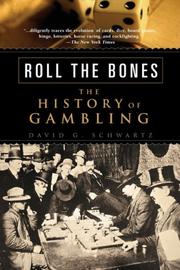
Gambling is one of the few businesses whose product is a known negative-expectation transaction, so the whole industry is an exercise in making a mathematically losing proposition feel worth repeating. Read it from the operator's side and in that order: the long history and the Nevada corporate takeover, how a casino floor is actually run, the slot machine as an engineered behavioural device, the mathematics and the few people who have beaten it, then the online and sports-betting expansion. Start with Roll the Bones.
The thing that trips readers up is that this subject has a large popular literature of first-person yarns, and those are not the same as documented accounts. Ben Mezrich's Bringing Down the House, the MIT blackjack story, is the best-known example and is deliberately not on this list: its embellishments have been widely reported, including by participants, and it is a poor basis for understanding either card counting or casino countermeasures. Where a book below is advocacy or a case for the prosecution, this article says so.
How the business got here
Roll the Bones is the standard general history, by the former director of the gaming research centre at the University of Nevada, Las Vegas — dice in antiquity through to Macau and online, 592 pages in our record and the reference point for everything after it. Suburban Xanadu is the same author's academic study of how the casino resort format was invented and sold as respectable middle-class leisure, which is where the industry's modern revenue mix comes from; our catalogue lists his name with the initial inverted.
The money and the power is Sally Denton and Roger Morris on Las Vegas as a laundering and political-financing machine from 1947 to 2000, naming operators, mob figures and politicians. It is documented investigative history rather than mob legend, and it is firmly a case for the prosecution — read it as one.
How a casino floor is actually run
Super Casino is a reporter given long access to the Las Vegas Hilton during the corporate era, and the most complete inside account of running a casino as a business rather than as a story. Whale Hunt in the Desert narrows to the high-roller trade through a casino host: how a whale is valued, comped, flown in and extended credit. It is the clearest illustration anywhere of a casino treating a customer as an expected-value calculation.
Casino is Nicholas Pileggi's reconstruction of the Teamsters-financed Stardust and the skim, built from FBI wiretaps and interviews — better sourced than its film reputation suggests, and a picture of the industry immediately before the regulatory clean-up.
The machine is the product
Slots and lotteries, not table games, are where most gambling revenue comes from. Addiction by design is the most important book on this list: fifteen years of fieldwork with machine gamblers and with the designers, regulators and industry conferences that shape the machines, showing addiction as a product specification rather than a side effect. Near-miss design, losses disguised as wins and time-on-device optimisation all get named here.
Selling hope is Charles Clotfelter and Philip Cook's economic analysis of state lotteries — who plays, what the implicit tax rate is, how states market them. It dates from 1989 and remains the standard scholarly treatment of the largest legal gambling channel in America. For a Dollar and a Dream is the modern update, a historian's account of how lotteries were sold to voters as painless revenue for schools and what the money actually did. Our record for it carries no page count.
The mathematics, and the people who beat it
The perfect bet is a mathematician's survey of every serious attempt to beat gambling with science — roulette computers, card counting, betting syndicates, algorithmic sports models — and the best explanation of where an edge can exist and why almost every claimed one does not. Beat the Dealer is the primary document: the 1962 book that proved blackjack could be beaten and forced the industry to change its rules, shuffling and surveillance. Read it for the operator's reaction as much as for the system.
Online, offshore and sports betting
Cutting the Wire is the history of American attempts to regulate gambling across communications wires, from telegraph race wires to the Wire Act. It predates the modern legal sports-betting era, which is exactly why it explains the statutory machinery all of that turns on. Gaming the game is a criminologist's reconstruction of the Tim Donaghy NBA betting scandal and the syndicate around it, built on court records — the documented account of sports betting corruption rather than the imagined one. Billion Dollar Fantasy is the business history of DraftKings and FanDuel, written close to its subjects.
One caution on this last stage: it is the fastest-dating material here. The legal position described in any of these books has already moved, so read them for mechanics and incentives rather than for current rules.
The full ordered list, with each record, is on the gambling industry path.