Defence contracting is not a market in the ordinary sense: one buyer, a handful of qualified sellers, contracts written to reimburse cost rather than reward efficiency, and a requirements process that can outlast the threat it was written for. The order that works is where the permanent arms industry came from, then how the buying machinery actually operates, then who the companies are, and only then whether the arrangement can still produce what a modern war would need. Start with The Arsenal of Democracy.
The trap is that almost every book here is written by someone with a position — an insider, a reformer, a prosecutor, a reporter — and meeting the polemics before you can test them is how people end up with strong opinions and no mechanism. This list puts three standpoints on the same institution in the opening stage deliberately, then spends its middle on how procurement works rather than on verdicts about it.
Where the industry came from
The Arsenal of Democracy is narrative business history: A. J. Baime on Ford's Willow Run bomber plant and the industrial mobilisation of 1941-45, which is where the modern relationship between the government and large manufacturers begins. It is admiring in tone, and it is the founding case that mass production could be applied to weapons.
Against it, War is a racket — a 1935 pamphlet by Smedley Butler, a Marine Corps general, and only 51 pages in our record — argues that war is conducted for corporate profit. It is entirely polemical and it is the ur-text nearly every later critique is quoting second-hand, which is the reason to read it in the original.
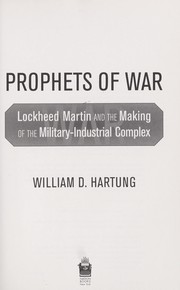
Prophets of war is William D. Hartung's corporate history of Lockheed Martin, from the 1930s through the F-35, and the best single account of how one prime contractor's lobbying, employment footprint and political relationships work. Hartung directs an arms-control policy programme and writes as a critic; the documentary record underneath is solid.
Procurement as a machine
Augustine's Laws and Major System Development Programs is the edition our catalogue holds of Norman Augustine's satirical laws of aerospace management, including the extrapolation that one aircraft will eventually consume the entire defence budget. Augustine ran Lockheed Martin, which is what makes the diagnosis land. Our record carries no page count and no ISBN.
Then The Pentagon wars, James G. Burton's first-hand account of trying to run live-fire survivability tests on the Bradley Fighting Vehicle against institutional resistance — a participant's account with a grievance, and the clearest illustration in print of captured testing. Boyd is Robert Coram's biography of John Boyd and the Fighter Mafia, whose reform campaign produced the F-16; it is hagiographic in places and disputed by aviation historians on several claims, so read it for the reform argument rather than as settled aviation history.
Skunk Works is the counterweight: Ben Rich and Leo Janos on Lockheed's U-2, SR-71 and F-117 programmes, and the best description available of what a small team with real authority can deliver. Our catalogue record for it has a mangled author field, listing a run-together third name alongside the two real authors.
The contractors, and the privatisation of war
Read Corporate Warriors first in this group. P. W. Singer's scholarly study of the private military industry gives you a taxonomy of firm types and an analysis of what outsourcing does to state control of force, which is the frame the reported books need. The Iron Triangle is Dan Briody on the Carlyle Group and the revolving door between senior office, private equity and defence holdings. Blackwater is Jeremy Scahill's openly adversarial investigation of the best-known private security contractor; its factual core on contracts and incidents is what has held up, and its catalogue record carries a Spanish translator in the author field. Spies for Hire covers contracted intelligence, the least-examined corner of the subject.
Can it build what the next war needs?
The Pentagon's Brain: An Uncensored History of DARPA is Annie Jacobsen on how the state funds risky research; she is a reporter rather than a defence analyst and some of her sourcing has been challenged. Wired for war was the first serious general treatment of military robotics, written when armed drones were novel — our record carries neither a year nor a page count, and the book is now partly historical, which makes it a useful set of predictions to score.
Finish with The Kill Chain, Christian Brose's argument that the acquisition system cannot produce the networked, expendable systems a peer conflict demands. Brose was a Senate Armed Services staff director and then went to a defence-technology company, so he has an interest in the outcome. One caution about our record: it lists 161 pages, roughly half the trade edition, so it may be a partial record. Do not confuse this book with Andrew Cockburn's Kill Chain, a different book about drone targeting with a confusably similar title.
The full sequence, with each record and its length, is on the defense industry path.