Start with Three parts dead. Then ignore the numbers, because they are the single most effective trap in modern fantasy publishing.
The titles count down — three, two, then a five, a first, a four — and readers reasonably assume the countdown is the sequence. It is not. The numbers encode internal chronology, so anyone taking them at face value opens with Last First Snow, which is chronologically earliest and by some distance the worst place to begin. Publication order is the reading order: Three parts dead, Two serpents rise, Full Fathom Five, Last First Snow, Four roads cross.
The reason to start where you are told is concrete rather than traditional. Only the first book was written as an introduction to the system. Gladstone drops you into a working legal-necromantic world with no glossary and expects you to infer it, and Three parts dead is the only volume where the protagonist is learning the rules at the same speed you are — a junior associate at a Craft firm, on her first case. Every later book assumes you already know how the world works.
What Craft actually is
Contract law practised as necromancy. Soulstuff is currency, obligations are literally binding, and a wizard is a lawyer with standing. Gods are counterparties: they take deposits of faith, incur liabilities, and can be restructured or foreclosed on when they default. The God Wars, in which humans with Craft fought and killed most of the gods, are the aftermath every book is set in.
The first sixty pages are the steepest. In Three parts dead a god has died and the mystery is an audit, with a city's water pressure and heat as the stakes. Read at 25 to 30 pages a day through the opening and it accelerates sharply.
The core
Two serpents rise and Full Fathom Five. Expect a jolt at the start of each: the sequence changes protagonist, city and register every volume, and there is no returning cast to ease you in. That is the design, not a flaw.
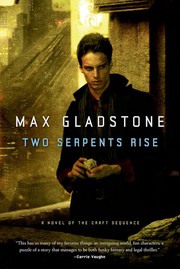
Two serpents rise moves to a city that killed its own gods rather than banking with them and now has to source water without divine intervention, with human sacrifice presented as an infrastructure policy that got replaced by a different infrastructure policy. It happens to be second in both publication and chronology, which is a coincidence — do not generalise from it.
Full Fathom Five is the most satirical of the six: an offshore tax haven that manufactures idols, artificial godlets with no will, held for foreign clients. The joke only works if soul-debt and faith-as-deposit are already familiar, which is precisely why it sits third.
Where the ordering argument gets settled
Last First Snow, then Four roads cross.
Last First Snow is the whole case for publication order in one book. Read first, it is a competent novel about a city and a riot. Read fourth, it is devastating, because you already know exactly where its two leads end up and what their city becomes. Every hope a character holds has already been foreclosed in a book you have read. That asymmetry cannot be recovered by any other arrangement.
Four roads cross is the direct sequel to Three parts dead, several years on, and pays off threads from all four preceding volumes at once — which is the other practical argument that publication order does something the numbers cannot. It is also the most plot-dense of the six.
Where chronological order does help: on a reread. Taking them by the numbers the second time gives you the God Wars as continuous history.
The last two, and where to stop
The Ruin of Angels closes the original run. It is the longest at around 550 pages and the strangest structurally, set in an occupied city with a second, older city folded inside it and legally unmentionable. It assumes Full Fathom Five specifically, since its lead returns from that book.
Dead Country is short and reads quickly, but it is not a sixth standalone — it opens the Craft Wars, a directly serialised continuation, and the reading contract changes from here. The books no longer resolve independently.
So: stop after The Ruin of Angels if you want a finished thing. Continue into Dead Country knowing you are starting something unfinished. Either way the numbers stay ignored. For more sequences with the ordering worked out, browse the site.
Follow the full ordered path here: The Craft Sequence Reading Order: Where to Start.