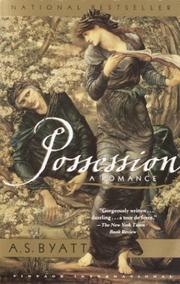
Start with Possession. It is neither her first book nor the beginning of anything, but it is the one that teaches you how Byatt works while also being a detective story: two present-day academics chasing a Victorian love affair through letters nobody was meant to read.
The obvious alternative is The virgin in the garden, the earliest of her major novels and the opening of the four-book Frederica sequence. Do not begin there. It is the densest and slowest thing she wrote, it is deliberately built as setup for a sequence rather than as a self-contained novel, and it is where nearly everyone who abandons Byatt abandons her. Take the sequence later, when you already trust her.
One warning before you open Possession. Byatt wrote the Victorian poems, letters and journals herself, and they take up a large share of the page count. They are the evidence, not the decoration — the modern characters are reading them for clues, so a reader who skims them is skipping the plot while the detectives on the page do not. People who bounce off this novel almost always do it around page two hundred, having skipped the verse and concluded nothing is happening. Decide in advance to read it slowly. Pair it with The Djinn in the Nightingale's Eye, which collects five stories, two of which appear inside Possession as the invented poet's own work.
Next: the historical fictions
Angels and Insects is two novellas, and it is the cheapest way to find out whether you enjoy the Byatt habit of stopping a story to explain something. In the first, an entomologist studies an ant colony and marries into a household described in the same vocabulary; the revelation is prepared through natural history rather than psychology.
Then The Children's Book, 600-odd pages that open in a museum basement and close in the trenches. A children's author writes a private ongoing story for each of her own children, and the novel's real subject is what that costs them. Be warned that Byatt will halt it for ten pages at a time to explain pottery glazes or Fabian politics. Angels and Insects trains you for that habit at a length where it stays charming, which is why it comes first.
The Frederica Quartet, in order
Publication order and internal chronology agree here, so there is no decision to make: The virgin in the garden, Still Life, Babel Tower, A whistling woman. About 1,870 pages, written across twenty-four years, and a social history of England from the 1953 coronation to the end of the sixties.
The honest warning is that it does not become gripping until the third volume. Read the first two back to back with no gap — they were conceived as one long novel, and Still Life resolves what the first book only sets up. If you stall in the opening volume, read its last hundred pages and start Still Life rather than quitting; abandoning at volume one is the standard way readers lose Byatt for good. Babel Tower is the payoff: an obscenity trial, a custody fight, and an entire invented novel running inside the book, which is the Possession method aimed at the 1960s.
The difficult late books
The biographer's tale is a deliberate anti-Possession — the same appetite for documents, no romance, no solution, and a researcher who ends with less the harder he works. It fragments into other people's papers, and skimming those makes the book incoherent. Elementals is short stories arranged around two opposing elements; read them in pairs rather than front to back. Ragnarok is 192 pages in which the Norse gods do not develop, they simply end, with a closing essay explaining why she refuses to novelise a myth.
Where to stop
Most readers can stop after the historical fictions and have the best of her. Finish the quartet only if Babel Tower sounds like your kind of book; it is the volume the sequence exists for. If you want another novelist of the same era whose entry point matters just as much, J.M. Coetzee is the obvious next case. More literary reading orders are on Discover.
Follow the full ordered path here: A.S. Byatt Reading Order: Where to Start.
Ready to learn something deeply?
Build a reading path — free