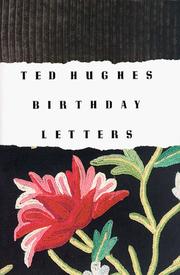
Start with The Hawk in the Rain, his 1957 debut, and read Birthday letters straight after it. That pairing beats the obvious alternative of working forward chronologically, because it puts the two books everyone actually arrives for side by side: the poet who turns up fully formed at twenty-seven with the best animal poems in modern English, and the same man at sixty-eight finally writing the one book his readers had been waiting forty years for.
The biography is unavoidable, so take it plainly and then move on. Hughes married the American poet Sylvia Plath in 1956. They separated in 1962 and she died by suicide in February 1963. As her husband he inherited and controlled her estate and her papers, edited the posthumous Ariel and the collected poems, and has stated that he destroyed the journal covering the final months of her life and that another volume went missing. Birthday letters, published in 1998 months before his own death, is his account of the marriage. Those are the facts; the arguments about them have run for sixty years and this guide does not adjudicate them.
Stage one: the debut and the last book
The Hawk in the Rain is fifty-two pages and needs no preparation at all. The Thought-Fox, The Jaguar and the title poem are here. Read them aloud — the early line is stressed and physical, built out of heavy consonant clusters, and it is half-dead on the page. The Thought-Fox is a poem about writing the poem, and once you see how it works the rest of the animal poems open.
Birthday letters is eighty-eight poems addressed directly to Plath in the second person, in a much looser and more conversational line than anything else he wrote. Take a handful at a time over three weeks rather than reading it as a narrative. Several of the poems answer specific Plath poems, and spotting one changes how you read the earlier poem.
Stage two: the mythic middle, where he lost half his readers
Lupercal from 1960 is the last of the well-made Hughes: Hawk Roosting, View of a Pig, Pike. If you only ever read one Hughes poem most people would send you to Hawk Roosting, which is spoken by the hawk and is either a poem about nature or a poem about fascism depending on who you ask.
Wodwo from 1967 is the transitional book and is deliberately a mess of forms — poems, short stories and a radio play. Hughes asked that it be read as a single work in the printed order, so do that rather than dipping.
Crow, published in 1970, is where the readership splits. The lyric is abandoned for a flat, brutal, folk-tale voice; God is incompetent, creation is a series of accidents, and Crow survives everything by refusing to be improved by it. Two warnings. First, it is unfinished and openly so — Hughes stopped work on the sequence in 1969 and published what existed, so the book you hold is a fragment of a planned epic. Second, read no more than five or six poems at a sitting. It is relentless by design, and forty pages in an evening flattens the effect into monotony.
Stage three: back down into a Devon field
Season songs began as poems for children and Hughes then let them grow up. They are simpler than Crow and much stranger than they first look, and they reward being read at roughly the time of year they describe.
Moortown diary is a farming journal in verse, written fast and barely revised, recording lambing, calving, injury and death on the Devon farm Hughes worked. Nothing is aestheticised: difficult births, dead lambs, maggots, mud. Read the notes at the back as you go, because they identify the animals and events the poems assume. This is the mode that seeded a whole contemporary shelf of British nature writing.
The rest, and one catalogue warning
The iron man is the children's book and is genuinely good on its own terms. Poetry in the making is his broadcast talks on writing, and is the clearest short statement of his method anyone has written.
One honest note about our catalogue: the record listed here as Ted Hughes' Tales from Ovid resolved to a stage adaptation credited to Tim Supple rather than to Hughes's own 1997 verse translations of Ovid. If you want the poems, look for the Hughes book of that title specifically. His official verse as Poet Laureate, a post he held from 1984 until his death, is not in this path and you are not missing anything.
Browse more poetry reading paths on Discover.
Follow the full ordered path here: Ted Hughes Reading Order: Where to Start.