Start with Solaris. It is the book Lem is famous for and, more usefully, the clearest single statement of the theme every other book on this path approaches from a different angle: that a genuinely alien mind may be permanently unintelligible to us, and that contact may be impossible in principle rather than in practice.
The obvious alternative is to start with the comic work, and there is a real case for it — readers who know only Solaris have met about half of Lem, and the half they have missed is funnier and stranger. But the comedy is easier to enjoy once you know what it is a comedy about, and The Futurological Congress in particular depends on knowing the register it is corrupting. Start with Solaris, then go straight to the jokes.
The translation warning, which comes before any recommendation
Lem wrote in Polish. The English editions of his work took different routes into English, and some were made from intermediate translations in other languages rather than from the Polish, with real losses along the way. Solaris has the most contested history of all, with more than one English version in circulation and a long-running argument about which one represents the book.
This matters most in the comic work, which is built on puns, invented words and mock-archaic diction — there the English text is a rewriting rather than a rendering, and a second-hand version is noticeably flatter.
The practical advice is not to trust a name. Read a page of whatever edition you can find before committing, and if the sentences feel flat, suspect the route rather than the author.
Start with Solaris
229 pages, but read it slower than that suggests: roughly half the book is lectures, library scenes and summaries of an invented scientific literature, and skimming those is skipping the argument. A sentient ocean covering a planet responds to a research station's probing by producing physical copies of the scientists' dead. The visitors are not ghosts and not punishment, and the refusal to explain their purpose is the novel's discipline. The film adaptations foreground the romance; the book is much colder than its screen reputation.
The comic Lem
The Cyberiad, then Star Diaries, then The Futurological Congress.
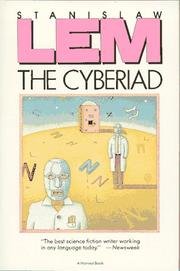
The Cyberiad is a cycle of fables about two robot constructors who build machines to solve absurd problems, told in the register of a medieval romance. Read two or three at a time rather than straight through; the verbal density is exhausting in bulk. The comedy is intellectual — the jokes are about logic, probability, engineering and the pretensions of scholarship — and the wordplay is the substance rather than the surface.
Star Diaries introduces Ijon Tichy, a Munchausen of space whose voyages include the most famous time-loop story in science fiction. The Futurological Congress is Tichy in a hallucinogenic satire on a chemically pacified future, and it is where the comedy turns genuinely bleak. Reading the sunnier books first is deliberate.
The space novels
The Invincible, More Tales of Pirx the Pilot, Return from the Stars. These are the most conventionally structured novels here and the easiest to read — actual plots, actual crews, actual jeopardy.
Two catalogue notes. Our listing for The Invincible carries a marketplace-style title with a date appended; it is the ordinary novel about a cruiser investigating a lost ship, and the mangled title is an artefact rather than a different edition. And the Pirx volume here is a later collection rather than the first one; the stories stand alone, but be aware there is more Pirx material than this book contains.
The Invincible poses the Solaris problem in a form that can shoot back — evolved machine swarms with no mind to speak to — and its idea of non-biological things evolving under selection pressure is the real payload. Return from the Stars, about an astronaut coming home to an Earth that has surgically removed aggression from its population, is the most emotionally direct thing Lem wrote.
The sombre novels
His Master's Voice, Fiasco, Memoirs Found in a Bathtub. If you stall anywhere on this path, it will be here.
His Master's Voice is the Solaris argument made rigorous: scientists fail to decode a signal from space, and the novel becomes an essay on how much of any interpretation is projection. Fiasco is his last novel and the bleakest, and reads as the final verdict — humanity achieves contact and destroys what it contacts, largely through its own certainty. Memoirs Found in a Bathtub is the most formally difficult book here, a nightmare inside an underground bureaucracy where every document may be a forgery, written from inside a surveillance state. Readers find it brilliant or unbearable.
The experiments and the philosophy
A Perfect Vacuum is a collection of reviews of books that do not exist, including a review of itself — more ideas per page than the novels. Summa technologiae is a genuine 1964 treatise on where technology is heading, written before almost all of the technology it discusses existed, and it is the hardest reading here in the ordinary sense. It is also the intellectual source of most of the fiction, which is why it closes the path rather than opening it.
Where to stop
Solaris, The Cyberiad and His Master's Voice give you the whole writer in three books. More science fiction paths are on Discover.
Follow the full ordered path here: Stanislaw Lem Reading Order: Where to Start.