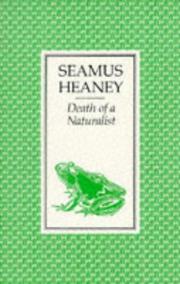
Start with Death of a naturalist, his 1966 debut, and read the collections in publication order. The alternative — a Selected Poems — is the standard advice and this path argues against it, because Heaney's fifty-year arc is the thing worth having, and an anthology flattens it into a set of greatest hits with the development removed.
The debut is 57 pages and should take about two weeks. That ratio is not a mistake. A poetry collection is not read at prose speed: three or four poems a sitting, each read aloud twice, is the right rate. Heaney's early poems are heavily consonantal, Anglo-Saxon rather than Latinate, and built to be spoken — half their effect is in the mouth. Read the book in order rather than dipping, because the arrangement moves outward from childhood and is doing work.
The ground
Death of a naturalist is mud, frogspawn, a father digging, a boy's small terrors, all in County Derry. Digging is the founding metaphor: the pen against the spade, and the son who will not inherit the trade. The physical labour of farm work becomes the craft standard against which writing gets measured, and it stays true for fifty years. It was published two or three years before the Troubles began, which makes it the last book he wrote from an unpolitical position.
The bog poems, and the argument about them
Door into the dark, Wintering out, then North.
Door into the dark stays close to the first book in subject but is darker and more inward. Wintering out turns to place-names and the sectarian geography they encode, where a townland name becomes evidence of who was there first. Then North, which needs longer than the other two and needs preparation: spend an hour on a short factual account of the civil rights marches, internment and Bloody Sunday before you open it, because the poems were written into that and do not explain themselves.
North uses Iron Age bodies found preserved in Jutland bogs — sacrificial victims of ritual killing — as a way of looking at contemporary sectarian murder. The bog is the model: things go in and come out unchanged centuries later, which is Heaney's figure for historical memory.
The controversy is real and fifty years old. Heaney has been accused of aestheticising violence, of giving atrocity a mythic frame that quietly excuses it and of turning murdered people into imagery. The counter-argument is that no other available register let a poet write about it at all, that the mythic frame is what made the subject approachable rather than what excused it, and that the book knows its own risk. The argument has not settled, and reading North without it in view is reading half the book.
The middle books
Field work, Station Island, The haw lantern.
Field work feels like a release after North: longer lines, more air, and elegies for real people killed in the Troubles that are personal rather than mythic — the opposite of the earlier method. Station Island is the hardest structurally, a Dantean pilgrimage in which dead friends, relatives and writers interrogate the poet about his own choices; read its central sequence straight through in two or three sittings, since it works as narrative. It is also the most self-accusing thing he wrote, and it puts his critics' charge directly into a poem. The haw lantern is spare and parable-like, with a great sonnet sequence on his mother's death that should be read as a unit.
Across these three books Heaney finds a way to be a political poet without being a spokesman, which is the career's central problem solved.
The late radiance
Seeing things, The Spirit Level, District and circle, Human chain.
Seeing things is the hinge: after his father's death the poems literally start to float, and weight gives way to air. District and circle returns to the tools and turf of the debut with fifty years of hindsight, and the rhyme with the first book is the whole point. Human chain, written after a stroke, is short, frail and unbearably good on inheritance; read it last and read it fast enough that it lands as a whole.
This is where publication order pays off completely. The lightness only reads as achievement if you carried the weight of the earlier books.
Beyond the collections
Beowulf and Preoccupations. The translation reads far faster than a collection and is a genuine Heaney poem as much as a translation — the Ulster idiom is unmistakable once you know the early books. Preoccupations collects his prose from the first decade, including essays on his own beginnings and on the bog poems, and is the best available gloss on everything before it.
More poetry reading paths are on Discover.
Follow the full ordered path here: Seamus Heaney Reading Order: Where to Start.