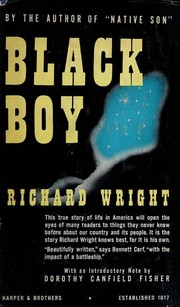
Start with Black Boy. The obvious alternative is Native Son, the 1940 novel that made Wright the most famous Black writer in America and is still the book on every syllabus. Here is the case against opening there: Native Son is built around Bigger Thomas, a protagonist Wright constructed specifically to be difficult to sympathise with, and it makes its argument through a long courtroom section that many readers experience as a lecture. Readers who meet Bigger cold often come away confusing the book's diagnosis with its author's opinion.
Black Boy solves that. It is Wright's account of his own Mississippi childhood — hunger, family violence, the daily calibration of how much of himself he could show a white employer without being killed — and it supplies the ground Native Son stands on. Read it first and Bigger stops being a thesis and becomes an argument you can weigh.
One thing to settle before you buy a copy, because almost nobody mentions it. Black Boy as published in 1945 is only the first half of the book Wright wrote. The Book-of-the-Month Club required that the Chicago section be cut, so the published book ends with Wright leaving the South. The remainder appeared separately in 1977 as American Hunger, covering Chicago, the factory jobs, and his years in and break from the Communist Party. Restored editions now print both parts together. Read them in sequence regardless of which edition you find — Black Boy then American Hunger — because the second half is where the book's optimism gets withdrawn.
The fiction, in order
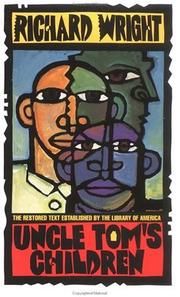
Uncle Tom's Children came first, in 1938: five novellas of Southern violence and resistance. Wright later said he had made a mistake with it — that he had written a book "even bankers' daughters could read and weep over" — and Native Son was his deliberate correction. Reading the two in that order lets you watch a writer decide to stop being consoling.
Native Son comes next, and here the editions problem returns. The 1940 text was expurgated at the publisher's request; the Library of America restored Wright's original in 1991, and the restored version is noticeably harsher, particularly in the early scenes. Take the restored text.
The Outsider, from 1953, is the Paris novel — Wright's existentialist book, written after years among Sartre and Beauvoir. Its reputation is genuinely divided. Some readers consider it his most intellectually ambitious work; others find the philosophy pasted onto the plot. Read it after the memoirs, when you know what he had been through to arrive at it.
The Man Who Lived Underground is the late arrival: a novel Wright wrote in 1941 and could not place, published in full only in 2021. A shortened version circulated for decades as a story. The complete novel is a genuine discovery and, for some critics, the best formal writing he did — a claim that could not be tested until recently.
The nonfiction of the exile years
Black power is Wright's 1954 account of travelling in the Gold Coast on the eve of Ghanaian independence, and White man, listen! collects the lectures he gave across Europe. Both are travel and polemic at once, and both are contested. Critics then and since have argued about how much Wright understood of the societies he visited and how much he read his American formation into them; others regard the books as pioneering Black transnational thought. That argument is unresolved and worth knowing about rather than settling here.
The same applies to his reputation generally. James Baldwin's essays attacking Native Son as protest fiction, and Ralph Ellison's later distancing, reshaped how Wright was taught for a generation; more recent scholarship has pushed back and restored him. Neither verdict is neutral, and it is better to read the books with the dispute in view than to inherit either side of it.
Where to stop
The core is three books: Black Boy, American Hunger, Native Son. Add Uncle Tom's Children and The Man Who Lived Underground if the fiction is what holds you, and the exile nonfiction if the politics is. Hazel Rowley's Richard Wright is the standard biography and is even-handed about the Paris years. Browse more literary reading paths on Discover.
Follow the full reading path →
Ready to learn something deeply?
Build a reading path — free