Start with Letters to a young poet. It is 101 pages of prose, it can be found in a dozen editions, and it states plainly the position that every Rilke poem is written from: that art is not a career choice but a test of whether you could live without making it, and that difficulty is a sign you are in the right place rather than a problem to be solved.
The obvious alternative is to start with Duino Elegies, because that is the work Rilke is famous for. Do not. The Elegies are ten long, deliberately difficult poems about the limits of what praise can do in the face of death, and readers who meet them cold usually decide the difficulty is decoration. Meet them last and they read as the end of an argument you have been following for four stages.
Read the prose first
Letters to a young poet, then The Notebooks of Malte Laurids Briggs — catalogued here under that spelling, published in most editions as The Notebooks of Malte Laurids Brigge. The Notebooks is a poet's notebook wearing a novel's clothes: a narrator, a Paris, and almost no story. Its actual subject is learning to see, which is exactly what the Paris-era poems will go on to perform. These two books are the argument; the poems are the practice.
Neither has a plot to lose your place in, so read slowly on purpose. One letter a sitting, ten sittings. Two or three fragments of the Notebooks at a time.
A translation note that matters more than any recommendation
Rilke wrote in German, and every English Rilke is a strong interpretation rather than a transcription. Versions of the same poem differ enormously in feel, and the divergence is widest in the late sequences, where the abstract nouns and compound coinages live.
The practical advice is not to trust anyone's favourite. Before you buy, open two editions to the same poem and read both pages aloud. The one that sounds alive in your mouth is the one to spend a month with. This is the cheapest possible way to find out what you are getting, and it takes five minutes in a bookshop.
The early poems
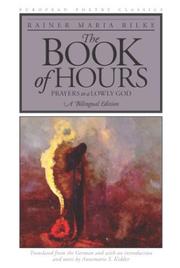
The book of hours, then The Book of Images. The Book of Hours addresses a God who is unfinished and is being built by the person praying, which inverts the usual direction of devotional poetry. It is chanted, incantatory, cumulative work, and it is the most immediately pleasurable thing Rilke wrote. Read it aloud; it will not survive being read silently at prose speed. The Book of Images is the transitional book, where the chanting loosens and individual poems start standing on their own.
The thing-poems
The rose window and other verse from New poems is a selection rather than the complete two-part New Poems, so you are meeting the mode rather than the whole collection. The mode is the point: look at one object until it looks back, and let the poem be the looking. Rodin taught Rilke to treat a poem as a made object with surfaces, and the self almost vanishes from these pages — the sharpest possible contrast with the praying speaker of The book of hours.
Read Letters on Cézanne alongside them rather than after. It is 98 pages of short letters to his wife, watching a painter solve the same problem in another medium, and it is the best available gloss on his own method.
The late sequences
Duino Elegies first, then Sonnets to Orpheus, in that order and close together, because that is the order they were completed in. Both arrived after a decade of near-silence, within weeks of each other. The angel of the Elegies is not consoling and not Christian; reading it as comfort wrecks the sequence. The Sonnets are the affirmative half of the same burst, fifty-five short poems written in a matter of days.
Understanding them on a first pass is not the goal. The goal is to have read them once so the second reading has somewhere to stand.
The deeper cuts
Auguste Rodin and Stories of God close the path. The Rodin monograph, written while Rilke was working as the sculptor's secretary, is the plainest statement of the craft ethic behind the thing-poems. The tales return to the devotional register of the early poems in prose. Both are minor Rilke by his own scale, and reading them as minor is what makes them enjoyable.
More poetry paths are on Discover.
Follow the full ordered path here: Rainer Maria Rilke Reading Order: Where to Start.