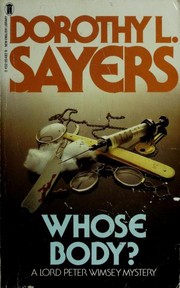
Start with Whose Body?. It is short, brisk, and the natural introduction, though be warned that the Wimsey of this book is close to a caricature: the monocle, the chatter, the collecting. That is deliberate, and the later novels peel it away.
The reason a Wimsey reading order is worth having is that the series changes enormously. Sayers wrote eleven novels across fourteen years, and the early ones are light Golden Age puzzles while the later ones are novels of ideas that happen to contain a corpse. If you read three and find them slight, you have not yet reached the books people actually mean when they say Sayers is still worth reading.
The one ordering rule that matters
The four Harriet Vane books are a single love story told across four cases and must be read in sequence: Strong Poison, Have his carcase, Gaudy night, Busman's honeymoon. That is the rule, and honouring it means departing from publication order — The Five Red Herrings was published between the first two Vane books and contributes nothing to the arc, so it belongs at the end rather than in the middle of a love story. Two other novels are also better read before the arc than during it.
Strict publication order is defensible if you want to watch Sayers develop in real time. For a first read, keep the arc intact.
The early puzzles
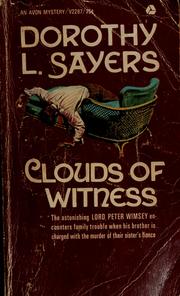
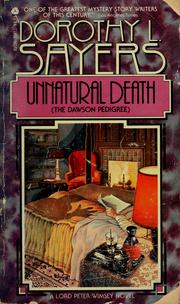
Whose Body?, then Clouds of Witness, then Unnatural Death. Clouds of Witness puts Wimsey's brother on trial for murder, which forces Sayers to give the family real weight and introduces the class machinery the series runs on. Unnatural Death brings in Miss Climpson, one of her best creations, and turns on a genuinely ingenious murder method — a clear step up from the first two.
Two honest warnings. Whose Body? contains antisemitic characterisation typical of English fiction of 1923, and Unnatural Death carries period attitudes about race and about lesbianism that are not incidental to its plot. They are of their time, and they are on the page.
Wimsey comes into focus
The unpleasantness at the Bellona Club is the first book to take Wimsey's war experience seriously, set among veterans who cannot talk about what happened to them, and it is much sadder than its title suggests. The shell-shocked man under the monocle becomes visible here, and everything the early books played as eccentricity is retroactively explained.
Murder Must Advertise draws on Sayers's own years writing copy in an advertising agency, and its portrait of an office is better reporting than most novels of the period manage — it is the funniest book in the series and is often recommended as an entry point in its own right. The Nine Tailors is the most admired and the least like a detective novel: an East Anglian fen village, church bells, a flood, and a solution that emerges from the landscape. Its change-ringing material is dense and many readers stall in it. Keep reading rather than trying to master it; the plot needs only the general principle.
The Harriet Vane arc
This is the achievement. Strong Poison opens with Harriet Vane on trial for murder and Wimsey falling in love with her from the public gallery, and it states the arc's central problem immediately: he saves her life, which makes an equal relationship between them almost impossible. The next three books work on that debt.
Have his carcase has the most fiendish and the most tedious puzzle in the series — a cipher and a tide table — and should be read for the relationship rather than the cryptography. Gaudy night is the masterpiece: a novel about women, work, scholarship and intellectual integrity set in an Oxford women's college, in which the mystery is almost incidental and Wimsey barely appears for a long stretch. It is meaningless without the two before it, because its whole tension is whether Harriet can accept him without giving up her work. Busman's honeymoon resolves the arc and is subtitled a love story with detective interruptions, which is exactly accurate.
The completist tail, and what to skip
The Five Red Herrings, set in a Scottish artists' colony and turning on railway timetables, is the most mechanical thing Sayers wrote and the one safest to skip. Lord Peter Views the Body is the first short-story collection, ranging from trivial to very good — enjoyable once you already like him, thin if you do not.
Our catalogue does not currently carry Sayers's later short-story collections; that is a gap on our side, and the eleven novels are complete here. The continuation novels finished or written by Jill Paton Walsh are a separate project by another author.
Where to stop
Busman's honeymoon is the correct ending, and having read the eleven novels you have the whole arc as its author wrote it — an unusually clean finish for a long-running detective series.
More classic crime reading orders on Discover.
Follow the full ordered path here: Lord Peter Wimsey Reading Order: Where to Start.