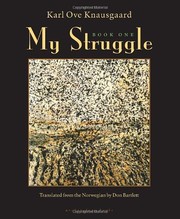
Start with My Struggle Book One. The volumes are numbered, they were written in order, and they build — there is no clever entry point and no best-of volume to sample. What makes book one the right start is not just that it is first: it contains the death of the author's father, which is the event the whole six-volume project is organised around, and it is the volume that either converts you or does not.
Two things to know before you open it. The first is scale. Six volumes run to roughly 3,600 pages, and this is not a series you drift through — it is a decision, and book one is where you make it. Read the first fifty pages and then the long section in which the narrator and his brother clean their grandmother's house. If neither holds you, stop. The later volumes ask considerably more.
The second is what the books are made of. Karl Ove Knausgaard wrote about his own family under their own names, in detail, without their consent. Several relatives on his father's side objected publicly and through lawyers before publication, disputing his account and his right to publish it. He has written about that objection at length inside the work itself. Stating this is not an argument that you should or should not read the books; it is a fact about them that readers deserve to have before they start rather than after.
A gap in our catalogue
Book Two is not currently in our catalogue and the path jumps from Book One to Book Three. That gap is ours, not the sequence — Book Two, on his second marriage and early fatherhood, is the volume many readers name as the best in the six, and you should source it yourself and read it in position. Skipping it will leave the later volumes missing their present-day frame.
Book One
Three to four weeks for around 430 pages. It is not difficult sentence by sentence, but it is relentless: long unbroken stretches with no chapter breaks to rest on. Roughly 25 to 30 pages a day beats sprinting.
Books Three, Four and Five
Eight to ten weeks for My Struggle Book Three, My Struggle Book Four and My Struggle Book Five — 427, 485 and 624 pages, and they ask very different things. My Struggle Book Three is the most self-contained, a childhood book that can be read quickly and almost works alone. My Struggle Book Four is the lightest thing in the sequence, a comic account of a teenage year teaching in northern Norway. My Struggle Book Five is long, the one most likely to take a month by itself, and the one where the writing about becoming a writer finally pays off.
Book Six, and the essay
Two to three months for My Struggle Book Six, roughly 1,150 pages — longer than Books Three and Four combined. It is three separate things bolted together: the fallout from publishing Book One, a central essay of around 400 pages on Hitler and on the title Knausgaard chose, and a final movement about his wife's breakdown.
Plan around the essay. It is where most readers of the sequence stop, and it is a genuine wall — a long, digressive close reading that has almost nothing to do with the narrative on either side of it. Skimming it and returning later is entirely legitimate. What is not worth doing is stopping before the last hundred pages, which are the point of all six volumes.
Where to stop
Stopping after Book One or Book Two is a completely reasonable outcome and a common one. You will have read the two volumes most people mean when they recommend the sequence.
More long-form literary paths are on Discover.
Follow the full ordered path here: My Struggle Reading Order and Reading Guide.
Ready to learn something deeply?
Build a reading path — free