Poker might be the most brutally order-sensitive subject on this site. The modern game has a deep theoretical literature — solver outputs, game-theory-optimal ranges, mixed strategies — and a beginner who starts there becomes something specific: a confident loser, misapplying concepts built on fundamentals they never learned. Meanwhile the player who never advances past fundamentals gets eaten alive at any serious table. The escalator matters: rules, then theory, then mindset, then the modern game.
One honest note before the books: poker is gambling, and even winning players ride vicious variance. Play with money you can lose without consequence, keep a strict bankroll, and treat any urge to chase losses as a signal to stop. No book fixes a leak in that department.
Why order matters here
Each layer of poker theory assumes the one below it. Hand values and position come before betting theory; betting theory comes before range construction; range construction comes before solver-based play. And the mental game — tilt control, variance tolerance — has to arrive before serious stakes, because it is learned cheaply in books and expensively at the table.
The path, stage by stage
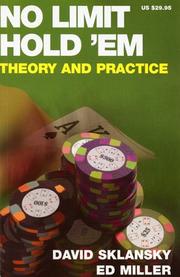
Start with the table itself. Poker for Dummies by Richard Harroch covers rules, hand rankings, position, and basic etiquette — genuinely useful groundwork, quickly outgrown, exactly as an on-ramp should be. Then read the book that created poker theory: The Theory of Poker by David Sklansky, whose fundamental theorem — you profit when opponents play differently than they would seeing your cards — is the lens behind every advanced concept. Follow with No Limit Hold'em: Theory and Practice by David Sklansky to apply the framework to the game everyone actually plays.
Then armor the mind. The Mental Game of Poker by Jared Tendler is the standard work on tilt — not as a character flaw but as a trainable performance problem — and reading it before you move up in stakes will save you real money. Thinking in Bets by Annie Duke generalizes the skill: separating decision quality from outcomes, which is the deepest thing poker teaches. Later, The Mental Game of Poker 2 extends the work to concentration and performance states.
Now the modern game. Poker's 1% by Ed Miller is the bridge book — frequencies and consistent aggression explained without solver output. Applications of No-Limit Hold 'em by Matthew Janda builds full-street theory around balanced ranges, the demanding text that makes solver-era poker legible. Then Modern Poker Theory by Michael Acevedo delivers the current GTO synthesis, and Play Optimal Poker by Andrew Brokos explains game theory with unusual clarity — including when to abandon optimal play and just exploit the table in front of you.
The staged sequence, with study plans per stage, is at the full reading path.
How to actually study this
Poker study is a loop, not a syllabus: read a concept, play a deliberately small-stakes session applying it, then review your worst hands against the book. Volume matters — online micro-stakes give you ten times the hands per hour of live play. Track every session honestly; your results over thousands of hands are the only exam. And revisit the mental-game books whenever stakes rise, because tilt scales with the money.
Start at the poker hub, or browse related paths on behavioral economics and statistics — the same decision science, without the rake.
Ready to learn something deeply?
Build a reading path — free