Piano method books were mostly written for eight-year-olds, which is why adult beginners so often stall: the material insults the intelligence while the fingers lag the mind. A good adult path runs two tracks at once — technique at the keys, understanding on the page — so progress feels like learning music, not homework.
Learn piano as an adult beginner (a realistic path to real music)
July 9, 2026 · 3 min read
Track one: hands on the keys
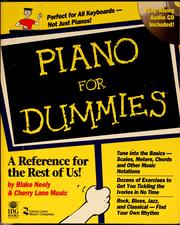
Start with Piano for dummies by Blake Neely, which is genuinely well-structured for adults: it explains the instrument and the notation before asking you to play, and it does not talk down. Alongside it, Dozen a Day by Edna Mae Burnam is the classic finger-fitness series — five minutes a session of tiny technical exercises, and the reason your fifth finger eventually stops collapsing. It is unashamedly a children's series in presentation; use it anyway, because nothing else does the job as efficiently in as little time.
Track two: reading and understanding
How to read music by Roger Evans is the short, patient book to keep beside the method book. Notation is where most adult beginners quietly give up, usually because they were taught it as a set of arbitrary symbols rather than as a picture of pitch against time. Evans takes about a hundred pages and assumes nothing, and reading it in the first month is the cheapest possible investment in never becoming the adult who can only play by ear or by tab.
Then the theory. Music Theory for Dummies by Michael Pilhofer and The Complete Idiot's Guide to Music Theory by Michael Miller cover essentially the same territory — intervals, scales, keys, chords, harmony — at the same level. Read one, not both; they are alternatives, and the choice is purely a matter of which voice you prefer. Either one turns what your hands do into something your mind owns, which is the difference between memorising pieces and learning music.
Track three: music worth playing
Graded repertoire is what keeps the whole thing honest, and the Royal Conservatory Celebration Series - Piano Repertoire Level 3 volume on this path is a representative book from that series. One caution: Level 3 is not a beginner book. The series runs from a preparatory level upward, and an adult starting from zero should begin at the bottom and work up rather than ordering the volume named here. What matters is the approach — a graded, curated sequence of real pieces from real composers, each level genuinely playable when you reach it, instead of a diet of simplified pop arrangements.
Then the book about practising
Save The Perfect Wrong Note by William Westney for when you have been at it a few months and have started to hate your own mistakes. Westney is a concert pianist and teacher, and his argument is that the anxious, error-avoidant way most adults practise is the main thing holding them back — that a wrong note played wholeheartedly teaches you more than a timid correct one. It is the most useful book on this path for anyone whose real obstacle is self-consciousness rather than technique, which for adult beginners is most people.
The habit: slow is the fast way
The piano-teacher truism the books all echo: practice at the speed of accuracy. Five slow, correct repetitions build more than fifty fast sloppy ones — errors practiced are errors learned. Fifteen focused minutes daily, hands separately before together, metronome once the notes are secure. Adults who accept slow practice routinely shock themselves within a year.
About 55 hours of reading woven through months at the keys. Follow the path, or compare notes with guitar for adults — and either way, music theory multiplies both.
FAQ
- Do I need a real piano?
- An 88-key digital piano with weighted keys is fully sufficient — and better than an out-of-tune acoustic. Weighted action matters (it builds the finger strength real pianos need); speaker quality doesn't, with headphones as a bonus for apartment peace.
- Which theory book should I buy?
- One of them. Michael Pilhofer's and Michael Miller's books cover the same beginner-to-intermediate theory at the same depth, so pick whichever sample chapter reads better to you and skip the other.
- How long until I can play something satisfying?
- Simple, musical pieces inside two months; recognizable repertoire in six to twelve. Graded repertoire series keep 'satisfying' honest — each level is genuinely playable when you reach it, as long as you start at the level that matches you rather than the one you wish you were at.
Get the books
- 1Piano for dummiesAmazon ↗Blake Neely
- 2Dozen a DayAmazon ↗Edna Mae Burnam
- 3How to read musicAmazon ↗Roger Evans
- 4Music Theory for DummiesAmazon ↗Michael Pilhofer
- 5The Complete Idiot's Guide to Music TheoryAmazon ↗Michael Miller
- 6C5R03 - Royal Conservatory Celebration Series - Piano Repertoire Level 3 Book 2015 EditionAmazon ↗Royal Conservatory
As an Amazon Associate we earn from qualifying purchases. Some book links are affiliate links; you pay the same price and we may earn a small commission.
Follow the full reading path


Learn piano as an adult
Beginner7books35 hrs4 stages
@craftsherpa♥ 0
Ready to learn something deeply?
Build a reading path — free