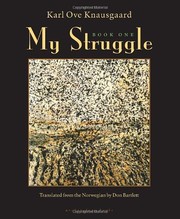
Start with My Struggle Book One. This is one of the rare cases where the obvious answer is simply correct: My Struggle is a single work published in six volumes, the volumes were written and released in sequence, and Book One opens with the essay on death and the body that sets the terms for the other five thousand pages.
One honest note before the list. My Struggle Book Two is missing from the path below — a gap in our book catalogue, not a recommendation. Read it second, in its normal place. It is the volume many readers rate highest, and skipping it would leave a hole in the middle of the work.
My Struggle, in order
Book One is the father's death and the long, unbearable cleaning of the house he died in. Book Two, the one absent from our list, is falling in love in Stockholm and then the daily grind of small children and a marriage under pressure. My Struggle Book Three goes back to a childhood on an island in southern Norway, with the father now present and frightening. My Struggle Book Four is an eighteen-year-old teaching in a village in the far north, drinking too much and failing at nearly everything. My Struggle Book Five covers the Bergen years, the writing school, and a long apprenticeship in not being good enough yet. My Struggle Book Six runs past a thousand pages and includes a very long essay on Hitler, Mein Kampf and the language of Nazism, plus the consequences of publishing the earlier volumes.
The warning worth giving: Book Six is the wall. The essay sits in the middle of the volume, it is not a digression you can skim in an afternoon, and a large share of readers who reach it do not come out the other side. It is defensible and some readers think it is the point of the whole project. Go in knowing it is there.
The books are presented as autobiography and their publication was contentious in Norway, since real people appear under their own names. That controversy is part of the reception and Book Six deals with it directly.
Where most readers actually stop
After Book Two or Book Three. That is a perfectly complete experience and nobody should feel they have quit — the first two volumes contain the death, the love and the domestic reality that made the series famous, and Books Three to Five deepen rather than redirect. Stopping at Three is a common, sane outcome.
The Seasons quartet
Autumn, Winter, Spring and Summer were written around the birth of a daughter and addressed to her. The first two are made of very short entries on ordinary objects and phenomena — chewing gum, wasps, the sun. Spring and Summer turn more continuous and narrative. If six volumes is too much commitment, this quartet is the low-cost way to find out whether the attention to ordinary things works on you, and it can be read before My Struggle without spoiling anything.
Before and after
A Time for Everything predates My Struggle and is unlike all of it: a novel about angels, retelling Old Testament episodes through an invented sixteenth-century naturalist. Readers who find the autobiographical mode airless often prefer this one.
Morning Star, published in English as The Morning Star, opens a later series. It is plot-driven, split between several narrators, and closer to a novel of dread than anything else here. A genuine change of mode, and a fair place to start if long autobiography is not your thing.
Where to stop
A good full reading is Books One and Two, then Three if the childhood material grips you, then the Seasons quartet. Treat Book Six as optional rather than obligatory. Other author reading orders live over on Discover.
Follow the full ordered path here: Karl Ove Knausgaard Reading Order: Where to Start.