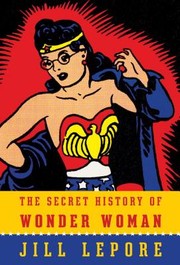
Start with The Secret History of Wonder Woman. The obvious answer is These Truths, her nine-hundred-page single-volume history of the United States, and it is a genuinely good book — but it is a survey, and a survey is the worst possible way to find out whether a writer works on you. The Secret History of Wonder Woman begins as a comic-book origin story and becomes a history of American feminism, birth control, the lie detector and a very strange household. It is the most enjoyable thing she has written and it takes a week rather than a month.
Lepore writes in two modes that look unrelated until you have read enough of her: enormous synthetic histories of the United States, and small strange books that use one obscure life to open a whole era. If the narrow book lands, the survey will too. If you want the frame first, invert this and read These Truths before everything else — that is the path's own order, and it is defensible.
The big argument
These Truths is organised around one question: whether the nation has lived up to the truths it declared self-evident. It is written for a general reader and moves fast, and the pleasure is the sentences and the selection of episodes rather than exhaustive coverage. It has been criticised for what it compresses, particularly foreign policy and economic history, and for how much weight it puts on political ideas relative to material conditions. Those objections are fair and worth holding as you read.
This America is a short polemic written immediately afterwards, arguing for a liberal nationalism against both its rivals. It makes explicit the political commitment the bigger book carries implicitly. Read the two together and you have the frame every smaller book fits inside.
The narrow histories
This is Lepore's best trick: one forgotten life used to explain a century. After Wonder Woman, read Book of Ages, which reconstructs Benjamin Franklin's sister from almost nothing and is as much about the absence of records as about the woman. The disparity is the subject — the surviving evidence for an eighteenth-century woman's life is a fraction of what survives for her famous brother. Reading it second shows you the same method with the archive removed.
If Then tells the story of a 1960s data company that tried to predict voters, and is the clearest link between her historical work and present-day anxieties about prediction and persuasion.
The early scholarship
The name of war is her first book, on King Philip's War in seventeenth-century New England and on how the winners wrote it down. It is the origin of her lifelong preoccupation with who gets to record events. New York Burning covers the 1741 slave conspiracy trials and is a study of how a panic manufactures its own evidence — testimony extracted under threat becoming a documented conspiracy. It is the most rigorous thing she has written, and the notes are where the argument with other historians happens, so do not skip them.
Reading these after the trade books makes the trade books look different: the fluency is a compression of this kind of work rather than an alternative to it.
The essays and the oddities
The story of America collects essays on American origin stories and is effectively a workshop version of These Truths, best read after it. The Mansion Of Happiness is a history of American ideas about life and death told through board games, breast pumps and cryonics, and applies the narrow-history trick at essay scale a dozen times over.
Joe Gould's teeth is the strangest thing in her catalogue: a short, unsettling book about a Greenwich Village eccentric who claimed to be writing the longest book ever written, and about the historian who goes looking for it. She visibly loses her own detachment — the search turns up a life far darker than the legend, including an allegation of sexual violence against the sculptor Augusta Savage — and she refuses to keep her distance from it. That loss of detachment is the point, and it is the one book she wrote about what happens when the historian becomes a participant.
Where to stop
There is no wrong stopping point, because nothing here is serialised. If you read only three, make them The Secret History of Wonder Woman, These Truths and New York Burning — the enjoyable one, the ambitious one and the rigorous one.
If you like this mode of history, try Erik Larson next.
Follow the full ordered path here: Jill Lepore Reading Order: Where to Start.