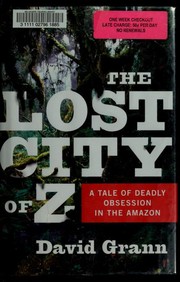
Start with The Lost City of Z. It is the shortest of the three big narratives, it is the book that made his name, and it is the only one where Grann puts himself on the page — following Percy Fawcett's 1925 disappearance up the same Amazon rivers, so that the obsession becomes the subject rather than the setting. Readers who begin with Killers of the Flower Moon because the film exists usually get a truer picture of what he can do, but a less useful picture of how he works.
Then read Killers of the Flower Moon immediately, with no other book in between, because it is the same reporter doing the opposite thing. The first person vanishes entirely; there is no narrator's charm, only documents. The contrast is only visible while the first book is still fresh, and it is the single most instructive pairing in his work.
A word on length before you plan anything: this reading order is short because the shelf is short. Grann has published a handful of books and two collections, and that is close to the whole output. You can read all of it in a couple of months, which is not true of most writers worth a reading guide.
Start here: the two that made his reputation
The Lost City of Z runs two timelines, 1925 and the present, and the modern strand exists to ask why anyone goes looking at all. Killers of the Flower Moon is about the murders of Osage people for their oil headrights in 1920s Oklahoma, and its argument is not about the killers but about the law: inheritance rules made killing Osage people financially rational. This is real, documented atrocity — dozens of deaths, poisonings, a bombing — and the final section, where Grann drops the FBI's account and works the archives with descendants, reframes everything before it. That structure is the argument. Read it knowing what it contains.
The later histories
The Wager is his most tightly constructed book: a shipwreck on a Patagonian island, a mutiny, castaway survival and a court-martial, in a little over four hundred pages. Its engine is a genuine evidentiary problem — two groups of survivors came home with irreconcilable accounts, both self-serving, both partly true — and the trial format lets him present the testimony without adjudicating it, putting you in the tribunal's chair. Our catalogue holds it under a Spanish-edition title, Los Náufragos del Wager, so it may look wrong in the list; it is the same book.
The White Darkness follows, and give it its own sitting rather than tacking it on. It is 160 heavily illustrated pages on Henry Worsley's solo Antarctic crossing, and as a coda it makes the pattern explicit: Fawcett and Worsley, the same compulsion, the same ending, at a tenth of the length.
The magazine pieces, last
The 10,000-word magazine piece is the unit his books are made from, and each of the long histories is recognisably several of them welded together. The Devil and Sherlock Holmes collects twelve pieces on obsession, deception and murder, including the Sherlock Holmes scholar found dead in his flat and a Texas arson case in which a man was executed on forensic evidence that later expert review dismantled. Read one piece per sitting; it is not a book to go through in a weekend. The Old Man and the Gun, built around a bank robber who escaped prison eighteen times, overlaps with the earlier collection and is honestly a completist's purchase rather than an independent book.
Where to stop, and what to read next
Anywhere after the first two, without guilt. If you want more of this kind of thing afterwards, the closest comparison is Erik Larson, who also builds narrative history out of documented catastrophe — the difference being that Larson works a template and Grann keeps changing instruments. Both write about real disaster and real atrocity, and neither softens it. The ordered list with page counts is in the David Grann reading path.
Ready to learn something deeply?
Build a reading path — free