For a century, science treated animal minds as off-limits — anthropomorphism was the cardinal sin, and to ask what a chimp or a crow understood was considered soft. That has flipped. Careful experiments now show planning in ravens, grief in elephants, tool cultures in whales. The field is thrilling, but it is also a minefield of over-claiming, which is why the order you read in matters: you want the skeptic's discipline before the wonder.
A good path starts with how we even ask the question, then moves outward from minds like ours to minds nothing like ours.
Start with the question itself
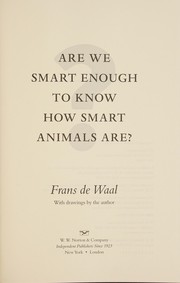
Begin with Are We Smart Enough to Know How Smart Animals Are? by Frans de Waal. It is the perfect first book because it is about the trap: how our tests have systematically underestimated animals by asking them human questions. It teaches you to read every later claim critically.
Emotions and the primate mirror
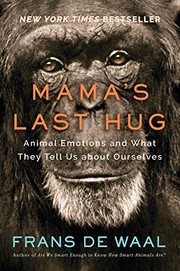
Stay with de Waal for Mama's Last Hug, which makes the case for animal emotions through primate behavior and is disciplined about what the evidence does and does not show. Then read The emotional lives of animals by Marc Bekoff directly afterwards. Bekoff is a cognitive ethologist making the same case with less hedging and more moral urgency, and the pairing is the most useful thing on this path: two serious scientists, the same body of evidence, noticeably different thresholds for what counts as proof. Deciding which of them you find more convincing, and why, is the whole skill.
Then meet the birds: The genius of birds by Jennifer Ackerman dismantles the word birdbrain with corvids and parrots that plan, count, and remember.
The familiar and the alien
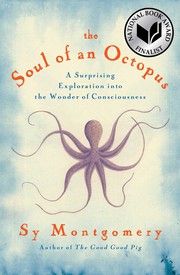
Now bring it home with Inside of a dog by Alexandra Horowitz, which reconstructs the dog's sensory world — a mind shaped by smell — and shows how different intelligence looks from inside another body. Then go fully alien: The Soul of an Octopus by Sy Montgomery and Other Minds by Peter Godfrey-Smith explore a creature whose intelligence evolved on a completely separate branch, distributed through its arms. Nothing stretches your intuitions harder.
Culture and the wider circle
Finish with the social dimension, which is where the field is currently most active. Beyond Words by Carl Safina argues that elephants, wolves, and whales have rich inner and social lives. Its sequel, Becoming Wild, narrows to the specific claim that animals have culture — behaviour learned socially and passed on, in sperm whales, macaws and chimpanzees — and it is the better of the two if you only read one.
Chimpanzee Politics, back to de Waal, shows strategy, alliance, and deception inside a single primate troop, and remains the book that made the case hardest to dismiss. If you want to see the argument fought out rather than narrated, The question of animal culture edited by Kevin N. Laland and Bennett Galef collects researchers disagreeing with each other in print. It is much drier than everything above it and it is the honest place to find out how contested the culture claim still is.
How to actually read this
- For every strong claim, ask what the control was. This field earns its credibility through experiment design, and noticing it is the real skill.
- Track the spectrum from minds like ours (primates) to minds unlike ours (octopus, birds); the contrast is where the insight lives.
- Notice the thresholds. Bekoff, de Waal, Safina and the researchers in the Laland collection are looking at overlapping evidence and drawing different lines. Watching where each of them stops is more educational than any single conclusion.
- Resist both traps as you read — cold denial and sappy projection. The best writers here walk the line, and watching them do it is instructive.
For the full staged sequence with study plans, follow the full reading path or start at the animal minds subject hub. If the octopus chapters hook you, browse the ocean and consciousness paths next.
Ready to learn something deeply?
Build a reading path — free