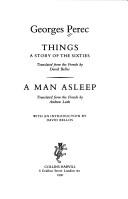
Start with Things, his first book: a young Parisian couple, the furniture they want, almost no dialogue and no interiority, and a novel that is nevertheless devastating about what wanting things does to a life. Our catalogue lists it in the paired volume that also contains A Man Asleep, which is how it is usually sold in English, so one purchase covers both.
The usual mistake is to begin with Life, a user's manual because it is the masterpiece. That is like starting a language course with its hardest text. It is a novel about a Paris apartment block with the facade removed, ninety-nine chapters generated by a knight's tour of a ten-by-ten grid, and a man who spends fifty years building a puzzle in order to destroy it. Everything in it is a constraint doing work, and the constraints are invisible if you have not already met them somewhere simpler.
Read An Attempt At Exhausting A Place In Paris second. It is forty pages of three days spent sitting in one square writing down every bus, pigeon and passer-by, and it is the purest statement of the whole project. After it, the rest of his work makes sense.
The memory books
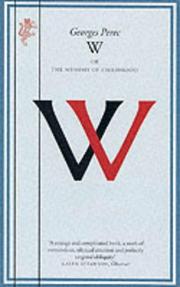
This is where the constraint stops being a game. W or the Memory of Childhood alternates two texts: a fragmentary memoir of a Jewish childhood in occupied France, and an adventure story about an island organised entirely around athletic competition. His father was killed in the war and his mother was deported and died in the camps, and the book is built around exactly the gap that fact leaves in a memory. It is the essential Perec, and the one book here that would justify the path on its own.
I Remember follows: four hundred and eighty sentences all beginning with the same two words, each recording something trivial and collective from postwar France. It is the same salvage operation performed on ordinary rather than catastrophic material. Then Species Of Spaces And Other Pieces, the essays — on the page, the bed, the apartment, the street — including his manifesto for what he called the infra-ordinary. It is the best single guide to what he thought he was doing.
The masterpiece
Now read Life, a user's manual. You will be able to see the machinery under it rather than only the stories, which is the difference between admiring the book and enjoying it.
The constrained experiments, last
A void is a three-hundred-page novel that never uses the letter E. The English version by Gilbert Adair is properly a rewriting rather than a translation, since a straight translation would restore the letter the book exists to omit — which means the English text makes different jokes and finds different words for the same absences. It reads as a stunt until you have read W or the Memory of Childhood, at which point the missing letter is obvious and not funny at all.
The Art of Asking Your Boss for a Raise is one unpunctuated sentence mapping every possible outcome of an office request, derived from a flowchart. Very funny, very short, and best appreciated once you know how seriously he took his own rules. La boutique obscure records a hundred and twenty-four dreams over five years, treated as documentary rather than psychology; it keeps its French title in English editions, which is why it looks out of place in a list of translations. It is a completist's book and the last of the inventory habit that runs through everything.
Where to stop
After Life, a user's manual, if you want the writer rather than the collection. Nothing after it is minor exactly, but the experiments are for people who already know what he was doing, which is precisely why they come last rather than first. The full sequence is in the Georges Perec reading path.
Ready to learn something deeply?
Build a reading path — free