Georges Perec Reading Order: Where to Start
Georges Perec's body of work in English is small, and the usual mistake is to start with Life A User's Manual because it is the masterpiece, which is like starting a language course with its hardest text. Begin instead with the short early books, where the obsessions — inventory, absence, the ordinary made unbearable — are already complete but the machinery is simple, then read the two memory books, then Life A User's Manual once you can see what its constraints are doing. The formal experiments come last, because a lipogrammatic novel is a joke you can only get if you already know the writer.
Start Here: The Short Early Books
IntermediateMeet Perec's fundamental method — describing the objects and surfaces of a life until a person appears in the negative space.
▸ Study plan for this stage
Pace: 2 weeks. The volume pairing Things: A Story of the Sixties with A Man Asleep is 224 pages and holds two short novels — read Things over four evenings, then A Man Asleep in one or two sittings, because its second person is relentless and breaking it up dissipates the effect. An Attempt at Exhausting
- Set expectations first: Perec is a formally experimental writer, and several of his books are built on rules that are the point rather than a gimmick attached to a story. The path is arranged so the rules make sense by the time you meet the strictest of them
- His fundamental method, present from the first book: describe the objects and surfaces of a life in exhaustive inventory until a person becomes visible in the negative space
- Things has almost no dialogue, almost no interiority and barely a plot — a young Parisian couple and the furniture they want — and is nevertheless devastating about wanting
- It is a novel written in the conditional and the imperfect: things they would have, rooms they would live in. The grammar is the characterisation
- A Man Asleep is its inverse, told in the second person, about a student who progressively withdraws from every commitment until indifference itself becomes total
- An Attempt at Exhausting a Place in Paris records three days in the Place Saint-Sulpice writing down every bus, pigeon and passer-by, and is the purest statement of the project
- Its subject is what Perec called the infra-ordinary: the events so common that nobody records them, which he argued are the real content of a life
- These books are short and their difficulty is not vocabulary but patience — a reader who wants incident will be bored, and boredom is one of the things being examined
- What do Jérôme and Sylvie in Things actually want, and does the novel think their wanting is a personal failing or a manufactured condition?
- What does the conditional grammar do to your sympathy for them that a plain past tense would not?
- A Man Asleep addresses you directly. What does the second person do here, and how does it differ from a first-person account of the same withdrawal?
- In An Attempt at Exhausting a Place, what does Perec fail to exhaust, and does the failure matter to the project?
- What counts as an event in these three books, and how is that different from what counts as an event in an ordinary novel?
- Sit in one place for an hour and write down everything that passes. Perec's book stops being an oddity the moment you attempt it.
- List every object named in the first twenty pages of Things. The list is the novel's real plot.
- Read a page of A Man Asleep aloud and note where the second person starts to feel accusatory rather than descriptive.
- Start a running note of Perec's recurring obsessions — inventories, apartments, absence, puzzles. You will be adding to it for the rest of the path.
Next up: You have the method as a technique; the memory books are where it stops being a technique and becomes the only way he can write about what happened to his family.
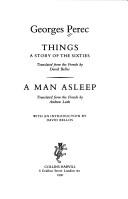
A young Parisian couple and the furniture they want. His first book, and the cleanest possible introduction: a novel with almost no dialogue and no interiority that is nevertheless devastating about wanting.

Three days sitting in the Place Saint-Sulpice writing down every bus, pigeon and passer-by. Forty pages, and the purest statement of the project; read it second and everything else makes sense.
The Memory Books
BeginnerRead the work about absence, where the constraint stops being a game and becomes a way of writing about parents who did not come back.
▸ Study plan for this stage
Pace: 5–6 weeks. W or the Memory of Childhood is 176 pages, I Remember 147 and Species of Spaces 324. Read W slowly and in order, alternating chapters as printed — it is short but the hardest emotional reading in the path. I Remember is read a few pages at a time, like a list, and takes as long as you wan
- The biographical fact the whole path turns on: Perec's father was killed in 1940 and his mother was deported and died at Auschwitz. He was a child, and he remembered almost nothing
- W or the Memory of Childhood alternates two texts — a fragmentary, heavily footnoted memoir of a Jewish childhood in occupied France, and an adventure story about an island whose society is organised entirely around athletic competition
- The two strands never meet in plot, and what happens to the island in the closing pages is the book's argument; read them as one document, not two
- The memoir sections are notable for what they doubt: Perec repeatedly records a memory and then corrects it, dates it wrongly, or admits he may have invented it
- This is where the constraint stops being a game — the rules exist because the direct account is unavailable, and a system of rules is a way of writing around a hole
- I Remember is 480 short sentences all beginning with those two words, each recording something trivial and collective from postwar France, modelled on Joe Brainard's book of the same title
- It is a salvage operation performed on ordinary memory rather than traumatic memory, and the two books are companions rather than opposites
- Species of Spaces collects the essays — on the page, the bed, the apartment, the street, the world — including his manifesto for the infra-ordinary, and it is the best single guide to what he thought he was doing
- What is the island of W, and at what point does the adventure story stop being an adventure story?
- Why alternate the two texts rather than tell either one straight? What would be lost if the memoir stood alone?
- Perec keeps correcting his own memories in the footnotes. What is that doing besides showing scruple?
- I Remember's entries are almost all trivial and shared. What kind of memory is he trying to preserve, and why that kind?
- Read the infra-ordinary essay in Species of Spaces. What is the political claim inside the aesthetic one?
- How does W explain why a writer would spend three hundred pages avoiding a letter?
- Read the last three pages of W twice. Nearly everything the book is doing is compressed there.
- Write twenty of your own sentences beginning I remember, without deliberating. It teaches you what Perec's list is and is not selecting for.
- Mark every footnote in W where Perec doubts himself, and write a paragraph on the cumulative effect.
- Read the essay on the apartment in Species of Spaces before starting the next stage. It is effectively the blueprint for the big novel.
Next up: You now know what the constraints are for, which is the one thing that makes the masterpiece readable as more than a machine.
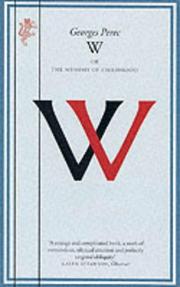
Two alternating texts: a fragmentary memoir of a Jewish childhood in occupied France, and an adventure story about an island run entirely on athletic competition. The essential Perec, and the book that explains why he wrote a novel without the letter E.
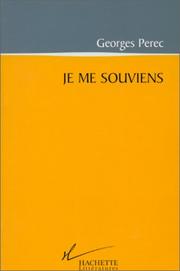
Four hundred and eighty sentences all beginning I remember, each recording something trivial and collective from postwar France. Read after W: the same salvage operation, performed on ordinary rather than traumatic memory.
The essays — on the page, the bed, the apartment, the street, the world — including the manifesto for what he called the infra-ordinary. The best single guide to what he thought he was doing.
The Masterpiece
BeginnerRead the big novel, now that you can see the constraint system underneath it rather than just the stories.
▸ Study plan for this stage
Pace: 6–8 weeks for 581 pages, which is slower than the length suggests. Life A User's Manual has 99 chapters, most of them short, and the natural rhythm is two or three a sitting. Do not read it as a novel with a plot to follow — read it as a building you are moving through room by room, and use the inde
- The conceit: a Paris apartment block with its facade removed at a single instant, and each chapter describing one room and the lives attached to it
- The order of chapters follows a knight's tour of a ten-by-ten grid representing the building, which is why the book moves between floors apparently at random — that is a rule, not a whim
- Perec also used a system generating the elements that had to appear in each chapter, so the recurring objects, quotations and situations are constrained rather than chosen
- The central story is Bartlebooth, a rich man who spends fifty years on a self-cancelling project: learn watercolour, paint five hundred ports, have each painting made into a jigsaw, reassemble them, and destroy each one so that nothing remains
- That project is the novel's model of itself, and also its joke about the constraint-writing Perec practised — an enormous system designed to produce nothing
- The book is a summation: the inventories from Things, the absences from W, the room-by-room attention of Species of Spaces, all running at once
- It is also genuinely funny and full of stories — the puzzle machinery does not prevent it being the most entertaining book in the path
- Read it after the earlier work and the constraints are visible as structure; read it first, as most people do, and it looks like an eccentric collection of anecdotes
- What is Bartlebooth's project actually for, and what does its failure mean given how the novel ends?
- Where can you see the chapter-generating constraints operating — what keeps recurring across unrelated rooms?
- The building is described at one frozen instant. What does that framing let Perec do with time inside the chapters?
- Which of the minor stories stayed with you, and why does a book built from rules produce that effect at all?
- How does the knight's-tour ordering change your experience compared with reading the chapters floor by floor?
- Is the novel humane or clinical? Argue the opposite of your first instinct before answering.
- Draw the building as a ten-by-ten grid and mark each chapter as you read it. Watching the tour move is half the pleasure.
- Use the character index actively. There are hundreds of names and the connections only appear if you look people up.
- Pick three chapters at random and list what they share. You will be reverse-engineering the constraint system.
- After finishing, reread chapter one. It is a set of instructions you could not read the first time.
Next up: With the system understood, the pure exercises become what they should be — a joke you are equipped to get.

A Paris apartment block with its facade removed, ninety-nine chapters generated by a knight's tour of a ten-by-ten grid, and the story of a man who spends fifty years constructing a puzzle to destroy. It is the summation of everything in the earlier books, which is exactly why it should not be first.
The Constrained Experiments
BeginnerFinish with the pure Oulipo exercises, the books that are unreadable as an introduction and delightful as a conclusion.
▸ Study plan for this stage
Pace: 4–5 weeks. A Void is 284 pages, The Art of Asking Your Boss for a Raise 104 and La Boutique Obscure 250. A Void is the slowest reading here: the prose is deliberately strained and 25 pages a sitting is honest. The Raise book is one unpunctuated sentence and works best read aloud in two or three goes
- A Void is a full-length novel that never uses the letter E, which in French removes the commonest letter in the language along with most articles, most plurals and the past participle
- Gilbert Adair's English version keeps the same constraint throughout, which required rewriting rather than translating — so what you are reading is a parallel achievement, not a faithful rendering, and other English translations under different titles exist
- The plot is a detective story in which characters search for something missing that they cannot name, and disappear when they get close to naming it. The absence in the prose is the absence in the story
- Having read W, the missing letter is obviously the missing family — Perec's own name loses its E, and so does the word for father, mother and them
- The Art of Asking Your Boss for a Raise is one unpunctuated sentence mapping every branch of an office request, derived from a flowchart, and it is very funny about bureaucracy precisely because it obeys the flowchart absolutely
- La Boutique Obscure records 124 dreams over five years, treated as documentary — Perec explicitly refuses psychoanalytic interpretation and presents them as found material
- It is a completist's book and the last extension of the inventory habit that runs through the whole path: dreams catalogued like furniture
- These are the right books to finish on and the wrong books to start on — as an introduction they read as stunts, and after W they read as method
- How long did it take you to notice the constraint in A Void, and what does the answer say about how much of reading is inattention?
- What does the novel gain from being a detective story specifically, given what its characters are looking for?
- Adair rewrote rather than translated. Is the English A Void the same book, and does the question have an answer?
- What is the Raise book satirising — the workplace, decision procedures, or the idea that a life can be flowcharted?
- Perec presents the dreams without interpretation. What does that refusal protect, and do you believe it?
- Having read the whole path, is the constraint a way of writing about absence or a way of avoiding writing about it?
- Write a paragraph without using the letter E. Ten minutes of this will teach you more about A Void than any commentary.
- Read a page of The Art of Asking Your Boss for a Raise aloud in one breath's worth of pace. The lack of punctuation is a performance instruction.
- Pick five dreams from La Boutique Obscure and note which of Perec's obsessions appear. The overlap with the novels is high.
- Return to Things now and reread the first chapter. The earliest book will look like the same project as the strictest one.
- Write half a page on what you would tell someone who says Perec is a gimmick writer. You are now the person qualified to answer.
Next up: That is the essential Perec in English, read in the one order that makes the strictest books legible rather than merely clever.
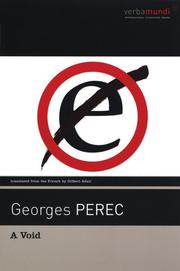
A three-hundred-page novel that never uses the letter E, translated into English under the same constraint by Gilbert Adair. A stunt until you have read W, at which point the missing letter is obviously the missing family.
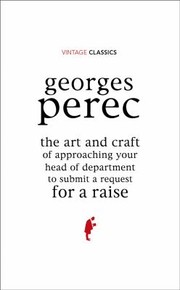
One unpunctuated sentence mapping every possible outcome of an office request, derived from a flowchart. Very funny and very short, and best appreciated once you know how seriously he took the rules.
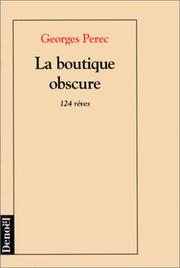
One hundred and twenty-four dreams recorded over five years, treated as documentary rather than psychology. A completist's book, and the last piece of the inventory habit that runs through the whole path.
Discussion
Keep reading
Paths that share books, cover the same subject, or open a related topic.