Forestry is a field where the popular books and the professional books have almost no overlap in style, and readers usually pick one pole and stay there. The nature writing gets you looking closely at a single stand; the management literature deals in rotation ages, growth-and-yield models, and net present value. Neither is complete alone: a forester who cannot see the ecology makes bad plans, and an ecologist who cannot read a management schedule cannot influence them.
This path is short — five books — and deliberately spans both poles, in an order that builds observation into analysis.
Learn to see a forest
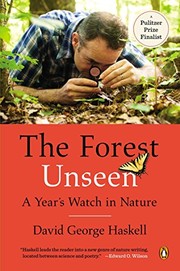
Start with The Forest Unseen. David George Haskell, a biologist, visited a single square metre of old-growth Tennessee forest repeatedly for a year and wrote a chapter from each visit. Lichen chemistry, salamander physiology, the mechanics of a falling leaf, deer browsing pressure — it is the best available training in noticing, and everything after it reads differently.
Then Wisdom from the Hidden Life of Trees, Peter Wohlleben's condensed presentation of the ideas that made his work a phenomenon: root networks, mycorrhizal exchange, the way trees in a stand respond to each other. Read it with the field's own caveat in mind — Wohlleben's language is deliberately anthropomorphic, and forest scientists disagree about how far the "wood wide web" findings can be pushed. The underlying research on mycorrhizal networks is real; the interpretive reach is contested. Knowing that argument exists is part of being literate in this subject.
The reference every forester uses
Silvics of North America, compiled by Russell Burns and Barbara Honkala for the Forest Service, is the profession's species reference: for each major tree, its range, climate tolerances, soils, reproduction, growth rates, damaging agents, and genetic variation. It is not a book you read through — it is the thing you consult when you need to know whether a species will regenerate on a particular site. Getting familiar with its structure early changes how you read everything else, because silviculture is essentially the applied version of what is in these entries.
Fire, the force that shapes everything
Fire in America by Stephen Pyne is the landmark history of fire on the American landscape — Indigenous burning practices, the suppression doctrine that followed the 1910 fires, and the century of fuel accumulation that produced the situation we now have. It is history rather than technical forestry, and it explains more about the current state of Western forests than any silviculture chapter will. Fire ecology is where forest science and public policy collide hardest, and Pyne is the standard starting point.
Planning and management
Close with Forest management and planning by Pete Bettinger, Kevin Boston, Jacek Siry, and Donald Grebner. This is the professional text: growth and yield projection, harvest scheduling, linear programming and heuristic optimization, spatial constraints, and the economics of rotation decisions. It assumes basic statistics and comfort with quantitative models, and it is where the observational reading becomes decisions with consequences across decades.
One gap worth naming: this is a North America-weighted list. The species reference, the fire history and much of the management text assume that context, and forestry practice varies enormously by region — tropical, boreal and European continuous-cover silviculture each run on different assumptions about regeneration, rotation length and ownership. If you work elsewhere, keep the ecology and the planning methods and replace the species and policy material with a regional equivalent.
Five books take you from a square metre to a landscape. Follow the full path in order, and pair it with soil science if you want the ground the whole system stands on.
Follow the full ordered path here: Forestry and Forest Science: Best Books in Reading Order.