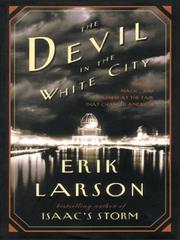
Start with The Devil in the White City. It is the book everyone means when they say Erik Larson, and it is the clearest demonstration of the device he has used ever since: two stories on parallel tracks, short alternating chapters that end on a hook, thriller pacing, and a catastrophe the reader already knows is coming. Daniel Burnham builds the 1893 Chicago World's Fair; H. H. Holmes murders people a few blocks away; the two strands barely touch, which is the standard and fair criticism of the book.
Read it knowing what is in it. The Holmes material is real murder, including of young women and children, and it is written for suspense. That is worth knowing at page one rather than discovering at chapter nine.
Then read Isaac's Storm, his shortest narrative history, which is the 1900 Galveston hurricane told through the Weather Bureau man who assured the city it was safe. It came first and the method is not yet a formula: the meteorology is explained at length and Isaac Cline's professional self-deception is the real subject. Reading it second shows you the technique before it hardened, which is the single most useful thing to know about a writer who works to a template.
The war books, where the structure is tightest
Dead Wake is the most disciplined book he has written: the Lusitania and the U-boat converging hour by hour, with the two tracks genuinely bound to each other rather than merely alternating. It is also the clearest demonstration of his central effect, which is that knowing the ending makes the suspense worse rather than better, because every ordinary detail is retrospectively doomed. Roughly 1,200 people died in the sinking, and he gives individual passengers names and plans before the torpedo. That is the technique, and it is deliberately hard to read.
In the garden of beasts swaps the countdown for a slow dawning: the American ambassador to Berlin and his daughter, with 1933 and 1934 happening around them. It is the slowest of the three despite being shorter, because nothing accelerates, and it is the most morally awkward book in the path — the device that generates suspense elsewhere here generates dread about a regime whose worst crimes are still ahead.
The splendid and the vile covers Churchill's first year in office through the Blitz, built from diaries and family papers rather than strategy documents. It is his biggest seller and his warmest book, which is worth noticing: the same formula produces a very different feeling when the catastrophe is survived.
The other histories
Thunderstruck is the most mechanical use of the two-track device — Marconi racing to transmit across the Atlantic, and a murder in London, connected only because a wireless message led to an arrest at sea. The connection is real but thin, and this is the book where you can watch the formula being applied rather than discovered, which is why it is more instructive than the earlier ones. The Marconi strand is genuinely good technical history and readers who skim it are skimming the better half.
Demon of Unrest covers the five months between Lincoln's election and the firing on Fort Sumter, told largely through participants' diaries. Its slowness is the argument: secession was not a moment but a series of small refusals to act, and reading it in near-real time is the only way to feel that. Neither of these is where a new reader should start.
The early journalism
Lethal Passage traces one handgun from manufacture to a Virginia school shooting, through the distribution chain and the regulatory gaps that let it travel. It is reported argument rather than narrative history, and it explains the investigative habits underneath everything else — the document requests, the paper trails, the willingness to keep asking who signed what. The naked consumer, from 1992, is about companies assembling dossiers on shoppers, and it is a completist's stop: the technology is long gone and the thesis is not.
Where to stop
After the war books. That is five titles and the strongest run he has. If you want the same territory handled by a writer who keeps changing instruments rather than refining one, read David Grann next. The full order is in the Erik Larson reading path.