Start with Under the eagle. Publication order and internal chronology are identical across this whole series, and Cato is promoted in almost every volume, so there is genuinely nothing to decide. Tracking his rank is the simplest way to keep the sequence straight.
The series rests on one mismatch: Macro is a career centurion who fought his way up and can barely read, Cato is an educated imperial freedman with no muscle and no idea, and every book runs some version of that friction. The real subject underneath is the Roman army as a machine — pay, kit, marching order, the century as a social unit — with the plots acting as a delivery system for it. The historical anchor is genuine: the AD 43 Claudian invasion, the Second Legion Augusta, the crossing of the Medway, Caratacus. The campaign chronology is real; the two soldiers are not.
Set your expectations about the formula now, because it does not change. A posting, an enemy, a superior who is either incompetent or corrupt, a battle, a promotion. You are reading for variation within a form rather than for surprise, and by the eighth book the repetition is undeniable.
The invasion of Britain
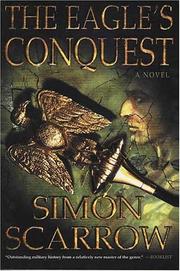
Under the eagle, The eagle's conquest, When the eagle hunts. The viewpoint stays low — you get the invasion from inside a century rather than from the commander's tent, so strategy arrives as rumour and is usually wrong.
When the eagle hunts is the most self-contained of the three and the first to show how violent the series is willing to be. If the tone puts you off there, it does not soften later, and stopping at three books is a clean exit.
The British campaign
Eagle and the Wolves, The Eagle's Prey, The Eagle's Prophecy. Read the first two back to back with no gap: the court martial in the second only lands if the training campaign in the first is still fresh. Eagle and the Wolves is the series' best argument that Rome held territory through client kings and native levies rather than through legions alone.
The Eagle's Prey uses decimation — the execution of one man in ten — as the pivot the whole novel turns on, and it is where both careers change shape. A court martial does something a battle cannot: it makes the army's own rules the antagonist, which is the most interesting recurring move Scarrow has. The Eagle's Prophecy takes the pair out of Britain onto the Adriatic and ends the single-campaign narrative; from here the series becomes a sequence of postings.
The eastern postings
The Eagle in the Sand, Centurion, The gladiator. The first two are one continuous eastern campaign and should be read together. The Judaean garrison in The Eagle in the Sand is the series' best treatment of ordinary imperial soldiering — a rotten unit on a frontier nobody in Rome thinks about — and Parthia finally gives Scarrow a peer enemy, so the Roman army stops being automatically superior to whatever it meets. Centurion is largely a siege, which suits him; he writes endurance far better than manoeuvre.
The gladiator strips both men of rank, authority and equipment after an earthquake on Crete, which is the most useful thing the series ever does to them, because the formula only becomes visible once it is removed.
Rome, and where to stop
Praetorian, then The Blood Crows. Check your edition's numbering first: there is one more volume in the published sequence between The gladiator and Praetorian, the tenth, set in Egypt, which is not in our catalogue — so the numbers on your spines will not match this page. Praetorian reads perfectly well without it.
Praetorian is the series' one true espionage novel, undercover in the Praetorian Guard during the last months of Claudius, with almost no open fighting. The Blood Crows returns to Britain under Nero with both men now senior officers, closing a loop that opened on the invasion.
Stop here. The series runs well past twenty volumes with no ending in sight, and nothing is left dangling at The Blood Crows that will nag at you. What happens if you carry on is more of the pattern: new province, new corrupt official, new campaign, with the historical setting doing steadily more of the work than the characters. The books stay in strict chronological order, so you can rejoin later by setting rather than obligation, at the price of a few spoilers about who is still alive. More historical fiction reading orders are on Discover.
Follow the full ordered path here: Eagles of the Empire Reading Order: Where to Start.