Start with Team of Rivals. It is the book that made her name, and unusually for a famous book it is also the best one — Lincoln building a cabinet out of the men who ran against him, with the argument that appointing them was a deliberate exercise of power rather than magnanimity. Everything else she wrote reads as a variation on it, so reading it first makes the rest legible.
The obvious alternative is Leadership in Turbulent Times, because it is short and it promises the distilled version. Do not start there. It sets Lincoln, both Roosevelts and Johnson side by side and compares them directly, which is genuinely useful — and almost weightless if you have not read the four books it is summarising. It is a conclusion, not an introduction.
One warning before you plan: these are big books. Team of Rivals is 916 pages, No Ordinary Time 764, The Bully Pulpit 910 and The Fitzgeralds and the Kennedys 932. The first stage alone is 1,700 pages.
Start here
Team of Rivals runs four lives in parallel from childhood for its first third, so it feels like four separate books until the 1860 convention. That is the design, not a pacing failure: the convention chapter only lands because you have watched three men expect to win. Its method is comparative — the same event through four sets of diaries — and its weakness is that Lincoln's competitors often end up more legible on the page than Lincoln himself.
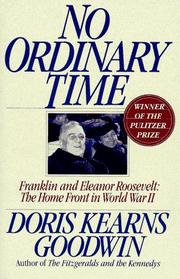
Read No Ordinary Time second, which applies the same lens to a household: Franklin and Eleanor Roosevelt as a working political partnership and a failed marriage at the same time. It won the Pulitzer and is her most emotionally exposed book, largely because Eleanor's position is documented so fully in her own writing. Both books argue that domestic reform and war leadership were the same job rather than competing ones.
The long ensembles
The Bully Pulpit is her longest and most demanding: Theodore Roosevelt, William Howard Taft, and the investigative journalists at McClure's who supplied the public pressure Roosevelt governed with. Its argument is that the muckrakers were part of the machinery of Progressive reform rather than adjacent to it, and its emotional spine is a friendship that collapses into the 1912 split. The three-strand structure only works if Team of Rivals has already taught you how she moves between parallel lives.
The Fitzgeralds and the Kennedys is family history rather than presidential study: three generations from Boston ward politics to the White House, covering the same decades as No Ordinary Time from outside the administration. Read it knowing that this book was at the centre of a 2002 controversy over passages closely resembling another author's work, which Goodwin acknowledged and corrected in later editions. It is worth knowing while you read, and it does not make the research unusable.
The early work, the synthesis and the memoir
Lyndon Johnson and the American Dream came out of her time as a White House fellow and then as Johnson's confidante in his final years, and it is the rawest thing she published — much of it rests on private conversations with a man talking about his own defeat, with no archive to check them against, which she says herself. That access-and-intimacy instinct is the origin of the whole career.
Leadership in Turbulent Times belongs here rather than at the start, as the explicit version of the theory the biographies only dramatise. Then finish with Wait Till Next Year, 267 pages on a 1950s Long Island childhood organised around the Brooklyn Dodgers and the nightly ritual of reconstructing a game for one listener. It is the origin story for the entire career, and it reads as explanation rather than introduction, which is why it comes last. Her most recent book, An Unfinished Love Story, is not in our catalogue yet.
Where to stop
After The Bully Pulpit is a defensible finish: three books, about 2,600 pages, and the whole method at full stretch. The full order with page counts is in the Doris Kearns Goodwin reading path.
Ready to learn something deeply?
Build a reading path — free