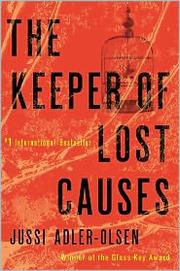
Start with The Keeper of Lost Causes, the first book Jussi Adler-Olsen published about the Copenhagen cold-case unit. Before you buy anything, though, check the cover: the first four novels were released under different titles in Britain and the United States, and this one appeared in the UK as Mercy. The Absent One is Disgrace, A Conspiracy of Faith is Redemption, and The Purity of Vengeance is Guilt. Readers buy the same book twice on a regular basis. This guide uses the American titles throughout.
Publication order is not negotiable here, for one specific reason. The cases close inside each book, but the backstories do not: every volume opens a little more of Assad's history and of the shooting that put Carl Mørck in a basement office, and those two threads run unbroken to the final book. Skip around and you will be handed answers to questions you have not been allowed to ask yet.
The first two cases
The Keeper of Lost Causes introduces the whole apparatus — a missing politician presumed dead for five years, a burnt-out detective exiled to the basement, a cleaner called Assad who turns out to be unaccountably good at everything, and a department that exists mainly as political cover so the police can appear to care about cold cases. The Absent One follows, with a double murder pinned on the wrong man and a group of boarding-school alumni who became untouchable.
These are the two shortest books in the series and the only ones that read like conventional Nordic crime novels. They also establish the structure that never changes: a present-day investigation cut against chapters following a victim who is still alive and still captive. That device is what makes the books tense rather than puzzling — you know something the detectives do not, and the clock belongs to the victim. If it does not grip you across two books, stop, because the series does not change. It only gets longer and darker.
The core sequence
A Conspiracy of Faith is where the series peaks: a message in a bottle written in blood by an abducted child, and a killer who hunts inside closed religious communities that will not report anything to the police. Most readers name it the best in the run. The Purity of Vengeance is the darkest, built on real Danish history — the Sprogø institution and the forced sterilisation of women judged morally deficient. Take a break before it and after it. The Marco Effect deliberately breaks the formula with a straightforward chase about a boy fleeing the clan that raised him to steal, and it is placed exactly where a lighter book was needed.
The Assad arc
The Hanging Girl looks like a standalone about a hit-and-run and a sun-worshipping cult; its real job is planting material the next two books detonate. The Scarred Woman finally gives Rose her own novel, and later volumes assume you have read it. Then Victim 2117 lays out Assad's history at last, recontextualising nine years of jokes made at his expense. Reading it before the two that precede it spoils both.
The endgame
The Shadow Murders runs to 742 pages, is slow for its first third, and is the book where the case starts closing in on Carl himself. Read Locked In immediately afterwards: it is the final Department Q novel, with Carl in custody and his own unit working to clear him, and it closes every thread the previous nine books left open. Almost nothing in it is legible cold, which is the strongest possible argument for having read in order.
Where to stop
Honestly: a reader who stops after Victim 2117 has had the best of the series. The last two books are the longest and the least tightly plotted, and their pleasure is resolution rather than construction. A reader who finishes gets the ending the series earned, which is a real thing to want — but ten books at roughly 5,500 pages is a genuine commitment, and the series peaked earlier than it ended. The whole sequence in order is in the Department Q reading path.
Ready to learn something deeply?
Build a reading path — free