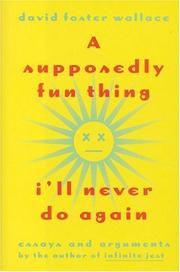
Start with A supposedly fun thing I'll never do again. The title essay sends him on a luxury Caribbean cruise and comes back with something far stranger and sadder than travel writing; the tennis pieces and the state-fair piece are as good. It is the fastest way to find out whether the voice — the recursive qualifications, the footnotes, the refusal to let any observation stand unexamined — is a pleasure to you or an irritation. That is the only question that matters before you commit further.
Do not start with Infinite Jest. It is his major work and it is also 1,079 pages with 388 endnotes, several of which have footnotes of their own, and it deliberately withholds its structure for hundreds of pages. Readers who begin there without having enjoyed the essays first abandon it at an extremely high rate, and they abandon it convinced the problem is them.
The essays first
A supposedly fun thing I'll never do again, then Consider the lobster, and other essays. The second collection is the stronger of the two on argument: the title essay works its way from a Maine food festival into the ethics of boiling an animal alive, and the piece on talk radio and the long one on usage dictionaries are similarly built — a small assignment opened up until it becomes a moral question. If you only ever read one Wallace book, make it one of these two.
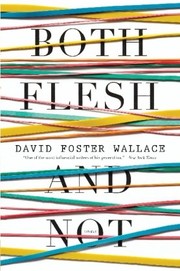
Both Flesh and Not: Essays is the posthumous scrapings — pieces the earlier collections passed over, plus some genuinely fine work on Roger Federer and on mathematics. It is the weakest of the three and should be read last, if at all.
Then the stories
Girl With Curious Hair is the early collection and the most conventionally enjoyable, though the long closing novella is heavy going. Brief Interviews With Hideous Men is the famous one: a sequence of monologues from men explaining themselves, formally aggressive and deliberately unpleasant in places. It is also the best short introduction to what he was actually trying to do about irony and sincerity.
Oblivion is the late collection and the hardest. The stories are longer, the sentences are denser, and several of them are about corporate work and consciousness in ways that are more admired than enjoyed. Read it after the novel, not before.
Infinite Jest, honestly
By now you know the voice and you have decided. If you are going in, some concrete advice. The first 150 to 200 pages are the wall — you are being handed a large cast across three settings with no visible connection between them, and the connections do not begin arriving until roughly page 250. The endnotes are not optional; several contain major plot material, so use two bookmarks. The Eschaton set piece around the middle is where most readers who make it that far report the book clicking. And the ending does not resolve in the way you expect, which is a design decision rather than an oversight; the answer is arranged in the first chapter, which is chronologically the last event in the book. Many readers immediately reread that opening chapter and find the novel closes.
Roughly a thousand pages, and it takes most people two to three months. It is worth it if you liked the essays. It is not worth grinding through if you did not.
Where to stop
Stop after Infinite Jest and Oblivion. The Pale King, the unfinished novel assembled from drafts after his death in 2008, is not on this path; it is a genuine fragment rather than a completed book, and it is best approached as material for people who already care rather than as a reading experience. The same goes for the various posthumous collections of interviews and commencement speeches.
If the essay side interests you more than the fiction, that is a completely respectable place to land — the two essay collections are the part of the work with the widest reach.
Follow the full ordered path here: David Foster Wallace Reading Order: Where to Start.