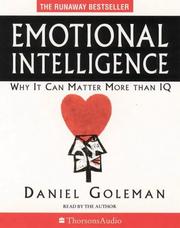
Emotional intelligence is one of those subjects where most people read exactly one book, nod along, and change nothing. The problem is not motivation. It is that a single book gives you a concept, not a skill, and skills need a sequence: first the case for why emotions run more of your life than you think, then an accurate model of what emotions actually are, then deliberate practice in specific relationships.
Order matters here because the science has moved. Read only the classics and you inherit some outdated assumptions; read only the new work and you miss the frame that made the field matter.
Stage 1: the case and the correction
Start with Emotional Intelligence by Daniel Goleman, the 1995 book that put EQ on the map. Its core argument holds up: self-awareness, self-regulation, and empathy predict life outcomes in ways raw intellect does not. Then immediately read How Emotions Are Made by Lisa Feldman Barrett as the scientific counterweight. Barrett's constructed-emotion research challenges the idea of universal, hardwired emotions, arguing instead that your brain builds emotional experiences from prediction and context. The two books disagree in places, and sitting with that disagreement is the point; this is a live scientific field, not a settled catechism.
Stage 2: skills you can train
Permission to Feel by Marc Brackett, from the Yale Center for Emotional Intelligence, turns theory into a trainable method for recognizing, labeling, and regulating emotions; his central insight is that granularity, having precise words for feelings, is itself a regulation skill. Follow it with Emotional Agility by Susan David, which teaches the acceptance-and-commitment move of unhooking from difficult emotions without suppressing them. For the perception side, Telling Lies by Paul Ekman digs into what faces and behavior reveal and conceal, and Empathy by Roman Krznaric makes the case for empathy as a practiced habit of curiosity about other lives rather than a fixed trait.
Stage 3: run it in your closest relationships
Abstract EQ dies at the kitchen table. The seven principles for making marriage work by John Gottman distills decades of observational research on couples into concrete practices, and his Raising an emotionally intelligent child applies the same lens to parenting through emotion coaching. At work, Primal Leadership by Daniel Goleman argues that a leader's emotional state is contagious and manageable, and Dare to lead by Brené Brown connects vulnerability and courage to trust in teams.
How to actually study this
One skill per fortnight beats one book per weekend. After Brackett, keep a two-week log where you name your emotional state three times a day with the most precise word you can find. After Gottman, pick a single principle and practice it for a month. Progress shows up in repaired conversations, not in vocabulary.
The staged curriculum with study plans is at the full reading path. Explore neighboring topics on the subject hub, or browse all paths.
Ready to learn something deeply?
Build a reading path — free