China has the longest continuous civilization on Earth, and for most Western readers it is a blank spot on the mental map — a few dynasty names, a wall, some proverbs. The gap is not lack of interest; it is that the subject is genuinely large. Thousands of years, competing schools of thought, cycles of unity and collapse. Grab a specialized book first and you will be lost among unfamiliar names and dates with nothing to anchor them.
So build a spine first, then hang the details on it. Reading order is what turns ancient China from an intimidating fog into a story you can follow.
Get the whole arc first
Start with a readable narrative sweep. The Story of China by Michael Wood moves from the earliest dynasties to the modern era with a traveler's eye, giving you the shape of the whole thing. Then deepen it with China A History by John Keay, a single-volume account that is more detailed but still very readable. Between them you will have the dynastic skeleton — Zhou, Qin, Han, Tang, Song and beyond — that every later book assumes you know.
A third single-volume survey sits on this path and needs a word of guidance rather than an endorsement. China - A New History by John King Fairbank is the classic American textbook account, the one that taught a generation of English-speaking students, and it is stronger than Keay on institutions, bureaucracy and the late imperial state. It also overlaps with Keay almost completely. Pick one as your spine and treat the other as a second opinion to dip into; reading both cover to cover is the commonest way to stall on this subject.
Add depth where the whole story turns
Two more focused histories are worth taking after the spine, not before it. The Early Chinese Empires by Mark Edward Lewis covers Qin and Han — the moment a collection of warring states became an empire with a script, a road network and a civil service. Everything later dynasties did was measured against that template, so this is the single most load-bearing period in the whole sequence. Then The Open Empire by Valerie Hansen reorganises the story around contact: trade, migration and religion arriving along the Silk Road and reshaping China from outside. It is a deliberate corrective to any narrative that treats Chinese history as self-contained, and it reads well against Keay or Fairbank.
Meet the ideas that shaped everything
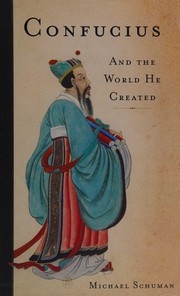
Chinese history is unusually driven by philosophy, so meet the thinkers next. Confucius by Michael A. Schuman is a smart modern biography that explains not just the man but why his ideas still echo through East Asian life. Then go to the source: The complete Analects of Confucius is short, aphoristic, and rewards slow reading. Balance it with Tao te Ching by Laozi, the founding text of Daoism and Confucianism's great counterweight — together they map the two poles of classical Chinese thought. If strategy interests you, The Art of War by Sun Tzu is the third primary text worth having, and it is far more about psychology and statecraft than combat.
See how it all worked in practice
Ideas and dynasties are the frame; now fill in the texture. Daily Life in Traditional China by Charles Benn drops you into the streets, homes, and markets of the Tang era, which makes the abstractions human. And The Genius of China by Robert Temple catalogs the staggering list of Chinese inventions — paper, printing, the compass, gunpowder — that reached the rest of the world often centuries later. It reframes China not as a place that fell behind, but as one that led for a very long time.
A note on perspective
Any single history of a civilization this old carries the angle of its author and era. This path deliberately pairs Western narrative historians with primary Chinese texts so you hear more than one voice, and you should hold interpretive claims — especially sweeping ones about the Chinese character — loosely. Fairbank in particular was writing within a mid-century American scholarly tradition that later historians have argued with hard. The sources are where you push back on the summaries.
How to actually study it
Keep a dynasty timeline open as you read; the names blur until you have somewhere to file them. When you reach the Analects or the Tao Te Ching, read a few passages a day rather than racing through — these were written to be chewed on. And connect the philosophy back to the history: notice how Confucian ideas about order show up in how dynasties actually governed.
Want the sequence laid out? Follow the full reading path, explore the subject hub, or browse related history paths.