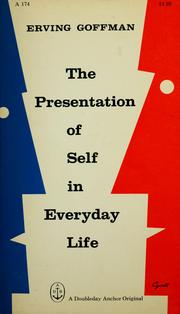
Begin with The presentation of self in everyday life. It is 255 pages, needs no prior sociology, uses hotel kitchens and Shetland crofts as data, and states the theatrical metaphor in full — front and back region, impression management, teams, the working consensus. Every later book assumes it. Read it before any introduction, then pick up Greg Smith's Erving Goffman, 152 pages in Routledge's Key Sociologists series, which maps the whole body of work and flags the arguments about how to read him.
One catalogue warning on that companion: at least two books are published under the title Erving Goffman, including Tom Burns's study. The one on this path is Smith's. Check the author before ordering.
What Goffman argued, and never really argued for, is that the interaction order is a domain in its own right rather than a residue of social structure. He offers a perspective, not a theory with predictions, and the standard objection — that his method cannot be replicated — starts from exactly that.
The fieldwork that made his name
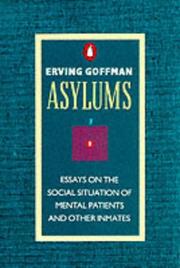
Asylums, 386 pages, came out of participant observation inside St Elizabeths psychiatric hospital and gave the social sciences the total institution; the essay on the moral career of the mental patient is the most influential thing he wrote, and it shaped deinstitutionalisation policy, which is why questions about its evidential base are not academic. Stigma, 171 pages, generalises that material into passing and the discredited versus the discreditable, and is a conceptual essay built from published cases rather than new fieldwork. Encounters, 152 pages, holds two essays on role distance and on fun in games, and is the hinge into the formal work.
The interaction order as a research programme
Four books build the grammar of face-to-face conduct. Behavior in public places, 248 pages, is the most concretely observational and the source of civil inattention. Interaction ritual, 270 pages, holds On Face-Work and Embarrassment and Social Organization, and is openly Durkheimian: ritual respect paid to persons instead of gods. Strategic interaction, 153 pages, is the outlier, on expression games and deception, and it is useful for showing where the dramaturgical model runs out. Relations in Public, 396 pages, is the most systematic statement of the whole programme and the best answer to the charge that Goffman wrote brilliant essays with no framework.
The one readers abandon, and why page count will not tell you
Frame analysis is 586 pages and it is where most readers stop. It asks how participants know what is going on at all, which the earlier books assume settled, and it became the foundation of framing theory across sociology, media studies and social movements. Attempt it only after the interaction-order books. Note that its catalogue record lists a Spanish translator alongside Goffman in the author field; that is metadata noise on the edition we link, but it is worth confirming the language of whatever copy you buy.
The page counts genuinely mislead. Encounters and Strategic interaction are 152 and 153 pages, the same length as Smith's introduction, and considerably harder work. Stigma at 171 pages goes down in an afternoon. Forms of talk, 335 pages, is longer than Interaction ritual and much more enjoyable — it applies frame analysis to speech, footing and radio announcers' blunders, and it is the right thing to read immediately after the book that defeated you.
Finish critically. The Goffman reader is a 285-page selection with substantial editorial essays and is useful for rereading passages, though the record credits it to Goffman rather than to its editors. Philip Manning's Erving Goffman and modern sociology, 200 pages, is the most careful critical study of the whole corpus. Goffman's Legacy is an edited collection assessing which of his concepts survived intact and which were absorbed so completely that people stopped citing him.
The full Goffman reading order sets these out stage by stage with a study plan for each.