Geometry: a reading path from shapes to proofs and intuition
This curriculum builds geometry knowledge from the ground up — starting with visual intuition and everyday shapes, then advancing through classical Euclidean proof, coordinate and analytic methods, and finally the rich world of transformations and modern geometric thinking. Each stage equips the reader with the vocabulary and reasoning skills needed for the next, balancing spatial imagination with logical rigor throughout.
Visual Foundations
BeginnerDevelop strong geometric intuition — understanding points, lines, angles, polygons, and basic spatial relationships through pictures, puzzles, and informal reasoning before any formal proof.
▸ Study plan for this stage
Pace: 6–8 weeks, ~25–30 pages/day (alternating between both books; start with "Shape" for intuition-building, then deepen with "Geometry Revisited")
- Points, lines, and planes as fundamental building blocks of geometric space
- Angles: measurement, classification (acute, right, obtuse), and relationships (complementary, supplementary, vertical)
- Polygons: properties, classification, interior/exterior angles, and symmetries
- Circles: center, radius, diameter, circumference, and basic arc relationships
- Congruence and similarity: recognizing when shapes are the same or proportionally related
- Spatial intuition: visualizing 2D and 3D relationships, transformations (rotation, reflection, translation)
- Informal reasoning and pattern recognition as precursors to formal proof
- What are the fundamental differences between points, lines, and planes, and how do they combine to form geometric figures?
- How do you classify and measure angles, and what relationships exist between angles formed by intersecting lines?
- What properties define different types of polygons, and how do you calculate their interior and exterior angles?
- What are the key properties of circles, and how do radius, diameter, and circumference relate?
- How can you determine whether two shapes are congruent or similar, and what transformations preserve these relationships?
- How does visual pattern recognition and informal reasoning help you predict geometric properties before proving them formally?
- Draw and label points, lines, line segments, rays, and planes; identify how they intersect and form angles in your sketches
- Measure angles in real-world objects (doors, windows, furniture) using a protractor; classify them and identify angle pairs (vertical, complementary, supplementary)
- Construct regular and irregular polygons using a ruler and compass; calculate their interior angles and verify your results by measurement
- Explore circles by drawing them freehand and with a compass; measure radius and diameter of circular objects; calculate circumference and verify with string
- Create a visual chart of congruent and similar shapes using cutouts, tracing, and scaling; explain what transformations map one shape to another
- Solve visual puzzles and tangram problems that require rotating, reflecting, and translating shapes to fit patterns
- Sketch 3D objects (cubes, pyramids, prisms) from different viewpoints; identify how 2D cross-sections relate to the 3D structure
Next up: This stage builds the visual intuition and informal reasoning skills needed to understand why geometric properties hold true, preparing you to engage with formal definitions, axioms, and logical proofs in the next stage.

A lively, accessible entry point that reveals geometry as a living subject woven through everyday life, building curiosity and intuition before any formal study begins.
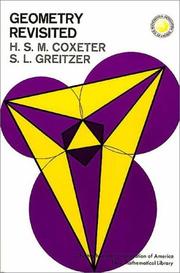
A concise, beautifully written tour of classical plane geometry that sharpens visual intuition and introduces elegant results — ideal as a first taste of what geometry really looks like before diving into proofs.
Euclidean Proof and Classical Geometry
BeginnerMaster the language and logic of Euclidean geometry — definitions, postulates, theorems, and two-column or paragraph proofs — building the rigorous foundation that all later geometry rests on.
▸ Study plan for this stage
Pace: 12–16 weeks, ~40–50 pages/day (Elements: 8–10 weeks; Hartshorne: 4–6 weeks)
- Definitions, postulates, and common notions as the axiomatic foundation of geometry
- Logical structure of proofs: how theorems follow deductively from axioms and previously proven results
- Congruence and equality: triangles, angles, and line segments in classical geometry
- Parallel lines, angle relationships, and the parallel postulate's role in Euclidean geometry
- Construction techniques (compass and straightedge) and their logical justification
- Area, proportion, and similarity in classical geometry
- The transition from classical Euclidean geometry to modern axiomatic treatments (via Hartshorne)
- What are the five postulates of Euclid, and why is the parallel postulate fundamentally different from the others?
- How do you construct a two-column or paragraph proof in Euclidean geometry, and what role do definitions and previously proven theorems play?
- State and prove the congruence criteria for triangles (SSS, SAS, ASA) and explain why they are foundational.
- What is the relationship between parallel lines and angle measures (alternate interior angles, corresponding angles, etc.)?
- How do compass-and-straightedge constructions relate to the postulates and theorems of Euclid?
- What is similarity, how does it differ from congruence, and how are proportions used to prove similarity?
- Work through at least 20 proofs from Books I–III of Euclid's Elements, writing out each step and justifying it with a postulate, definition, or prior theorem.
- Construct a geometric figure using only compass and straightedge (e.g., bisect an angle, construct a perpendicular, construct a regular hexagon) and write a logical justification for why the construction works.
- Prove the congruence criteria (SSS, SAS, ASA) from Euclid's postulates, then use them to prove 5–10 additional theorems about triangles.
- Prove at least 8 theorems about parallel lines and transversals, including properties of alternate interior angles and angle sums in triangles.
- Read and critique 3–5 proofs from Hartshorne's treatment, identifying how his modern axiomatic approach differs from Euclid's classical presentation.
- Write 5–10 original two-column proofs for geometric statements not explicitly covered in the texts, using only the definitions and postulates available at that point in the curriculum.
Next up: This stage establishes the rigorous logical language and proof techniques that underpin all subsequent geometry; mastery of Euclidean foundations enables you to understand non-Euclidean geometries, coordinate geometry, and advanced topics by recognizing how they modify or extend the classical axioms.

The original source of axiomatic geometry; reading Books I–IV gives the reader direct experience with how definitions, postulates, and logical deduction build an entire geometric world from scratch.
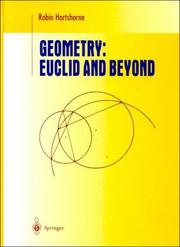
Bridges the ancient Elements and modern axiomatic thinking, clarifying exactly what Euclid assumed and filling logical gaps — essential for understanding proof at a deeper level after reading Euclid directly.
Coordinate Geometry and Analytic Methods
IntermediateConnect geometric figures to algebra through coordinates, equations of lines and conics, vectors, and distance — gaining the analytic toolkit that unifies geometry with the rest of mathematics.
▸ Study plan for this stage
Pace: 8–10 weeks, ~40–50 pages/day (Coxeter first 3–4 weeks, then Audin 4–6 weeks)
- Coordinate systems and Cartesian coordinates as a bridge between geometry and algebra
- Equations of lines: slope-intercept, point-slope, and general forms; parallel and perpendicular lines
- Distance formula, midpoint formula, and their geometric interpretations
- Conic sections (circles, ellipses, parabolas, hyperbolas) and their standard equations
- Vectors in the plane: addition, scalar multiplication, dot product, and geometric meaning
- Transformations of the plane (translation, rotation, reflection) expressed algebraically
- Parametric equations and their role in describing curves and motion
- Analytic methods for proving geometric theorems using coordinate geometry
- How do you write the equation of a line given two points, and how does this equation encode geometric properties like slope and intercepts?
- What is the relationship between the algebraic form of a conic section and its geometric shape, and how do you identify which conic a given equation represents?
- How do vectors provide an algebraic way to represent direction and magnitude, and what does the dot product tell you geometrically?
- Given a geometric configuration (e.g., a triangle or circle), how would you set up a coordinate system and use algebra to prove a property that might otherwise require classical geometric arguments?
- How do parametric equations describe curves, and when is the parametric form more useful than the Cartesian form?
- What is the geometric meaning of transformations (rotation, reflection, translation) when expressed as matrix operations or coordinate changes?
- Work through Coxeter's coordinate geometry chapters: derive the distance and midpoint formulas from scratch, then apply them to find distances between points and midpoints of segments in various configurations
- Solve 15–20 problems on writing equations of lines: given points, slopes, or geometric constraints (e.g., perpendicular to a given line through a point), write the equation and sketch the line
- Identify and classify conic sections: given 10–15 equations in standard and non-standard forms, determine whether each is a circle, ellipse, parabola, or hyperbola, and sketch them
- Vector practice set: compute sums, scalar multiples, and dot products of vectors; interpret dot products geometrically (angles, projections); solve problems involving vector equations of lines
- Prove 5–8 classical geometric theorems using coordinate geometry (e.g., the diagonals of a rectangle bisect each other; the midpoint of the hypotenuse of a right triangle is equidistant from all three vertices)
- Parametric curve exploration: convert between Cartesian and parametric forms for circles, ellipses, and lines; sketch curves given parametric equations and describe the motion they represent
Next up: This stage equips you with the analytic language and algebraic tools to describe and manipulate geometric objects, preparing you to tackle more advanced topics such as transformations, projective geometry, or differential geometry where coordinates and equations become essential for understanding curvature, symmetry, and higher-dimensional structures.
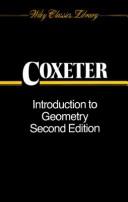
A comprehensive intermediate text covering Euclidean, projective, and non-Euclidean ideas with both synthetic and analytic approaches — the ideal bridge from classical proof to broader geometric thinking.
Develops plane and space geometry rigorously using linear algebra and coordinates, teaching the reader to move fluently between algebraic and geometric descriptions of the same objects.
Transformations and Symmetry
IntermediateUnderstand geometry through the lens of transformations — reflections, rotations, translations, dilations, and symmetry groups — seeing how motion and invariance unify all of classical geometry.
▸ Study plan for this stage
Pace: 6–8 weeks, ~25–30 pages/day. Start with Martin's "Transformation Geometry" (weeks 1–4, ~200 pages), then move to Weyl's "Symmetry" (weeks 5–8, ~150 pages). Allocate 2–3 days per major section for reflection and exercises.
- Isometries as distance-preserving transformations: reflections, rotations, translations, and glide reflections as the fundamental building blocks of Euclidean geometry
- Composition of transformations: how combining transformations creates new transformations, and the algebraic structure (group properties) that emerges
- Invariance under transformation: identifying what properties remain unchanged (angles, distances, collinearity) and what changes, revealing the deep structure of geometric objects
- Symmetry groups: classifying symmetries of figures (frieze groups, wallpaper groups, point groups) and understanding symmetry as organized transformation
- Congruence and similarity through transformation: reframing congruence as the existence of an isometry and similarity as the existence of a similarity transformation (dilation + isometry)
- Fixed points and orbits: how transformations act on points, creating orbits and revealing geometric structure through the lens of group actions
- Weyl's unification principle: seeing classical geometry (Euclidean, spherical, hyperbolic) as the study of invariants under different transformation groups
- What are the four types of isometries in the Euclidean plane, and how can any isometry be decomposed into or expressed as a composition of these basic transformations?
- How does the composition of two reflections across intersecting lines produce a rotation, and what is the relationship between the angle between the lines and the angle of rotation?
- What defines a symmetry group, and how do frieze groups and wallpaper groups classify the possible symmetries of repeating patterns in the plane?
- How does Weyl's approach unify Euclidean geometry with other geometries by focusing on invariants under transformation groups rather than on specific metric properties?
- Given a geometric figure, how would you determine all of its symmetries and represent them as a group?
- What is the difference between congruence and similarity in terms of transformations, and why is this distinction important for understanding geometric relationships?
- Work through Martin's exercises on composing reflections: given two lines at various angles, predict the resulting rotation and verify by construction (compass and straightedge or dynamic geometry software)
- Classify frieze patterns: find or create 5–7 examples of frieze patterns (borders, decorative strips) and identify which frieze group each belongs to; document the symmetries present
- Construct wallpaper patterns: using a fundamental domain and a known wallpaper group (e.g., p4m or p6m), create a tiling by hand or digitally, then identify all symmetries
- Prove that any isometry in the plane is one of the four types (reflection, rotation, translation, glide reflection) by analyzing fixed points and the effect on a chosen point
- Symmetry group analysis: select 3–4 familiar objects or figures (regular polygons, letters, snowflakes) and determine their full symmetry groups; represent each group using notation and list all generators
- Transformation chains: given a sequence of transformations (e.g., reflect across line L₁, then rotate 45°, then translate), compute the composition and identify what single transformation (if any) produces the same result
Next up: This stage establishes transformation and symmetry as the organizing principles of geometry, preparing you to apply these ideas to more specialized topics—whether that is advanced group theory, crystallography, non-Euclidean geometries, or the geometric foundations of physics.

Systematically develops the four isometries of the plane and their compositions, connecting them to symmetry groups — the perfect first book for seeing geometry as the study of what stays the same under change.
A classic meditation on symmetry in art, nature, and mathematics by one of the great mathematicians of the 20th century — deepens conceptual understanding of why transformations are the heart of modern geometry.
Deeper Structures: Projective and Non-Euclidean Geometry
ExpertExpand beyond Euclidean geometry into projective and non-Euclidean spaces, understanding how changing the parallel postulate or the notion of distance creates entirely new, consistent geometric worlds.
▸ Study plan for this stage
Pace: 8–10 weeks, ~25–30 pages/day (accounting for dense mathematical content and frequent re-reading of proofs)
- Projective plane and projective space: points at infinity, homogeneous coordinates, and the duality principle
- Desargues' Theorem and Pappus' Theorem: foundational results showing how perspective and collinearity behave in projective geometry
- Cross-ratio and harmonic division: invariant measures that replace Euclidean distance in projective settings
- Conics in projective geometry: how ellipses, parabolas, and hyperbolas unify under a single projective framework
- Projective transformations and collineations: how geometric properties are preserved and how to work with projective maps
- The relationship between Euclidean and projective geometry: how Euclidean geometry emerges as a special case when you designate a line at infinity
- Pole-polar relationships and reciprocal figures: dual structures that reveal hidden symmetries in projective configurations
- What is the projective plane, and how do points at infinity resolve the parallel postulate?
- State and explain Desargues' Theorem and Pappus' Theorem. Why are these results fundamental to projective geometry?
- What is the cross-ratio, and why is it invariant under projective transformations?
- How do conic sections unify in projective geometry, and what role does the line at infinity play?
- Describe the duality principle in projective geometry. How does it relate points and lines symmetrically?
- How does Euclidean geometry emerge from projective geometry by designating a line at infinity?
- Work through Coxeter's proofs of Desargues' Theorem and Pappus' Theorem step-by-step; reproduce the proofs from memory to internalize the logical flow
- Compute cross-ratios for specific sets of collinear points; verify that the cross-ratio remains constant under a projective transformation you construct
- Set up homogeneous coordinates for points in the projective plane and perform matrix operations representing projective transformations; verify that they preserve collinearity
- Sketch or construct (using ruler and compass or dynamic geometry software) a projective configuration illustrating Desargues' Theorem in both 2D and 3D perspectives
- Identify and classify conics in projective coordinates; show how a parabola, ellipse, and hyperbola can be mapped to each other via a projective transformation
- Explore pole-polar duality: given a conic and a point, construct its polar line and verify reciprocal relationships for multiple point-line pairs
- Solve 3–4 problems from Coxeter's exercises that involve computing invariants, applying theorems, or constructing projective figures
Next up: Mastering projective geometry—where the parallel postulate dissolves and distance becomes secondary to incidence and cross-ratio—prepares you to explore non-Euclidean geometries (hyperbolic and elliptic), where the parallel postulate is explicitly violated and distance is redefined, revealing that multiple consistent geometric worlds are possible.
The definitive introduction to projective geometry, revealing the elegant duality and incidence structure that lies beneath Euclidean geometry — a natural next step after mastering transformations.
Traces the historical and logical path from Euclid's parallel postulate to hyperbolic and elliptic geometries, providing both rigorous proofs and rich context that ties the entire curriculum together.
Discussion
Keep reading
Paths that share books, cover the same subject, or open a related topic.