The History of Korea: Best Books to Read, in Order
This curriculum traces Korean history from its mythological origins through the ancient kingdoms, the Joseon dynasty, Japanese colonization, the devastating Korean War, and the divergent paths of North and South Korea — building from accessible narrative overviews to richly detailed, scholarly deep dives. Each stage assumes the vocabulary and context built in the previous one, so reading in order is essential for the deepest understanding.
Foundations: The Big Picture
BeginnerGain a confident, chronological overview of Korean history from ancient times to the modern era, establishing the key dynasties, turning points, and cultural concepts you'll encounter in every later book.
▸ Study plan for this stage
Pace: 4–5 weeks, ~40–50 pages/day (approximately 280–350 pages total across both books)
- The three ancient kingdoms (Goguryeo, Baekje, Silla) and their regional competition, culminating in Silla's unification
- The Goryeo dynasty's role in establishing Korean cultural identity, Buddhism's centrality, and the Mongol invasions
- The Joseon dynasty's 500-year dominance: Neo-Confucianism, Hangul invention, and the tributary relationship with China
- The impact of Japanese colonization (1910–1945) on Korean identity, economy, and society
- The division of Korea (1945) and the Korean War (1950–1953) as a watershed moment creating two separate states
- The concept of 'Koreanness' and how geography, foreign pressure, and internal values shaped Korean civilization
- The role of Confucianism and Buddhism as foundational philosophical frameworks across dynasties
- Korea's position as a cultural bridge between China and Japan, and how this shaped its historical trajectory
- What were the three ancient kingdoms, and how did Silla's unification establish the foundation for a unified Korean identity?
- How did the Goryeo dynasty contribute to Korean cultural distinctiveness, and what external threats did it face?
- Why was the invention of Hangul during the Joseon dynasty significant, and what does it reveal about Korean governance philosophy?
- What were the major consequences of Japanese colonization on Korean society, economy, and national consciousness?
- How did the division of Korea in 1945 and the Korean War reshape the peninsula, and why is this period considered a turning point?
- How have geography and foreign powers (China, Japan, Russia) influenced Korea's historical development across different eras?
- Create a visual timeline spanning from 57 BCE to 1953 CE, marking the major dynasties (Goguryeo, Baekje, Silla, Goryeo, Joseon) and key events (unification, Mongol invasions, Hangul invention, colonization, division, Korean War). Annotate each with 1–2 sentences explaining its significance.
- Write a 500-word comparative essay: 'How did Confucianism and Buddhism shape Korean governance and society differently across the Goryeo and Joseon dynasties?' Use specific examples from Park and Breen.
- Map Korea's geographical regions and explain how topography influenced the development of the three ancient kingdoms and their eventual unification. Identify which regions were most vulnerable to foreign invasion.
- Create a chart comparing Korea's relationship with China and Japan across three periods: ancient/medieval (Goryeo), early modern (Joseon), and modern (colonization through division). What patterns emerge?
- Read Park's and Breen's accounts of Hangul's invention and write a 300-word reflection on why a ruler would commission a new writing system. What does this reveal about Korean values?
- Construct a 'before and after' document for Korea in 1945: list major characteristics of Korean society under Japanese rule, then list the immediate changes after liberation and division. What continuities and ruptures do you notice?
Next up: This stage equips you with a solid chronological scaffold and understanding of Korea's major turning points, allowing the next stage to zoom in on specific periods, themes (such as cultural production, intellectual history, or social structures), or comparative contexts with greater depth and nuance.

A concise, authoritative single-volume survey written for general readers, covering the full sweep from prehistoric Korea to the 21st century. Reading this first gives you the chronological skeleton on which everything else hangs.
A journalist's warm and accessible introduction to Korean identity, culture, and modern society. It humanizes the history you just read and builds intuition for why Koreans think and act as they do — essential context for deeper study.
Ancient Kingdoms to the Joseon Dynasty
BeginnerUnderstand the rise and fall of the Three Kingdoms (Goguryeo, Baekje, Silla), the Goryeo dynasty, and the long Joseon era — including Confucian governance, the invention of Hangul, and the devastating Imjin War.
▸ Study plan for this stage
Pace: 8–10 weeks, ~25–30 pages/day. Start with Seth's *A History of Korea* (weeks 1–6, ~150 pages covering ancient kingdoms through Joseon foundations), then move to Hawley's *The Imjin War* (weeks 7–10, ~120 pages for deep focus on the 1592–1598 conflict and its aftermath).
- The Three Kingdoms (Goguryeo, Baekje, Silla): territorial competition, cultural development, and Silla's unification of the peninsula
- Goryeo dynasty: the transition from Three Kingdoms rule, Buddhism's role in governance, and the origins of the name 'Korea'
- Joseon dynasty's founding principles: Neo-Confucianism as the state ideology, centralized bureaucracy, and the yangban scholar-official class
- King Sejong and Hangul: the invention of the Korean alphabet (1443) as a tool for literacy and cultural independence
- The Imjin War (1592–1598): Toyotomi Hideyoshi's invasion, its devastating impact on Korean society, and the peninsula's recovery
- Confucian governance: examination systems, hierarchical social structure, and the relationship between ruler and ruled
- Cultural and technological achievements: printing, ceramics, architecture, and scholarship during the Goryeo and early Joseon periods
- The long-term consequences of the Imjin War: demographic collapse, economic disruption, and shifts in Korean-Japanese-Chinese relations
- What were the key differences between Goguryeo, Baekje, and Silla, and why did Silla ultimately unify the peninsula?
- How did Buddhism influence Goryeo governance and culture, and what role did it play in the transition from the Three Kingdoms?
- What was Hangul, when was it invented, and why was its creation significant for Korean society and literacy?
- Explain the role of Neo-Confucianism in Joseon governance: how did it shape the bureaucracy, social hierarchy, and the examination system?
- What were the causes, major events, and immediate consequences of the Imjin War as described by Hawley?
- How did the Imjin War reshape Korean society, economy, and international relations in the century following the conflict?
- Create a timeline chart spanning 57 BCE to 1598 CE, marking the rise/fall of the Three Kingdoms, Goryeo, Joseon's founding, Hangul's invention, and the Imjin War—annotate each with 2–3 key events from Seth's text.
- Write a comparative essay (800–1000 words) on how Goguryeo, Baekje, and Silla each approached governance, military strategy, and cultural development, using specific examples from Seth.
- Design a visual diagram showing the Neo-Confucian bureaucratic hierarchy of Joseon (king, officials, examination system, yangban class) and explain how each level functioned based on Seth's chapters.
- Read Hawley's account of the Imjin War and create a detailed battle map or campaign timeline showing Hideyoshi's invasion routes, key sieges, and Korean resistance efforts—annotate with casualty figures and strategic turning points.
- Write a 500-word reflection on King Sejong's decision to create Hangul: what problem was he solving, what opposition did he face (per Seth), and what were the long-term cultural implications?
- Conduct a 'before and after' analysis: compare Korean society, economy, and demographics in 1590 (pre-Imjin) versus 1610 (post-Imjin), using data and descriptions from Hawley's epilogue and Seth's later chapters.
Next up: This stage establishes the foundational political, cultural, and ideological structures of Korea through the Joseon era and its greatest crisis, positioning you to explore the later Joseon period's internal conflicts, the rise of Western influence, and Korea's encounter with modernity in the subsequent stage.

The most thorough yet readable academic survey available in English, with rich chapters on the ancient kingdoms and Joseon. Read after the Park overview so the detail feels like elaboration rather than overwhelm.
A gripping, deeply researched narrative of Japan's 1592–1598 invasions of Korea — one of East Asia's most consequential conflicts. It brings the Joseon period to vivid life and explains fault lines that echo into the 20th century.
Japanese Colonization & the Road to Division (1876–1945)
IntermediateUnderstand how Korea was absorbed into the Japanese empire, how Koreans resisted and survived colonial rule, and how the liberation of 1945 immediately set the stage for national division.
▸ Study plan for this stage
Pace: 8–10 weeks, ~40–50 pages/day. Start with Cumings' analytical framework (weeks 1–5), then transition to Kang's personal narratives (weeks 6–8), with 1–2 weeks for review and synthesis.
- Japan's imperial expansion and the mechanisms of colonial control in Korea (1910–1945), including political, economic, and cultural assimilation policies
- Korean resistance movements: from early armed uprisings to the March 1st Movement (1919) and underground nationalist organizations
- The role of the Korean diaspora and international dimensions of Korean independence efforts, particularly in Manchuria and Shanghai
- How colonial rule transformed Korean society: industrialization, land dispossession, forced labor, and the creation of a colonial underclass
- Personal survival strategies and everyday resistance under colonialism, as illustrated through individual and family experiences
- The sudden liberation in 1945 and the immediate power vacuum that led to Korea's division at the 38th parallel
- How colonial legacies (administrative structures, economic inequality, ideological divisions) directly shaped the conditions for national partition
- What were the key mechanisms Japan used to consolidate and maintain colonial control over Korea, and how did these differ from earlier forms of domination?
- How did the March 1st Movement of 1919 represent both a watershed moment in Korean nationalism and a turning point in colonial repression?
- What roles did the Korean diaspora and overseas independence movements play in resisting Japanese rule, and why did they ultimately fail to prevent division?
- How did Japanese colonialism reshape Korea's economy, land ownership, and social hierarchy, and what groups bore the heaviest burden?
- What personal and family strategies did ordinary Koreans employ to survive and resist colonial rule, as documented in oral histories and memoirs?
- Why did the liberation of Korea in 1945 immediately lead to division rather than unification, and what colonial-era factors contributed to this outcome?
- Create a timeline of major events from 1876–1945 (Treaty of Kanghwa, 1910 annexation, March 1st Movement, 1932 Shanghai bombing, 1945 liberation) and annotate each with the colonial policies or resistance responses it triggered.
- Map the geography of Korean resistance: identify key locations of uprisings, diaspora communities (Manchuria, Shanghai, Hawaii, Siberia), and explain why these regions mattered for independence efforts.
- Write comparative character sketches of 3–4 individuals from Kang's oral histories, analyzing how their survival strategies reflected broader colonial conditions and personal agency.
- Analyze a primary source document (e.g., a Japanese colonial policy decree, a Korean independence manifesto, or a personal diary entry) and explain how it illustrates the power dynamics between colonizer and colonized.
- Debate the question: 'Was Korean resistance to colonialism fundamentally successful or unsuccessful?' using evidence from both Cumings' structural analysis and Kang's personal accounts.
- Create a visual or written analysis of how one specific colonial policy (e.g., land reform, language suppression, forced labor) affected different social groups (peasants, intellectuals, women, workers) differently.
Next up: This stage establishes the deep historical roots of Korea's division and the competing visions of independence that emerged during colonialism—setting up the next stage's focus on how these tensions exploded into the Korean War and the hardening of the Cold War partition.

The landmark modern history of Korea by America's foremost Korea scholar. Its detailed treatment of the colonial period and the origins of division is unmatched; the earlier stages prepare you to engage critically with Cumings's interpretive arguments.
Oral histories from Koreans who lived under Japanese rule, giving a human face to the colonial experience. Reading this alongside Cumings balances structural analysis with lived reality.
The Korean War
IntermediateGrasp the causes, course, and catastrophic human cost of the Korean War (1950–1953), and understand why it remains the 'Forgotten War' in the West but the defining trauma of modern Korean identity.
▸ Study plan for this stage
Pace: 8–10 weeks, ~40–50 pages/day (Hastings first: 4–5 weeks; Halberstam second: 4–5 weeks). Allocate 1–2 weeks for synthesis and review.
- The geopolitical origins of the Korean War: Cold War ideology, Soviet-American competition, and the division of Korea at the 38th parallel
- The military course of the war: North Korea's invasion, the Inchon landing, Chinese intervention, and the stalemate that led to armistice
- The catastrophic human cost: civilian casualties, refugee crises, mass atrocities, and the physical destruction of the Korean peninsula
- The role of key military and political figures: MacArthur's strategic vision and dismissal, Truman's decision-making, and Korean leadership under Syngman Rhee
- Why the Korean War became the 'Forgotten War' in Western memory: media coverage, Cold War narrative dominance, and the absence of clear victory
- The war's defining impact on Korean national identity: collective trauma, family separation, and the unhealed division of North and South Korea
- The intersection of military strategy and human suffering: how tactical decisions directly affected civilian populations and shaped postwar Korea
- The ideological and strategic miscalculations that prolonged the conflict: assumptions about Soviet and Chinese intentions, and the limits of military solutions
- What were the immediate political and military circumstances that led to North Korea's invasion of South Korea in June 1950, and how did Cold War assumptions shape the initial Western response?
- How did the Inchon landing change the trajectory of the war, and what were the strategic consequences of MacArthur's subsequent push toward the Yalu River?
- Why did China intervene in the Korean War, and how did Chinese entry fundamentally alter the military and political dynamics of the conflict?
- What was the human cost of the Korean War—in terms of military casualties, civilian deaths, and displacement—and how do Hastings and Halberstam document these losses?
- Why is the Korean War called the 'Forgotten War' in the West, and what does this forgetting reveal about how Western societies remember Cold War conflicts?
- How did the Korean War shape modern Korean identity, and why does it remain a defining trauma for both North and South Korea in ways it does not for Western nations?
- Create a detailed timeline of the war's major military phases (invasion, Inchon, Chinese intervention, stalemate, armistice) using both books, noting how each phase shifted the human and strategic dimensions of the conflict.
- Map the geographic progression of the war using the books' descriptions: trace the front lines from June 1950 through July 1953, and annotate key civilian population centers affected by military operations.
- Write a comparative character study of MacArthur and Truman based on how Hastings and Halberstam portray their decision-making, strategic assumptions, and responsibility for the war's course and costs.
- Compile a 'casualty audit' from both books: document the numbers and types of casualties (military, civilian, refugee) cited by each author, and reflect on what these figures reveal about the war's scale and the authors' emphasis on human cost.
- Select 3–4 specific incidents or episodes from the books (e.g., a particular battle, atrocity, or refugee crisis) and write a detailed analysis of how each author frames it and what it reveals about the war's impact on ordinary Koreans.
- Research and write a short essay on why the Korean War has been marginalized in Western historical memory compared to World War II or Vietnam, using the books' arguments as your foundation and extending them with additional sources.
Next up: This stage establishes the Korean War as a foundational trauma and geopolitical rupture that directly produced the Cold War division of Korea; the next stage will examine how this division shaped the divergent political, economic, and social trajectories of North and South Korea in the decades following the armistice.
A masterful, balanced military and political narrative accessible to non-specialists. Hastings draws on interviews with veterans from all sides, making this the ideal entry point into the war after the colonial background is established.

A sweeping account focusing on the American experience and the catastrophic Chinese intervention at the Chosin Reservoir. Its deep political and command analysis complements Hastings's broader narrative perfectly.
Two Koreas: Divergence to the Present
ExpertAnalyze how South Korea became an economic miracle and democracy while North Korea became the world's most isolated state — and what the future of the peninsula might hold.
▸ Study plan for this stage
Pace: 4–5 weeks, ~40–50 pages/day (approximately 2 weeks per book, accounting for reflection and note-taking)
- The role of ideology and propaganda in shaping divergent national identities: how Juche (self-reliance) doctrine in North Korea contrasts with South Korea's market-oriented development model
- Economic systems and outcomes: understanding North Korea's planned economy collapse versus South Korea's chaebol-driven industrialization and export-led growth
- The human cost of isolation: personal narratives from 'Nothing to Envy' that illustrate daily life, family separation, and survival under totalitarianism in North Korea
- Democratic transition and civil society: how South Korea evolved from military dictatorship to democracy through popular movements, while North Korea entrenched authoritarian control
- The role of external actors: U.S. military presence, Chinese support, and Cold War geopolitics in shaping each nation's trajectory
- Information control and the information gap: how North Koreans' limited access to outside information contrasts with South Korea's media openness and its role in each society's development
- Prospects for reunification and future scenarios: analyzing realistic pathways, obstacles, and implications for the peninsula and region
- How did the Juche doctrine shape North Korea's economic and political development, and why did this model ultimately fail to sustain the state?
- What were the key differences between South Korea's chaebol system and North Korea's planned economy, and how did these differences produce such divergent outcomes?
- Based on the personal testimonies in 'Nothing to Envy,' what were the lived experiences of ordinary North Koreans during the famine and economic collapse, and how did propaganda shape their understanding of reality?
- How did South Korea transition from military authoritarianism to democracy, and what role did civil society and popular movements play in this transformation?
- What is the relationship between information control and state stability in North Korea, and how does this contrast with South Korea's media environment?
- According to 'The New Korea,' what are the most realistic scenarios for the peninsula's future, and what are the major obstacles to reunification?
- Create a detailed timeline comparing North and South Korea's political and economic milestones from 1945 to the present, noting key divergence points and their causes
- Write character profiles of 3–4 individuals from 'Nothing to Envy' (e.g., Mi-ran, Jun-sang, Yong-ho), documenting how their personal choices and constraints reflected broader systemic pressures
- Construct a comparative chart analyzing the chaebol model (Samsung, Hyundai, LG) versus North Korea's state enterprises, including productivity, innovation, and worker conditions
- Analyze a primary source document (propaganda poster, speech excerpt, or policy statement) from either North or South Korea, identifying how it reflects each state's ideology and goals
- Debate or write a position paper on one reunification scenario from 'The New Korea' (e.g., gradual opening, absorption, federation), weighing feasibility and consequences
- Interview or survey 2–3 people with personal or family connections to Korea (if available) about their perspectives on division and reunification, then synthesize findings with the books' arguments
Next up: This stage equips you with a granular understanding of how two nations with shared history diverged radically under different systems, providing the analytical framework and historical context needed to evaluate contemporary Korean geopolitics, inter-Korean relations, and the role of external powers in shaping the peninsula's future.
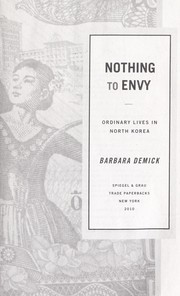
A Pulitzer Prize finalist built from interviews with North Korean defectors, this is the most humane and penetrating portrait of life inside the DPRK. It makes abstract geopolitics viscerally personal.

A clear-eyed account of South Korea's transformation from war-ravaged nation to global economic and cultural powerhouse, tying together the economic, political, and social threads from across the entire curriculum.
Discussion
Keep reading
Paths that share books, cover the same subject, or open a related topic.