Teju Cole Reading Order: Where to Start
Teju Cole works in three modes at once — the wandering novel, the critical essay, and the photobook where his own pictures carry the argument — and each one explains the others. Start with the novel that made his name and the short Lagos book that preceded it, move to the essay collections, then to the photography books, which are the least familiar part of his work and the part he now considers central, and finish with the late novel that folds all three together.
Start Here
BeginnerMeet Cole's essential form — a highly educated narrator walking a city, thinking in digressions — in the two short novels.
▸ Study plan for this stage
Pace: 2 weeks. Open City is 320 pages but is almost plotless — a narrator walking and thinking — so it goes badly if you read it in ten-minute fragments and well at 30 pages a sitting. Every Day Is for the Thief is 162 pages with photographs set into the text and can be finished in two evenings. Read the
- The walking narrator as Cole's essential form: a highly educated man moving through a city, thinking in digressions, with the associations rather than the events supplying the structure
- Erudition as characterisation — Julius's fluency in Mahler, Brueghel and psychiatric case history is not the author showing off, it is the thing the novel is examining
- The buried city: New York's slave burial ground, its immigrant detention, its layered violence surfacing under an ordinary walk
- A reliability that quietly gives way — something the reader has been trusting is dismantled late in Open City, and the whole book is designed to be reread after it
- Cosmopolitanism under suspicion: the novel is sceptical of the very sophistication it is written in, and of the assumption that being well-read makes a person good
- Every Day Is for the Thief as the compact prototype — a returning narrator cataloguing Lagos corruption, music and heat in short numbered sections
- Photographs inside the prose: the images in the Lagos book are Cole's own and are placed to interrupt rather than illustrate, which is the beginning of the photobook practice
- Sebald as the acknowledged model — the wandering, the digressions, the embedded images — and worth knowing before you meet Cole's essay on him
- What is Julius avoiding thinking about, and how far back can you trace the avoidance once you know?
- How does Open City use its digressions — do they relieve the narrative or are they the narrative?
- What does the Farouq section in Brussels do to the novel's politics, and why is Julius so unpersuaded?
- What changes when you learn what the novel withholds until near the end, and which earlier scenes become unbearable?
- In Every Day Is for the Thief, what is the returning narrator's relationship to Lagos — insider, tourist, or something the book will not name?
- How do the photographs in the Lagos book change the pace of reading, and what would be lost without them?
- Track Julius's route through New York on a map for the first hundred pages. The city's geography is exact and the walks are not random.
- Keep a list of every artwork, piece of music and book Julius mentions. The list is a portrait of him and it is the evidence for the novel's argument about him.
- Reread the first thirty pages of Open City immediately after finishing. This is the standard second reading and it is where the book's real design becomes visible.
- In Every Day Is for the Thief, cover each photograph and read the surrounding page, then look. Noticing what the image adds or refuses is training for the photobook stage.
- Write 300 words in Cole's mode: one walk, three digressions, no plot. The form is much harder to sustain than it looks.
Next up: You have met the sensibility in fiction — the walker, the digression, the doubt about looking at other people — and the essays are where Cole turns that sensibility on photography, literature and politics under his own name.
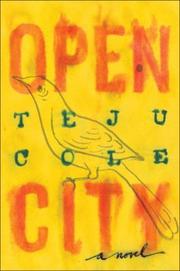
A Nigerian-German psychiatrist walks New York and talks to strangers, and something the reader has been trusting quietly gives way. The book to begin with, and the one everything else in his career is measured against.

A returning narrator moves through Lagos, cataloguing corruption, music and heat, with photographs set into the text. Written first but published in the US later; read it second as the compact prototype of Open City.
The Essays
IntermediateRead Cole as a critic of photography, literature and the politics of who gets to look at whom.
▸ Study plan for this stage
Pace: 4 weeks for 393 and 288 pages. These are collections, not arguments to be read straight through: one or two essays per sitting, three or four sittings a week. Known and Strange Things is the longer and more various; Black Paper is shorter but darker and denser. Read them in this order — the second i
- Cole as a critic of photography above all: how images make claims, who is authorised to look, and what a photograph does to the person inside it
- The white saviour industrial complex — his best-known polemic, on the appetite for African suffering as an occasion for Western feeling
- The ethics of the image in conflict and disaster reporting, which is the recurring problem behind most of the criticism
- Sebald and Baldwin as his two acknowledged ancestors, one for form and one for position, both written about directly
- Drone strikes, borders and the vocabulary of remote violence — where his politics is most explicit
- Black Paper's darker key: Caravaggio, migration and grief, essays written under a sense of political emergency and openly saying so
- The critic's first person — Cole rarely pretends to be a neutral observer, which is continuous with the novels
- Criticism as preparation for practice: these essays are where he works out what he later attempts with his own camera
- What is the white saviour argument precisely — and what does Cole say should be done instead?
- How does Cole read a photograph? Take one essay and reconstruct the method step by step
- What does he take from Sebald, and does the essay on him explain anything about Open City that the novel hides?
- In Black Paper, what has changed in tone and why does the book say it has changed?
- Does the criticism hold Cole himself to the standard it applies to other image-makers?
- Which essay would you hand to someone who had read no Cole at all, and why that one?
- Look up every photograph Cole discusses before reading his account of it, and write one line of your own first. This is the only way to read photography criticism honestly.
- Take the white saviour essay and write the strongest counter-argument in a paragraph. It is a polemic and it improves under pressure.
- Read Baldwin's essay that Cole is responding to, then Cole's. The pairing shows exactly what he inherits and what he changes.
- Keep a running note of every claim Cole makes about what a photograph can and cannot do. You will test that list directly in the next stage.
Next up: You now know what Cole thinks photographs do to their subjects and their viewers, which is the necessary preparation for the books where his own images have to survive that standard.

Essays on Sebald, Baldwin, drone strikes and the white saviour industrial complex. The best single volume of his criticism and the natural next step after the novels.

Essays written in a darker key, on Caravaggio, migration and grief. Read after Known and Strange Things: it is explicitly a sequel in mood, and it sets up the photobooks.
The Photography Books
IntermediateWork through the books where Cole's own images do the arguing, and where his writing about looking becomes a practice rather than a subject.
▸ Study plan for this stage
Pace: 4–5 weeks, and page count is a poor guide — these are photobooks, not prose to be read through. Expect a genuinely different reading experience: images and short texts on facing pages, no narrative to carry you, and a book that stalls if you flip. Sit with 15–20 spreads per session, roughly an hour.
- The photobook as a form: sequence, pacing and the page turn are the compositional tools, so what stands next to what is as meaningful as any individual image
- Blind Spot's method — a photograph from somewhere in the world paired with a short prose fragment that does not explain it, and the reader made to close the gap
- Text that refuses to caption: Cole's fragments deliberately fail to describe the image, so the two elements argue rather than agree
- A collaboration read differently — Human Archipelago pairs Fazal Sheikh's portraits with Cole's text, on hospitality, migration and the stranger, and is the most politically direct of these books
- Portraiture and consent, which the essays raised in theory and the collaboration confronts in practice with named, photographed people
- Fernweh and the refusal of the picturesque: photographs of Switzerland that decline every view a Swiss landscape is supposed to provide, and the driest, most formally controlled of the series
- Golden Apple of the Sun as diary — one kitchen counter photographed daily through 2020, cut with quotations, where the project becomes a record of confinement
- Repetition and constraint as compositional method in the late books, which is the opposite of the world-roaming Blind Spot and deliberately so
- In Blind Spot, take any three pairings — what is the relation between image and text in each, and is it the same relation twice?
- Where does Cole's own photography meet the standard his criticism sets for other people's, and where does it not?
- How does Human Archipelago handle the problem of photographing displaced people, and does the text absolve the image or implicate it?
- What does Fernweh gain by systematically avoiding the beautiful view?
- What does the 2020 constraint do to Golden Apple of the Sun — is it a limitation the book overcomes or the subject itself?
- Do these books read as a fourth form, or as the essays and the fiction conducted by other means?
- Go through Blind Spot once looking only at images, then again reading only the texts, then a third time as a book. The three passes reveal how much of the meaning is in the pairing rather than in either part.
- Pick five consecutive spreads in any of these and write down why you think those images are adjacent. Sequencing is the photobook's argument and it is invisible until you look for it.
- In Human Archipelago, cover Cole's text and look at Sheikh's portraits alone, then read. Note what the words changed about what you saw.
- Photograph the same object once a day for a week and lay the results out in sequence, as Golden Apple of the Sun does. Nothing explains the book faster.
- Return to your list of claims from the essays stage and mark which ones Cole's own books satisfy. This is the payoff of reading the criticism first.
Next up: You have now read Cole in all three modes separately — novel, essay, photobook — which is the exact preparation for the late novel that runs all three at once and stops distinguishing between them.

Photographs from around the world, each paired with a short prose fragment. The essential one to read first here, because it shows exactly how his images and sentences are meant to work on each other.

A collaboration with the photographer Fazal Sheikh on hospitality, migration and the stranger. The most politically direct of the photobooks.

Photographs of Switzerland that refuse the picturesque. Read after Blind Spot; it is the driest and most formally controlled of the series.

A kitchen counter photographed daily through 2020, cut with quotations. The pandemic book, and the point where the photographic project becomes a diary.
The Late Novel
IntermediateReturn to fiction with the essays and photobooks behind you, and see the three modes fuse.
▸ Study plan for this stage
Pace: 2 weeks for 256 pages. Slower than the length suggests: the book breaks form repeatedly, dropping out of the protagonist's story into criticism, into a sequence of Lagos voices, into extended analysis of single images. Read it in longer sittings so the shifts register as shifts, at roughly 25 pages
- The three modes fused: a novel that stops being a novel to become an essay, a photobook commentary and an oral history, then resumes
- A professor of photography as protagonist, which lets the criticism enter the fiction without a seam — the character's job is Cole's practice
- Looted objects and museums: the sections on West African artefacts in Western collections are where the novel's politics is most concentrated
- The Lagos chapter of unattributed voices — a formal break that hands the book to people the protagonist would otherwise be observing
- Marriage and mortality as the domestic thread, which is quieter than in Open City and carries the book's actual feeling
- Image analysis inside fiction: extended readings of specific photographs, performed by a character, which is what the previous three stages make legible
- The Cambridge and New England setting as the counterpart to Open City's New York — the same walking figure two decades on, with different privileges and different fears
- Why this book belongs last: almost every section rhymes with something earlier in the path, and read cold it looks like a series of digressions rather than a summation
- What holds Tremor together as a novel, given how far its sections diverge in form?
- How does the protagonist's professional expertise change what the novel can do that Open City could not?
- What is the argument about looted objects, and does the novel offer any resolution?
- What is the effect of the Lagos voices section, and why is it placed where it is?
- How does this narrator compare with Julius — what has Cole kept, and what has he deliberately corrected?
- Having read the whole path, which mode does Cole do best, and does Tremor's fusion improve on any of them individually?
- Mark each formal break in Tremor and label it — essay, oral history, image reading, domestic scene. The map of those shifts is the novel's real structure.
- Take one photograph analysed in the novel and read the passage against the method you reconstructed in the essays stage. It is the same method inside a character.
- Set the opening of Tremor beside the opening of Open City. Two walkers, one career apart, and the difference is the clearest measure of what changed.
- Write 400 words on whether the fusion works or whether the pieces would have been better apart. It is the open question about the book and you are unusually well placed to answer it.
Next up: This is the end of the path — with the novels, the criticism and the photobooks all in view, the natural next move is back to Open City, which reads differently once you know what its author's camera was going to do.

A Nigerian-American professor of photography in Cambridge, in a novel that breaks into criticism, Lagos voices and image-analysis. It is the book that most rewards having read everything above, so it belongs last.
Discussion
Keep reading
Paths that share books, cover the same subject, or open a related topic.